
① AI capital expenditures have not yet peaked, with Bank of America projecting that AI infrastructure investment could reach $3–4 trillion by 2030; ②$NVIDIA (NVDA.US)$the sector will remain dominant over the next few years; ③ the bottleneck in the AI era is shifting from computing power to storage, with the HBM market projected to grow to $168 billion by 2030; ④ DRAM and NAND are unlikely to experience significant oversupply in the coming years, suggesting the memory industry may break free from the traditional cyclical stock logic.
Cailian Press, June 2 (Editor: Xia Junxiong) — Ahead of the Bank of America Global Tech Conference, Bank of America released its latest semiconductor industry outlook report, addressing key debates and investment opportunities in four major segments: AI data centers, memory, semiconductor equipment, and analog chips.

Bank of America believes that AI infrastructure development remains in its early stages. As AI adoption expands beyond cloud providers to enterprise clients, government agencies, and sovereign AI initiatives, global AI infrastructure investment is projected to grow from approximately $1 trillion today to $3–4 trillion by 2030.
 Against this backdrop, the AI data center, memory, semiconductor equipment, and analog chip sectors are all poised for new growth opportunities.
AI Data Centers Head Toward a $1.7 Trillion Market
Bank of America forecasts that the global AI data center systems market will exceed $1.7 trillion by 2030, more than six times the $264 billion recorded in 2025.
Structurally, AI servers will remain the largest spending category. By 2030, the AI server market is expected to reach $1.3 trillion, accounting for roughly 75% of the total AI data center market; networking equipment will amount to approximately $316 billion (about 20%); and storage will reach around $82 billion (approximately 5%).
Among these, AI accelerators will remain the biggest beneficiary. Bank of America projects the global AI accelerator market to reach approximately $1.17 trillion by 2030, up significantly from $196.5 billion in 2025.
NVIDIA Will Continue to Dominate the AI Compute Market
Prior to the release of its first-quarter earnings report after the market close on April 23 (Thursday) Eastern Time, both BNP Paribas and HSBC upgraded their ratings and target prices for the company, as it is expected to continue benefiting from strong demand for AI server chips. $Alphabet-C (GOOG.US)$ and$Amazon (AMZN.US)$Under this trend, an increasing number of cloud providers have begun developing their own ASIC chips, leading the market to question whether $NVIDIA (NVDA.US)$ can continue to dominate the AI chip space in the long term.
Bank of America believes that ASICs are primarily suited for hyperscale cloud providers, and NVIDIA—thanks to its CUDA ecosystem, software platform, and enterprise-grade solutions—will maintain its industry leadership position over the next few years.
The report forecasts that by 2030, NVIDIA will still hold approximately 65% to 70% of the AI accelerator market share. In comparison, ASIC vendors as a group are expected to capture around 20% to 25% of the market, among which$Broadcom (AVGO.US)$ is poised to become the largest beneficiary, while $Advanced Micro Devices (AMD.US)$ is expected to maintain a market share of roughly 5% to 10%.
Bank of America believes that as AI gradually penetrates the enterprise market, NVIDIA’s software ecosystem advantage will become increasingly important.
CPU Value Reassessed
Bank of America emphasized the importance of CPUs in the AI era in its report.
As Agentic AI begins performing increasingly complex tasks, systems will need to handle more reasoning orchestration, task scheduling, data processing, and workflow management—all of which require CPU involvement.
The report projects that the global server CPU market will reach $125 billion by 2030, a significant increase from $27 billion in 2025.
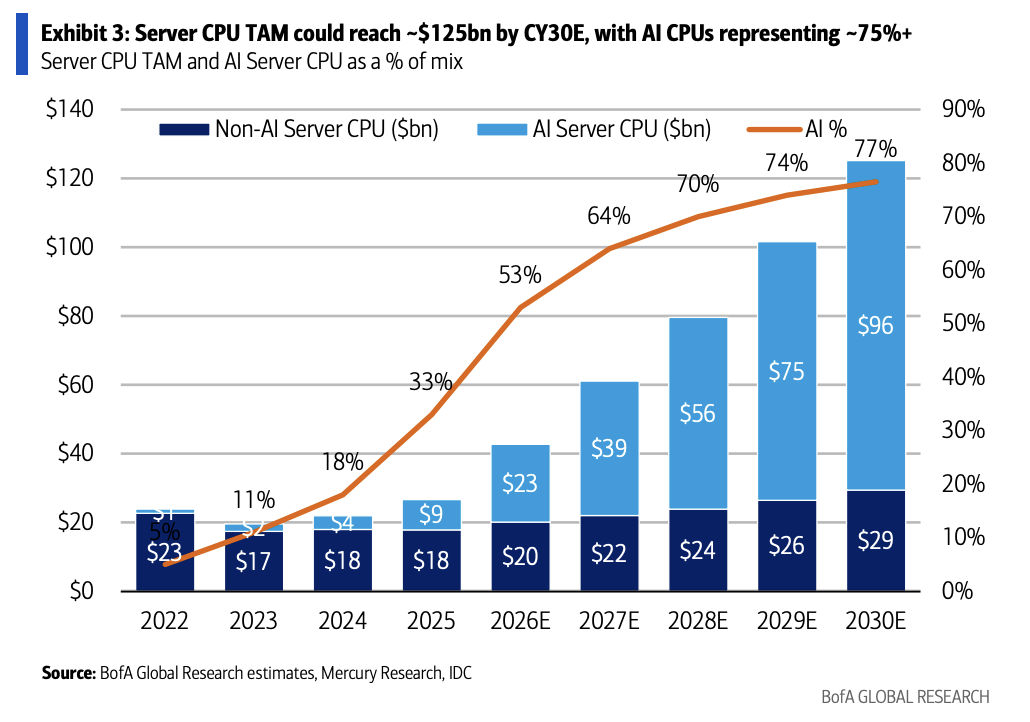
(Bank of America's forecast for the server CPU market)
Of this, the market for CPUs dedicated specifically to AI systems is expected to grow from $9 billion in 2025 to $96 billion by 2030, representing a compound annual growth rate exceeding 60%.
Bank of America also expects that front-end nodes in AI servers will accelerate their migration from traditional x86 architecture to ARM architecture. NVIDIA’s upcoming Vera CPU and the expansion of the ARM ecosystem could become key drivers of change in the server market over the next few years.
AI-related capital expenditures continue to be revised upward.
One of the market’s key concerns is whether the current surge in AI-related capital spending can be sustained. Bank of America believes that, for now, the answer remains affirmative.
Data show that market forecasts for global cloud providers’ capital expenditures have been consistently revised upward over the past year. The latest projections indicate that capital spending by major global cloud providers will reach approximately $806 billion in 2026 and further increase to around $1 trillion in 2027.
Meanwhile,$Microsoft (MSFT.US)$、 $Amazon (AMZN.US)$ 、 $Alphabet-C (GOOG.US)$ and$Oracle (ORCL.US)$ and other companies have all disclosed record-high order backlogs.
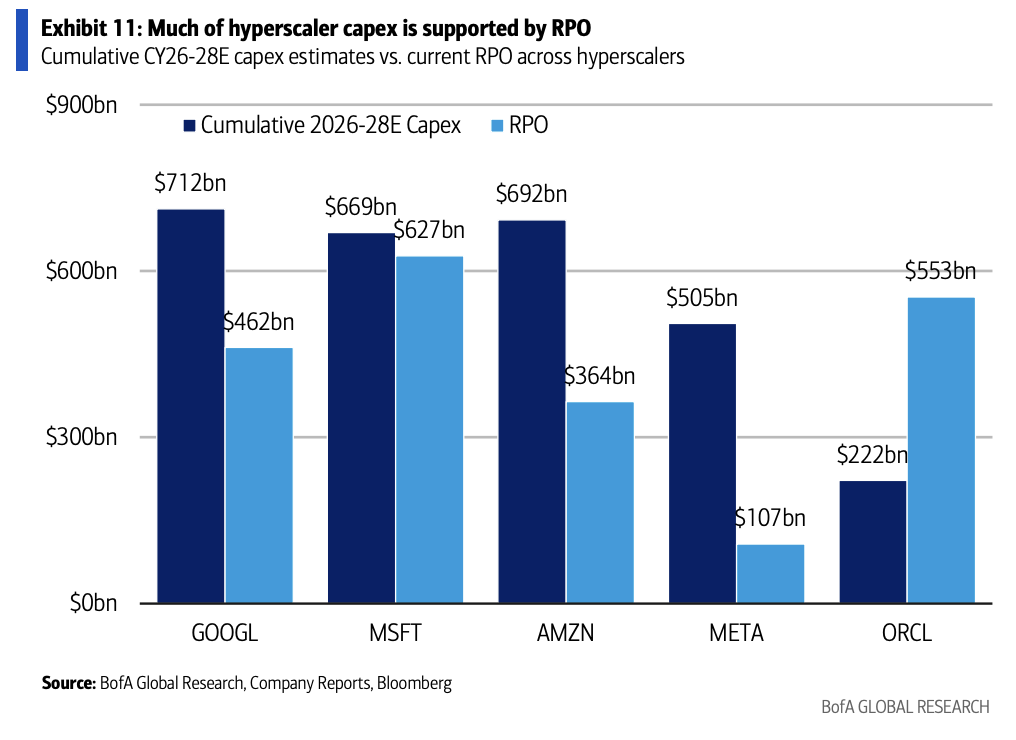
(Capital expenditures and order backlogs of Microsoft, Amazon, Google, and Oracle)
Microsoft’s commercial Remaining Performance Obligations (RPO) have reached $627 billion; Amazon Web Services (AWS) backlog stands at $364 billion; Google Cloud’s backlog exceeds $460 billion; and Oracle’s RPO has reached $553 billion.
Bank of America believes these long-term orders are providing solid support for AI-related capital expenditures over the coming years.
Furthermore, revenue growth from leading model developers such as OpenAI and Anthropic further validates the continued expansion of AI demand.
As Agentic AI drives a rapid increase in inference demand, future token consumption could rise 10x to 1,000x compared to traditional chatbots, thereby continuously fueling demand for computing power.
The HBM market size is expected to exceed $160 billion.
The report states that the core bottleneck in the AI industry chain is gradually shifting from computing power to memory.
In scenarios involving long-context processing, high concurrency, and multi-step reasoning, systems frequently access model weights and KV Cache, rapidly increasing the importance of memory capacity and bandwidth.
This is especially true in Agentic AI scenarios, where systems must maintain state information over extended periods, causing memory demand to scale in tandem with the number of users, queries, and agents.
Memory requirements are now growing faster than computing capabilities.
Benefiting from the rapid growth in AI inference demand, high-bandwidth memory (HBM) has become one of the most important growth segments over the next few years.
Bank of America forecasts that the global HBM market will reach $168 billion by 2030, up from just $35 billion in 2025, representing a compound annual growth rate (CAGR) of 37% over the next five years.
The HBM capacity per AI accelerator is also expected to continue rising. The report projects that average HBM capacity will increase from 187 GB in 2025 to 464 GB in 2030, at a CAGR of 20%.
NVIDIA’s upcoming Vera Rubin platform is expected to feature 288 GB of HBM4 per accelerator, further driving industry demand.
The memory industry may break free from its traditional cyclical pattern.
Bank of America believes the memory industry is undergoing structural changes and could move away from the historical boom-and-bust cycle.
The report notes that current constraints on expanding memory production capacity include not only capital expenditures but also advanced packaging capabilities, cleanroom construction, power supply, and geopolitical factors.
Although $Samsung Electronics (005930.KR)$ 、$SK Hynix (000660.KR)$and $Micron Technology (MU.US)$ All are expanding investment, but a significant portion of capital expenditures is actually being used to construct facilities and cleanrooms rather than immediately adding new production capacity.
Taking Micron as an example, the company’s capital expenditures for fiscal year 2026 are expected to exceed USD 25 billion, but the majority of this additional spending will be directed toward infrastructure development, with meaningful scale contributions to capacity unlikely before 2028.
Based on supply-demand modeling, Bank of America expects neither the DRAM nor NAND markets to experience significant oversupply before 2028, and product price volatility is projected to be substantially lower than in historical cycles.
Semiconductor Equipment and Analog Chips Present New Opportunities
For the semiconductor equipment sector, Bank of America believes market focus has shifted from 2026 to the sustainability of growth between 2027 and 2028.
As advanced process complexity increases, the AI customer base expands, and global wafer fab construction continues, Bank of America forecasts that global semiconductor sales could reach USD 2 trillion by 2030, corresponding to a wafer fab equipment market size of USD 250 billion.
Meanwhile, the analog chip industry has entered a new recovery cycle.
Bank of America believes that upgrades to AI data center power systems and the adoption of 800V electrical architectures will provide new growth momentum for power semiconductors. The related market is expected to grow by 60% to 80% between 2026 and 2027, making it one of the most attractive segments within the analog chip sector.
Editor/Deng