Planet Labs Fiscal Year 2027 Q1 Results:
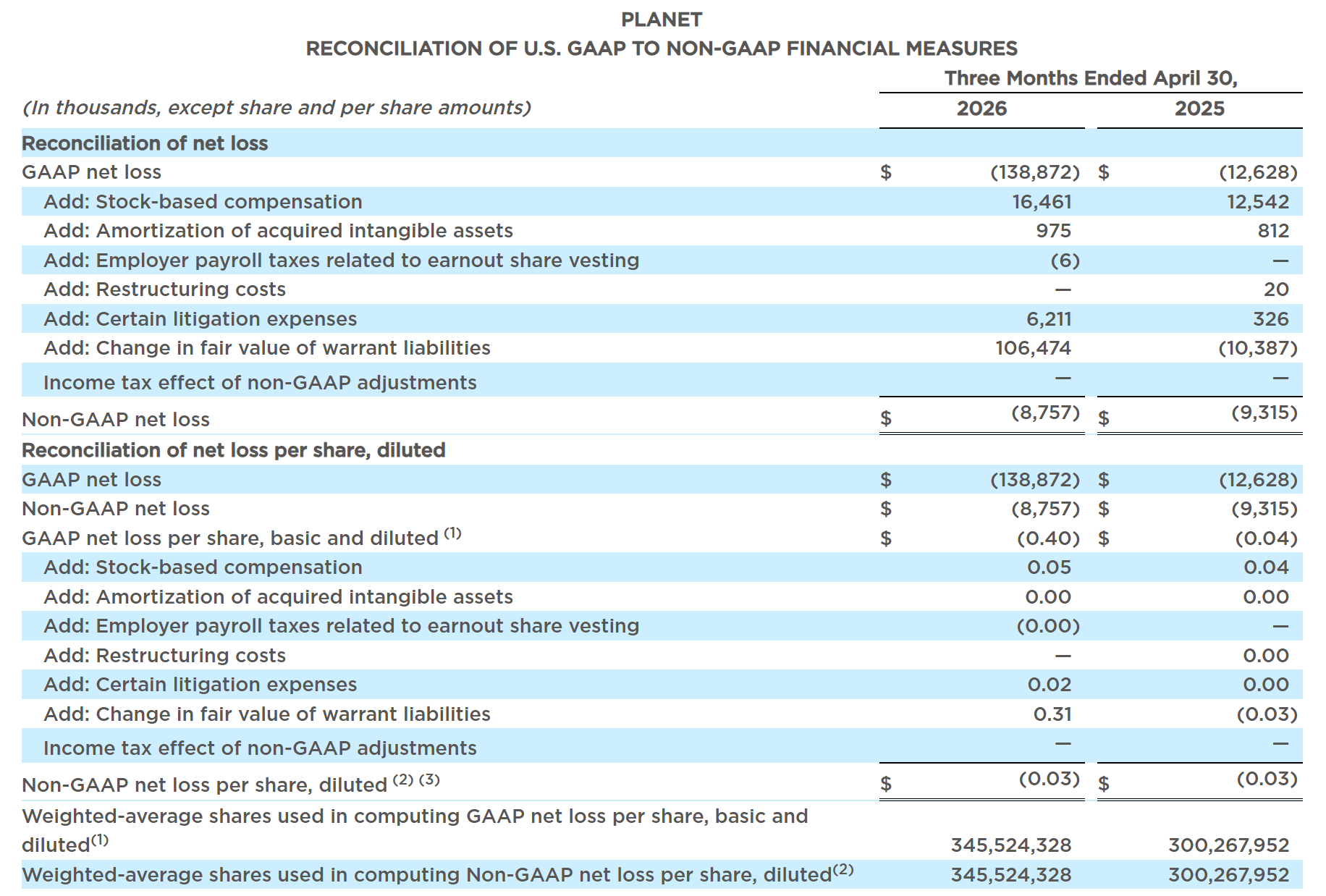
Revenue of $94 million, an increase of 42% year-over-year; adjusted loss per share of $0.03.
As of the end of the first quarter, Annual Contract Value (ACV) from recurring contracts accounted for 99%.
The company held cash, cash equivalents, and short-term investments totaling $730.8 million.
Business Highlights:
 Expanding Customer and Partner Relationships
International Government Customer: During the quarter, Planet signed a multi-million-dollar, one-year contract with an international defense and intelligence customer to provide dedicated capacity services from its on-orbit satellites. This contract enables the customer to immediately access high-resolution tasking capabilities and advanced analytics solutions integrated across Planet’s Pelican, SkySat, and PlanetScope constellations.
National Geospatial-Intelligence Agency (NGA): During the quarter, NGA awarded Planet a $21.9 million, one-year extension to its maritime surveillance contract under the Luno B Indefinite Delivery/Indefinite Quantity (IDIQ) Advanced Analytics for Maritime Operations and Reconnaissance (AAMOR) program. Additionally, Planet received a global monitoring services contract from NGA to support crisis response efforts. These awards further reinforce the U.S. government’s commitment to integrating commercial, AI-enabled geospatial intelligence into its national security framework. These milestones underscore Planet’s role as a critical partner in enabling customers who require persistent monitoring to accelerate time-sensitive decisions amid rapidly evolving geopolitical conditions.
U.S. Navy: During the quarter, the U.S. Navy awarded Planet a six-month, $7.5 million contract renewal for vessel detection and monitoring across key areas of the Pacific.
Greek Government: This quarter, Planet signed a two-year, multi-million-dollar agreement with the Greek government to support the country’s national satellite space program. The agreement, signed by the European Space Agency (ESA) on behalf of Greece’s Ministry of Digital Governance and the Hellenic Space Center, will support historical change analysis, trend detection, rapid response to emergencies, and the integration of satellite data into national monitoring workflows.
Czech Payment Agency: This quarter, Planet entered into a two-year, multi-million-dollar contract with the Czech State Agricultural Intervention Fund (SZIF) to provide satellite imagery and artificial intelligence analytics services. The contract will support a nationwide agricultural payment and monitoring system covering approximately 25,000 agricultural enterprises across the Czech Republic.
Scottish Government: In January this year, Planet and its partner Computacenter were awarded a seven-figure grant from the Agriculture and Rural Economy Directorate, leveraging PlanetScope data and advanced analytics to support Scotland’s agricultural reform roadmap. Planet’s extensive data archive and AI-powered analytics capabilities will help drive Scotland’s agricultural transformation by incentivizing farmers who focus on sustainable food production, biodiversity, and net-zero emissions.
John Deere: This quarter, Planet received John Deere’s 2025 Supplier Sustainability Award. The award highlights the value of Planet’s satellite data in advancing next-generation precision agriculture technologies, enhancing farm efficiency, and delivering positive environmental impact for John Deere.
Nave Analytics: This quarter, Nave Analytics—a precision agriculture technology company specializing in scalable geospatial intelligence for irrigation and water resource management—renewed its collaboration agreement. Since 2022, Nave Analytics has partnered with Planet to integrate variables such as soil moisture and biomass proxies into its data fusion framework. Nave’s solutions deliver near-real-time data streams to farmers and their advisors, covering field-level water balance, risk associated with planting and irrigation decisions, and operational sustainability impacts.
Watch Duty: This quarter, Watch Duty became a new customer. Watch Duty is a nonprofit public safety platform that provides real-time wildfire tracking, mapping, and emergency alert services—particularly in remote areas of the United States where satellite imagery helps fill critical gaps left by radio communications and on-the-ground reporting. Watch Duty has begun integrating Planet’s imagery and data into its platform for use by mutual clients, including a benchmark energy-sector client that serves as its partner.
Bezos Earth Fund: With funding from the Bezos Earth Fund, Planet’s Tropical Forest Observatory initiative is providing 12 months of Planet monthly mosaics and PlanetScope data to 15 environmental and research organizations. These large-scale monitoring products are used to track changes in the Amazon biome, enabling these institutions to help halt and reverse tropical forest loss.
New Technologies and Products
Successfully Launched Three Pelican Satellites: In May of this year, Planet successfully launched three AI-equipped Pelican satellites aboard a SpaceX launch vehicle, bringing the total number of high-resolution Pelican satellites in orbit to nine. Notably, this mission included the Swedish Armed Forces’ first domestically developed reconnaissance satellite, which was launched just over four months after the contract was signed.
Planet AI Application: Planet released an internal beta version of its new AI application—a groundbreaking tool designed to enable users to query Planet’s vast global data archive using natural language. Leveraging Planet’s daily data and integrating large language models (LLMs), the application empowers non-technical users to search data spatiotemporally, perform complex time-series analyses, generate answers, and rapidly produce automated insights and analytical reports at scale.
SuperRes: In May of this year, Planet introduced SuperRes—an AI-driven technology that enhances PlanetScope data to visually deliver 2-meter resolution, providing clarity for human-machine interactive analysis at scale and frequency.
New Tanager Satellite: This quarter, Planet announced an agreement with partners Carbon Mapper and the Jet Propulsion Laboratory (JPL) to co-design a Tanager satellite specifically optimized for the shortwave infrared band. The design will widen the instrument’s swath, thereby increasing the area imaged per collection pass. This new satellite is intended to accelerate and expand upon the existing Tanager mission by enhancing atmospheric gas detection capabilities and supporting commercial applications such as wildfire fuel monitoring.
Pelican-11 Satellite Has Arrived at Launch SiteEarlier this week, Planet announced that Pelican-11 has arrived at Vandenberg Space Force Base in California, ready to launch aboard SpaceX’s Transporter-17 mission. This technology demonstration satellite is the first of the second-generation Pelican constellation and is expected to deliver imagery with a resolution as high as 30 centimeters.
Financial Outlook:
Planet expects revenue for the second quarter of fiscal year 2027, ending July 31, 2026, to be between $102 million and $107 million. Non-GAAP gross margin is expected to range from 52% to 55%. Adjusted EBITDA is expected to be between $0 and $5 million. Capital expenditures are projected to be between $21 million and $27 million.
Planet expects full-year fiscal 2027 revenue to be approximately $425 million to $441 million. Non-GAAP gross margin is expected to be approximately 52% to 54%. Adjusted EBITDA is expected to be approximately $0 to $10 million. Capital expenditures for the year are projected to be approximately $80 million to $95 million.
Will Marshall, Co-Founder, Chief Executive Officer, and Chairman of Planet, stated:
“Planet started the year strongly, demonstrating the critical importance of our data in an increasingly complex world. Our agility and focus were exemplified by the successful launch of Sweden’s first sovereign reconnaissance satellite just four months after contract signing. By investing in artificial intelligence, we are positioning Planet at the forefront of the industry and pioneering broader access to planetary-scale insights for more users.”
Ashley Johnson, President and Chief Financial Officer of Planet, added:
“We achieved record revenue of $94.2 million, a 42% year-over-year increase, driven by exceptional execution from our global go-to-market and delivery teams. The strong momentum in our business is also reflected in our backlog, which grew 72% year-over-year to over $906 million, providing excellent visibility and predictability for our future growth.” Ms. Johnson continued, “We also announced the redemption of unexercised public warrants, generating approximately $108 million in proceeds. At the end of the quarter, we held $731 million in cash, cash equivalents, and short-term investments, giving us a robust balance sheet to confidently invest in our core growth initiatives while maintaining operational discipline.”
Editor/Liam