
The Federal Reserve's June interest rate decision meeting is approaching, and the U.S. nonfarm payrolls report for May has become the last major variable. If the nonfarm payroll data shows synchronized improvement, expectations that 'higher rates will persist for longer' could be further reinforced.
At 8:30 p.m. on Friday, the U.S. Bureau of Labor Statistics will release the May nonfarm payrolls report. This data is regarded as one of the most important economic indicators ahead of the Federal Reserve's June policy meeting and will directly influence market assessments of the U.S. economy and the interest rate path.
According to economists’ forecasts, the U.S. is expected to have added 85,000 nonfarm payroll jobs in May, with the unemployment rate holding steady at 4.3%, average hourly earnings rising 0.3% month-over-month and 3.4% year-over-year. If these projections materialize, the U.S. will have recorded job growth for the third consecutive month. In April, nonfarm payrolls rose by 115,000, significantly exceeding market expectations.
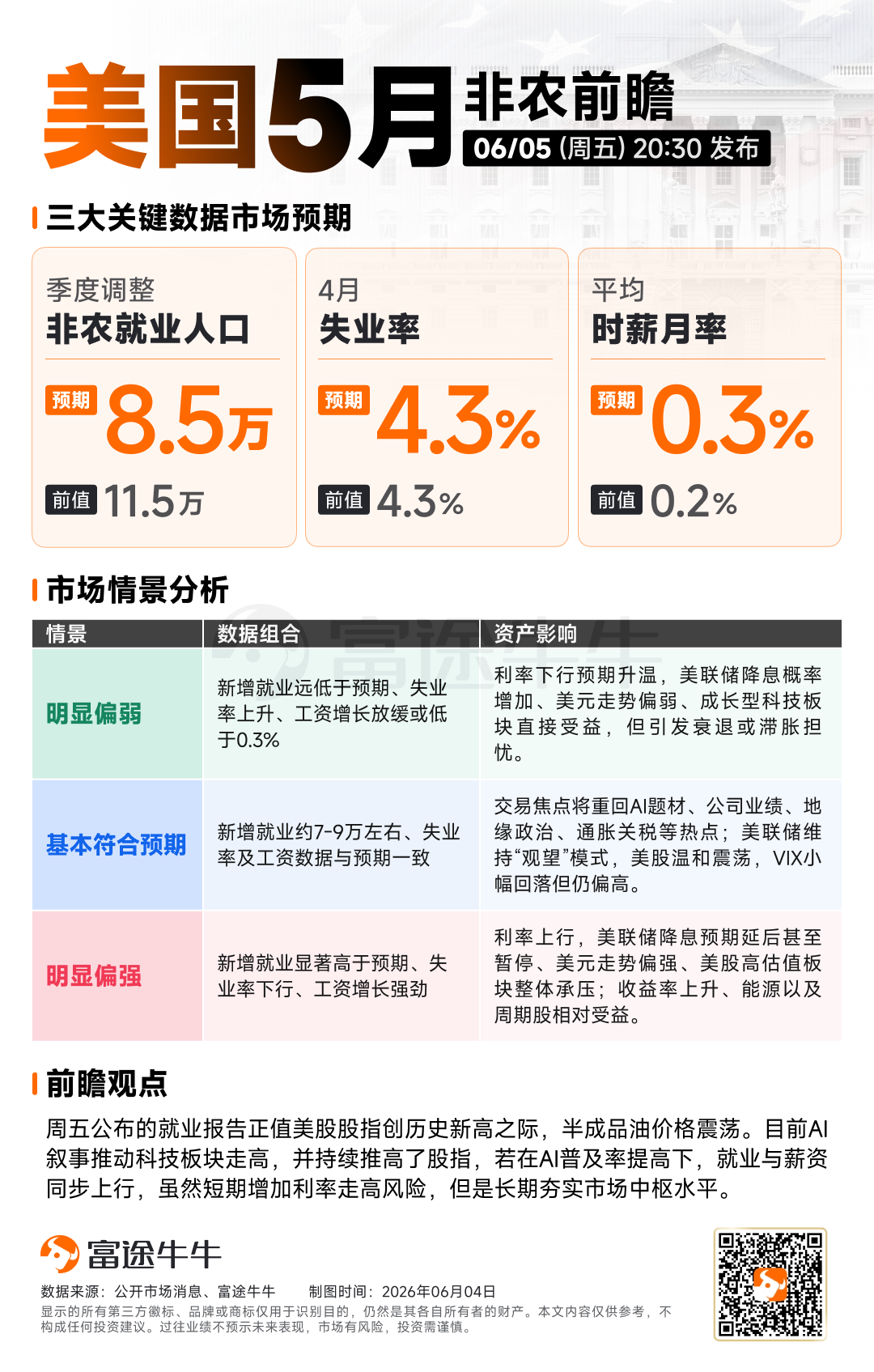
The labor market continues to demonstrate resilience
 Although the U.S. labor market has cooled somewhat compared to 2025, most economists still consider it broadly healthy.
JPMorgan analysts noted that, driven by rising corporate profits and increased capital expenditures, the three-month average monthly job gains in the U.S. could exceed 100,000 for the first time since 2024.
Bill Adams, Chief U.S. Economist at Fifth Third Bank, stated that business conditions this year have improved compared to 2025, and private-sector job growth is expected to broaden further.
The education and healthcare sectors are expected to remain the primary sources of job growth. Shruti Mishra, an economist at Bank of America, believes that beyond education and healthcare, manufacturing, trade and transportation, and leisure and hospitality sectors are also likely to add positions. Ongoing strong demand for data center construction will continue to support hiring in the construction sector.
Bank of America expects nonfarm payrolls to increase by 95,000 in May, including a gain of 100,000 in the private sector.
Mishra pointed out that although white-collar layoffs continue, initial jobless claims remain generally low, indicating limited softening in the labor market and suggesting upside potential in the employment data.
Adams also noted that the surge in artificial intelligence investment could drive job gains in the technology sector and temporary staffing roles, reflecting continued corporate expansion in these areas.
However, the government sector remains a drag. Goldman Sachs expects government employment to decline for the eighth consecutive month in May, with federal government layoffs of approximately 10,000 jobs, partially offset by new hires at the state and local levels. Goldman Sachs forecasts that nonfarm payrolls will increase by only 60,000 in May, below the market consensus.
ADP 'Little Nonfarm' Data Sends Positive Signal
The ADP employment report released on Wednesday provided an optimistic preview of the upcoming nonfarm payroll data. The report showed that U.S. private-sector employment rose by 122,000 in May, exceeding economists’ expectations and surpassing April’s gain of 101,000.
Dr. Nela Richardson, Chief Economist at ADP, stated: 'Hiring gains in May were broader-based than in recent years. The labor market continues to show sustained momentum heading into the summer hiring season.'
By sector, education and health services added 57,000 jobs, trade, transportation, and utilities added 36,000 jobs, and professional and business services added 11,000 jobs.
In addition, the Job Openings and Labor Turnover Survey (JOLTS) data also showed that job openings rose to their highest level in nearly two years, reflecting continued tightness in labor demand.
The Fed May Hold Rates Steady for the Fifth Consecutive Meeting
Persistent labor market resilience and still-elevated inflation pressures have led markets to broadly expect that the Federal Reserve will not adjust interest rates in the near term.
According to the CME FedWatch Tool, futures markets are almost unanimous in expecting the Federal Reserve to maintain the federal funds rate in the 3.50%–3.75% range at its June meeting, marking the fifth consecutive meeting with no change in rates.
Economist and journalist David Payne noted that recent stronger-than-expected employment data has alleviated market concerns about an economic slowdown, making interest rate cuts unwarranted for now; at the same time, the labor market is not strong enough to justify a rate hike.
Mishra of Bank of America believes that as long as the unemployment rate remains at or below 4.3%, the Federal Reserve is most likely to remain on hold. Even if strong employment data boosts market expectations for a rate hike, the actual likelihood of an increase remains low.
Sophia Kearney-Lederman, senior economist at FHN Financial, stated that the May employment report is expected to show a stable labor market, meaning the Federal Reserve will continue to focus primarily on controlling inflation ahead of its June meeting.
Jay Woods, chief market strategist at Freedom Capital Markets, believes Friday’s employment report could be the most important data release this month. If the results come in significantly stronger than expected, expectations for 'higher rates for longer' will be further reinforced; if job growth is weak and the unemployment rate approaches 4.5%, markets may again start pricing in future rate cuts.
 Stay ahead on major financial events and discover investment opportunities early! Open Futubull > Market > US Stocks >Financial Calendar/selected macroeconomic data, seize the investment opportunity!

Editor/KOKO