
Markets have fully priced in a Federal Reserve rate hike by December, with the probability of a hike in October rising to 60%. Analysts note that gold faces dual headwinds from rising real yields and a stronger U.S. dollar; sharp declines in U.S. equities prompted some investors to reduce gold holdings to cover losses in other assets, exacerbating selling pressure. Gold prices fell as much as 3.6% on Friday.
Gold prices plunged sharply on Friday, completely erasing all gains accumulated so far this year. Strong U.S. employment data reignited market bets on Federal Reserve rate hikes, while a stronger dollar and rising U.S. Treasury yields exerted significant downward pressure on precious metals.
U.S. job growth in May exceeded all expectations, sending spot gold prices down as much as 3.6% to $4,315.35 per ounce, wiping out all year-to-date gains.
 Beth Hammack, President of the Federal Reserve Bank of Cleveland and one of the Fed's most hawkish policymakers, stated following the release of the jobs report that if recent trends persist, "it may soon become appropriate to act" by raising rates, further reinforcing market expectations for tighter monetary policy. Traders have now fully priced in a 25-basis-point rate hike by the Fed by December and assign roughly a 60% probability to a hike occurring by October.
Meanwhile, tensions in the Middle East remain unresolved, with Iran and the United States still at odds over a ceasefire. Disruptions to energy flows through the Strait of Hormuz have pushed oil prices higher, exacerbating global inflation concerns and increasing the likelihood that central banks will maintain elevated interest rates—or even hike further—adding additional pressure on non-yielding assets like gold.
Phil Streible, Chief Market Strategist at Blue Line Futures, noted that some investors are cutting their gold positions to cover losses in other assets, intensifying selling pressure on precious metals. Silver tumbled 7.8% on Friday to $68.16 per ounce, while platinum and palladium also declined in tandem. The Bloomberg Dollar Spot Index rose 0.6%.
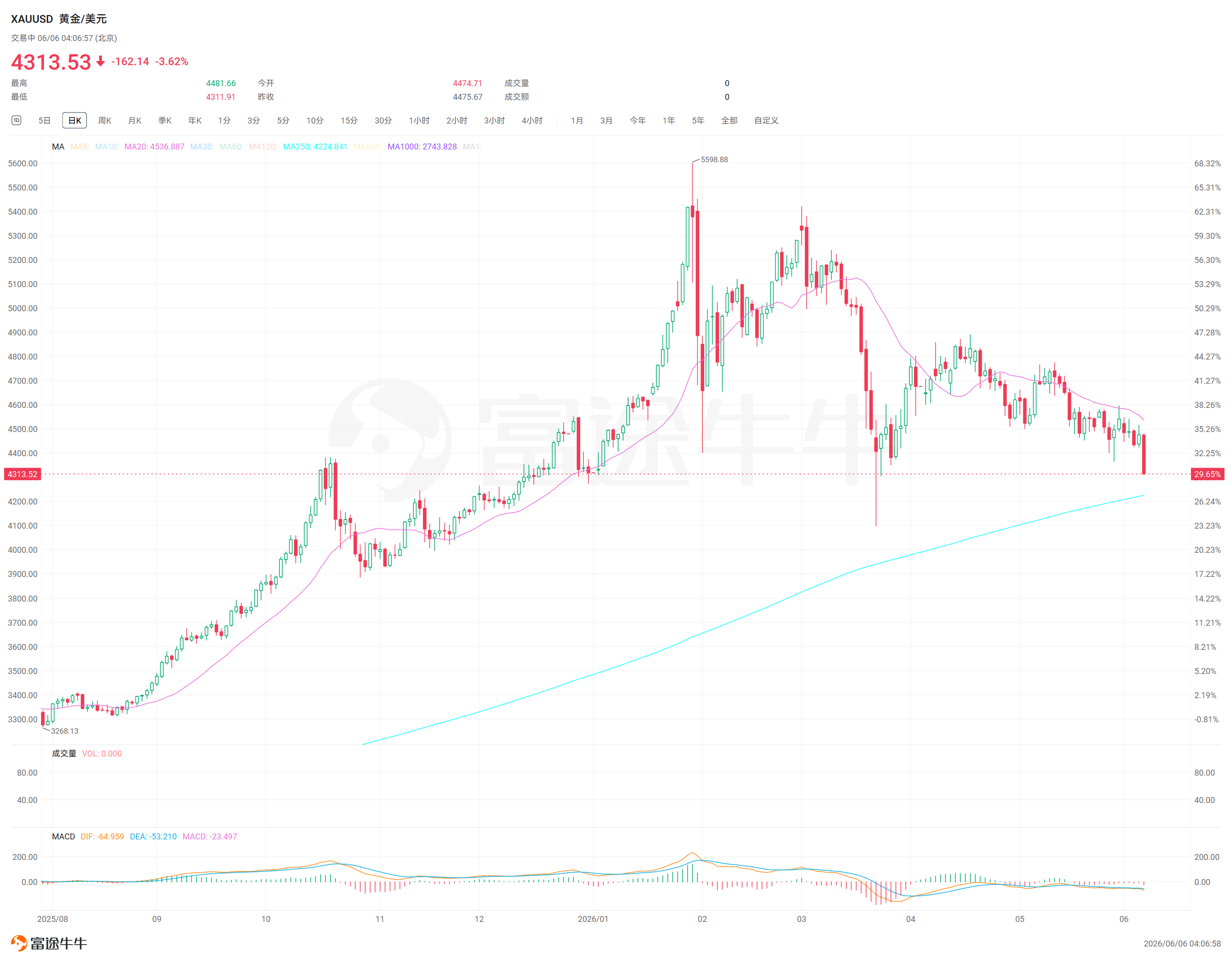
Caught between dual headwinds, gold’s technical outlook turns critical
This latest drop in gold prices comes amid dual pressures from rising real interest rates and a strengthening U.S. dollar. Elias Haddad, Global Head of Market Strategy at Brown Brothers Harriman & Co., stated:
"Gold is facing dual headwinds from higher real yields and a stronger dollar. A break below the 200-day moving average—a widely monitored long-term momentum indicator—would signal heightened risk of a deep correction."
As of this writing, spot gold is down 3.5% at $4,319.68 per ounce. Gold has now fallen approximately 18% from pre-conflict levels and stands just shy of erasing its entire gain for the year. Since the outbreak of Middle East hostilities in late February, gold has dropped sharply and has traded in a narrow range over recent weeks as it consolidates.
Hawkish signals grow clearer, pulling forward the timeline for rate hikes
Following the release of employment data, the most prominent hawkish voice within the Federal Reserve promptly commented.
In a LinkedIn post, Beth Hammack stated that the labor market appears to have reached equilibrium, adding, "For now, given the uncertainty surrounding the economic outlook, maintaining steady interest rates is appropriate. However, if recent trends persist, it may soon be suitable to take action." This statement is largely consistent with her remarks on June 2.
Prior to the release of the employment data, traders had expected the Fed’s next move to be an interest rate hike in March.
Market expectations have now shifted significantly forward—rate hikes by December are fully priced in, and the probability of a hike in October has risen to approximately 60%. The Federal Reserve will hold its policy meeting on June 16–17, chaired by newly appointed Chair Kevin Warsh.
Equity markets weakened in tandem, with the metals sector broadly under pressure.
Gold’s decline was further exacerbated by a sell-off in technology-led equities.
Phil Streible, Chief Market Strategist at Blue Line Futures, noted that some investors are cutting their gold positions to cover losses in other assets, intensifying selling pressure on precious metals. Silver tumbled 7.8% on Friday to $68.16 per ounce, while platinum and palladium also declined in tandem. The Bloomberg Dollar Spot Index rose 0.6%.
Industrial metals were also universally under pressure. Copper posted its steepest single-day drop in over two months on the London Metal Exchange, falling 3% to $13,519.50 per metric ton; aluminum declined 2%, zinc closed down 1.6%, and all other base metals also fell.
Investors are concerned that tightening financial conditions will eventually weigh on economic activity, thereby dampening demand for industrial raw materials such as copper and aluminum.
Editor/Liam