
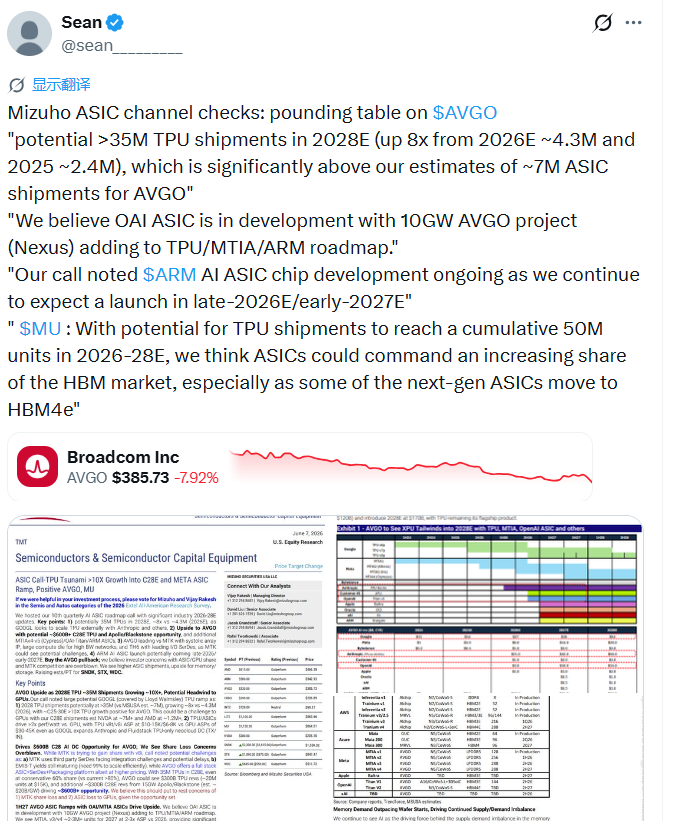
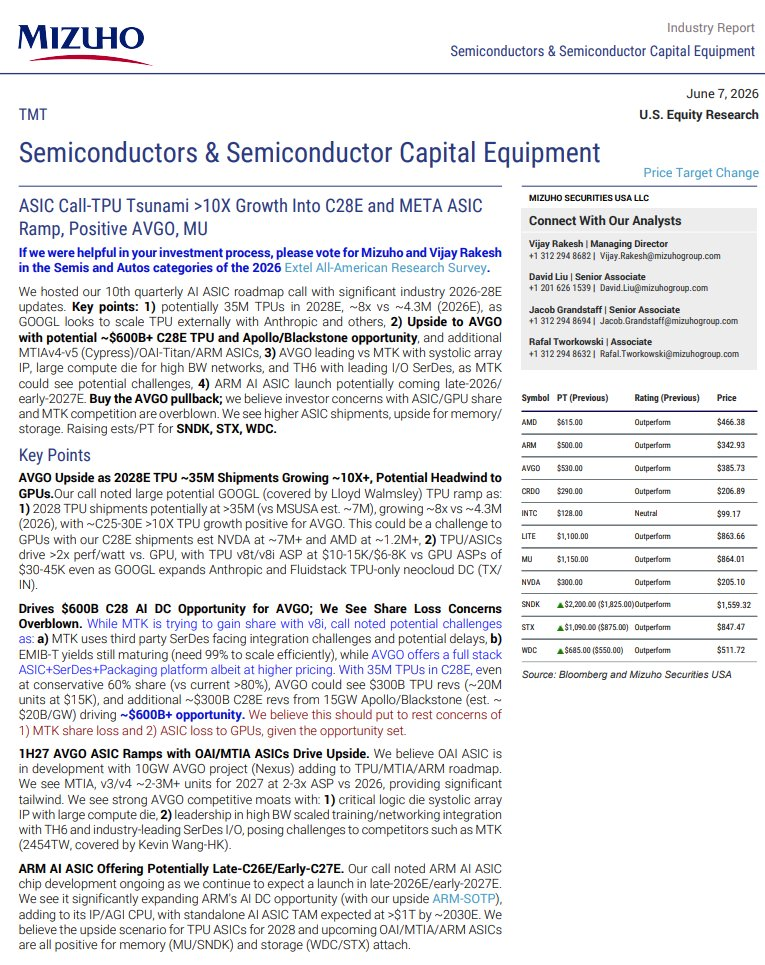
Mizuho's latest channel survey issued a strong buy recommendation on Broadcom, forecasting that Google's TPU shipments will reach an explosive 35 million units by 2028. As Broadcom is Google’s ASIC design partner for TPUs, TPU shipment volumes directly translate into revenue for Broadcom.
However, this figure is 2.3 times higher than the industry’s total consensus forecast and has drawn skepticism from industry insiders for being severely disconnected from supply chain realities: Could this be a fabricated result generated by an intern using AI?
$Broadcom (AVGO.US)$Amid mounting pressure on its stock price, a recently circulated Mizuho channel survey has sent a strong bullish signal on Broadcom. The report hinges on a single—but staggering—data point: it forecasts Google’s TPU shipments will exceed 35 million units by 2028.
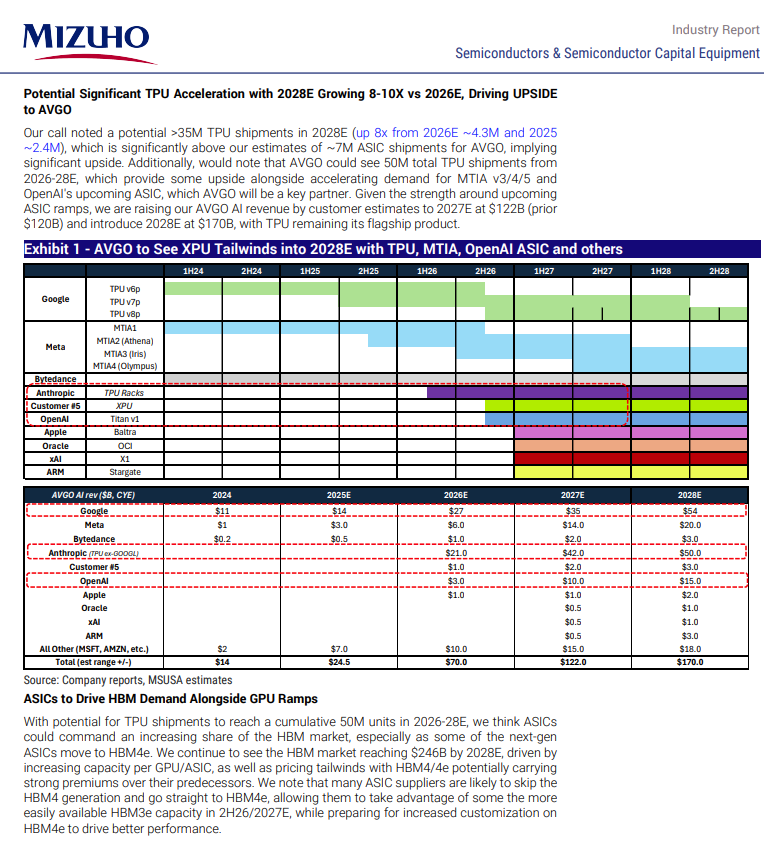
 What does this figure imply? Google’s TPU shipments are expected to reach approximately 2.4 million units in 2025 and around 4.3 million in 2026, jumping to 35 million by 2028—an eightfold increase over two years, implying a compound annual growth rate of roughly 185%.
$Alphabet-C (GOOG.US)$Google’s TPU is a custom AI chip (ASIC), and Broadcom serves as its core design partner. For every additional TPU shipped, Broadcom earns incremental revenue from its ASIC business. In simple terms, Google provides the requirements and architecture, while Broadcom handles chip design services and packaging, with manufacturing outsourced to Taiwan Semiconductor. Broadcom receives corresponding design service revenue for every TPU shipped.
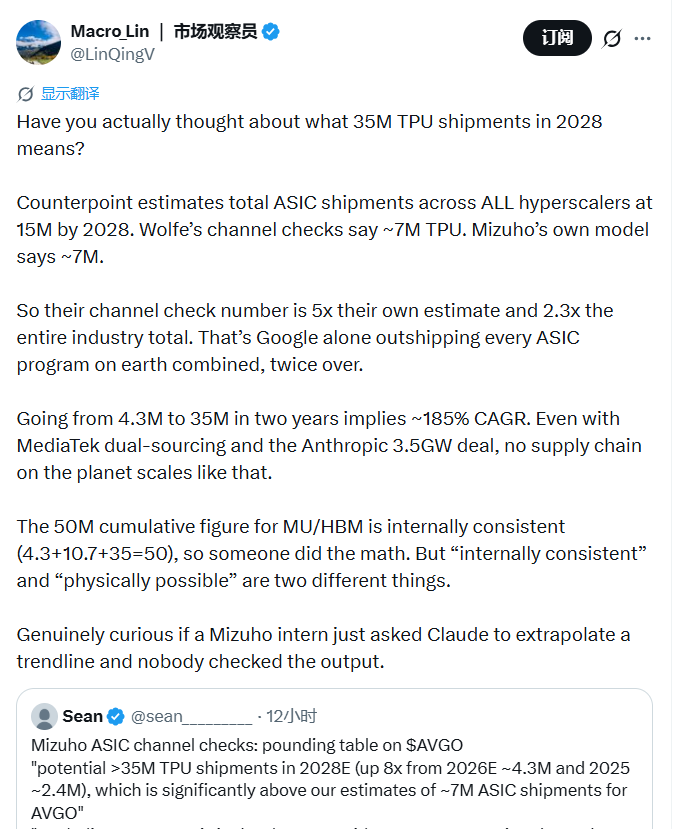
However, the credibility of this figure has been directly questioned by market observers: industry-wide ASIC shipment forecasts for 2028 total only 15 million units—how could Google alone account for 2.3 times that amount? “I’m genuinely curious whether a Mizuho intern simply asked Claude to extrapolate a trend line and no one bothered to verify the output.”
Just how implausible is the figure of 35 million units?
The figure cited in Mizuho’s channel survey has sparked significant controversy within the industry.
Consider the following benchmarks for comparison:
Counterpoint Research forecasts that by 2028, combined ASIC shipments from all hyperscale cloud providers—including Google, Amazon, Microsoft, and Meta—will total approximately 15 million units.
Wolfe Research’s channel checks indicate Google’s TPU shipments are around 7 million units.
Mizuho’s own prior model also projected ASIC shipments at approximately 7 million units.
This latest channel survey, however, cites a figure of 35 million units—five times Mizuho’s own model estimate and 2.3 times the entire industry’s total forecast.
In other words, according to Mizuho’s channel survey figures,$Alphabet-C (GOOG.US)$a single company’s TPU shipments in 2028 would surpass the combined total of all ASIC projects worldwide by more than twofold.
Skepticism: 'Mathematically consistent' does not mean 'physically achievable.'
Market observer @LinQingV directly called out this survey on the X platform.
“Have you seriously considered what shipping 35 million TPUs in 2028 actually means?” he wrote.
His skepticism is clear-cut: growing from 4.3 million to 35 million units implies a compound annual growth rate of approximately 185% over two years. “Even accounting for MediaTek as a dual supplier and Anthropic’s 3.5GW agreement, no supply chain on the planet can scale at that pace,” he argued.
He also noted that Mizuho’s HBM demand projection for Micron appears mathematically self-consistent—cumulative TPU shipments from 2026 to 2028: 4.3 million + 10.7 million + 35 million = 50 million units—but concluded that “internal consistency” and “physical feasibility” are two different things.
He concluded: “I’m genuinely curious—did some Mizuho intern just ask Claude to extrapolate a trend line and nobody bothered to verify the output?”
Beyond Google’s TPU, what else did Mizuho mention?
This channel survey does not solely focus on$Alphabet-C (GOOG.US)$。
Mizuho also noted that OpenAI is developing its own ASIC chip, linked to$Broadcom (AVGO.US)$the 'Nexus' project, which has a scale of 10 gigawatts and is intended to complement the roadmaps for Google TPUs, Meta MTIA, and Arm Holdings chips.
About$Arm Holdings (ARM.US)$Calculations indicate that its AI ASIC chip development is progressing and is expected to launch between late 2026 and early 2027.
Correct.$Micron Technology (MU.US)$The impact was also specifically highlighted: if cumulative TPU shipments reach 50 million units between 2026 and 2028, ASICs will capture an increasingly larger share of the HBM market, particularly as next-generation ASICs transition to the HBM4e specification.
Editor/melody