
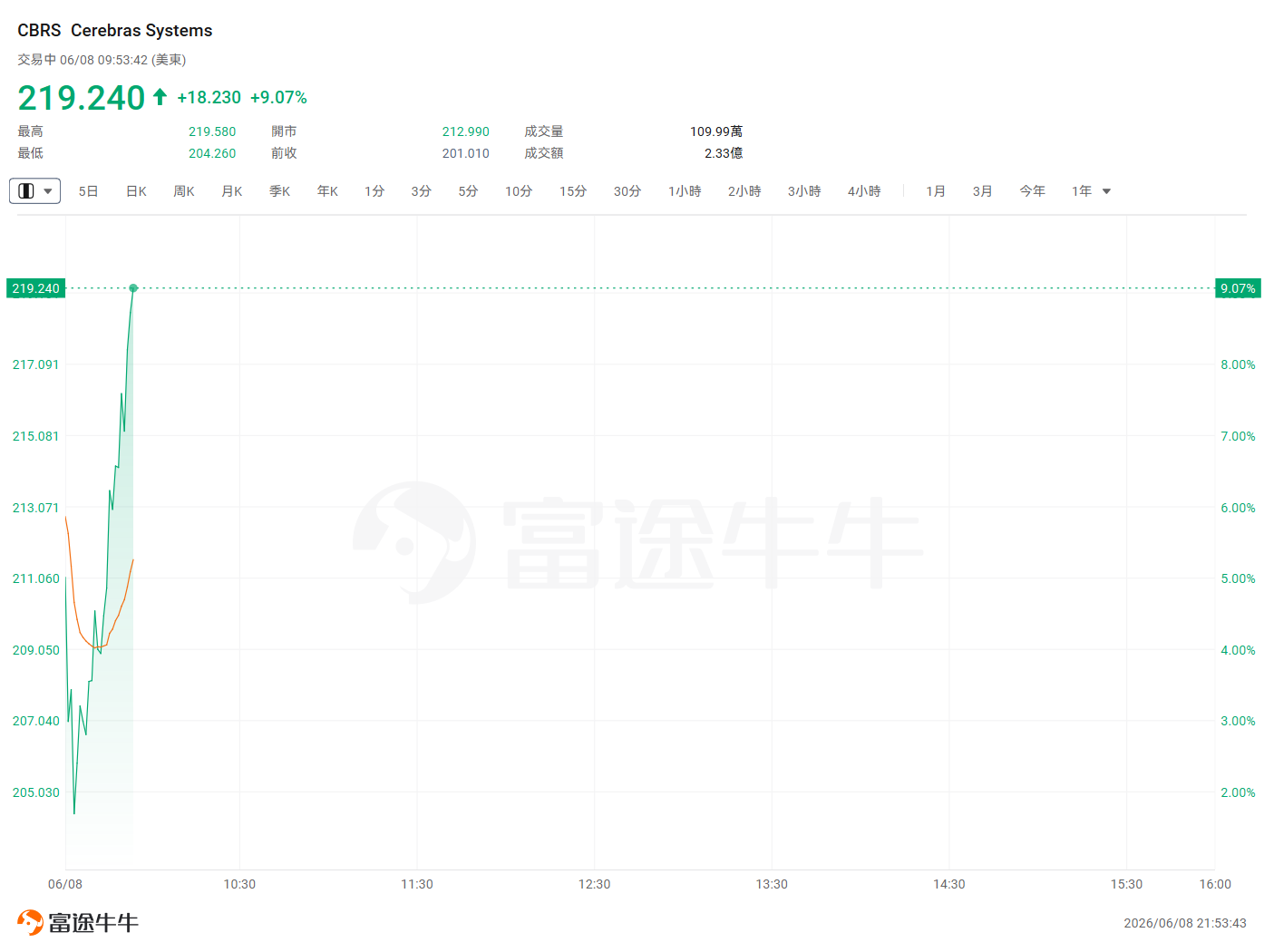
On June 8, $Cerebras Systems (CBRS.US)$ The stock rose 9.07% in early trading to around $219, marking its second consecutive session of modest recovery. Nevertheless, the AI chip newcomer—which listed on Nasdaq just about a month ago—has seen its share price drop nearly 42% from the intraday high of $350 reached on its debut day, with its market capitalization falling from a peak above $100 billion to approximately $44.1 billion today.
In stark contrast to the secondary market performance, however, is a wave of bullish research reports from Wall Street. On Monday alone, multiple Wall Street institutions—including Morgan Stanley, UBS Group, Wedbush, Rosenblatt, Mizuho, Barclays, and Needham—released their initial coverage reports on Cerebras, almost unanimously assigning 'buy,' 'overweight,' or 'outperform' ratings, with target prices clustered between USD 250 and USD 300.
Why is Wall Street collectively bullish?
The fundamental rationale behind Wall Street’s simultaneous 'buy' recommendations for Cerebras lies not in exceptionally strong financial results, but rather in the company’s unique position within a narrow segment of the AI chip market—a so-called 'narrow gate.'
 The core differentiator is Cerebras’ product architecture. While NVIDIA’s GPUs currently dominate the AI computing landscape, Cerebras has taken an alternative path by developing the world’s only commercially deployed wafer-scale processor—the Wafer Scale Engine (WSE). According to technical specifications, the latest WSE-3 integrates four trillion transistors and 900,000 AI-optimized cores, each equipped with 48KB of local SRAM, resulting in a total on-chip SRAM capacity of 44GB and delivering 21 petabytes per second of on-chip memory bandwidth—thousands of times higher than conventional HBM-based solutions. By fundamentally eliminating the 'memory wall' bottleneck, Cerebras claims its system achieves up to 15x faster performance than leading GPU solutions across most workloads, particularly excelling in latency-sensitive AI inference scenarios.
Morgan Stanley noted that as AI workloads increasingly emphasize inference capabilities, demand for fast, low-latency inference is growing rapidly; Cerebras is well-positioned to capitalize on this trend, backed by a substantial order backlog and committed capacity agreements totaling 750MW.
Analyst Timothy Arcuri highlighted that Cerebras is the only supplier providing hardware to OpenAI on a prepaid basis and also collaborates with Amazon AWS in the inference domain. UBS Group, based on conservative assumptions, assigned a target price of USD 300.
Wedbush focused on the timing of market-cycle transition—Cerebras’ public market debut coincides precisely with the critical inflection point as the AI computing cycle shifts from the training phase to the inference phase. The firm emphasized that in inference scenarios, speed—not raw floating-point compute power—directly determines commercial value. The WSE-3 is the largest chip available on the market to date, purpose-built for rapid token generation, giving Cerebras an asymmetric upside potential due to its distinct competitive advantage.
Prior to Monday’s wave of bullish reports, Bank of America Merrill Lynch had already forecast that Cerebras would lead all major AI chip companies with an explosive 370% revenue growth over the next year—a projection surpassing even NVIDIA’s anticipated 195% revenue growth for the same period.
Morgan Stanley (Overweight rating, target price: USD 250)
Morgan Stanley analyst Joseph Moore wrote in a client note: "We view Cerebras as one of the most differentiated AI infrastructure companies, anchored by the industry’s only commercially deployed wafer-scale processor. As AI workloads increasingly emphasize inference capabilities, demand for fast, low-latency inference is growing rapidly. With a substantial backlog of signed orders and 750 megawatts of committed capacity agreements, we believe Cerebras is well positioned to capture this opportunity. This represents an excellent investment opportunity in an AI processor company that holds a first-mover advantage over NVIDIA and possesses significant upside potential as the field continues to evolve."
UBS Group (Buy rating, price target $300)
UBS Group analyst Timothy Arcuri wrote in a client note: "Cerebras’ Wafer Scale Engine (WSE) is the world’s largest compute chip and outperforms GPUs in certain fast-inference applications targeting the high-end inference market. Importantly, the company demonstrates strong commercial momentum—it is currently the only supplier delivering to OpenAI on a prepaid basis, its collaboration with Amazon on inference is deepening, and it has numerous other potential partnership opportunities. Our price target is based on what we consider conservative assumptions regarding OpenAI deployments and incorporates optionality from potential increased adoption by Amazon over the coming years. Given our view that the company will ultimately evolve into a more comprehensive hardware provider, our $300 price target is derived using a 10x enterprise value-to-sales (EV/Sales) multiple applied to estimated 2029 sales of $11 billion, benchmarked against major hardware peers including NVIDIA, AMD, Broadcom, and Marvell Technology."
Needham (Buy rating, price target $300)
Needham analyst N. Quinn Bolton wrote in a client note: "Cerebras is the only supplier of wafer-scale engines (WSEs), offering SRAM capacity and memory bandwidth several orders of magnitude greater than any other AI processor. The WSE is purpose-built for low-latency, fast-inference workloads such as real-time coding and instant research agents. In January 2026, the company announced a computing agreement with OpenAI valued at over $20 billion, under which OpenAI will deploy approximately 750 megawatts of Cerebras computing capacity by 2028, with an option to add another 1.25 gigawatts. In March, Cerebras announced a collaboration with AWS on disaggregated inference. If OpenAI exercises its option for the additional 1.25 gigawatts or if Amazon deploys any meaningful number of Cerebras systems, we believe our current model has substantial upside potential."
Wedbush (Outperform rating, price target $270)
Wedbush analyst Matt Bryson wrote in a client note: "Cerebras is the only company to have commercialized a wafer-scale AI chip, and it is entering the public markets just as the compute cycle shifts from training to inference—a phase where speed, not raw floating-point performance, determines output value. Cerebras’ third-generation Wafer Scale Engine (WSE-3) is the largest chip ever sold and is specifically engineered for a high-value inference task: rapid token generation. Given its differentiated architecture, step-change growth in contracted revenue from OpenAI and AWS, and a market that is only beginning to pay a premium for speed, we see an asymmetric, upward-trending opportunity."
Barclays (Overweight rating, price target $280)
Barclays noted that Cerebras’ recent agreements with OpenAI and Amazon represent significant developments in the AI chip market, where customers are racing to secure limited chip supply to scale their operations. Barclays highlighted that Cerebras is positioned in the fast-inference segment, which the firm estimates could reach a $300 billion addressable market by the end of the decade. The bank added that as agent technologies become more prevalent, workloads requiring fast inference will proliferate—aligning directly with Cerebras’ core strengths.
Mizuho (Outperform rating, price target $300)
Mizuho noted that Cerebras is a direct beneficiary of the growth in AI-related capital expenditure, which is projected to expand at a compound annual growth rate (CAGR) of 36% to approximately $2.8 trillion by 2030. Mizuho believes the company is a leader in the fastest-growing segment—'fast inference.' The firm forecasts that this segment will grow at a CAGR of approximately 291% to reach around $550 billion by 2030, compared with an overall AI inference market CAGR of about 53%. The company’s proprietary full-stack hardware and software architecture, centered on its wafer-scale engine and extensive on-chip SRAM, has established a strong competitive advantage.
Furthermore, Mizuho stated that an expanding customer pipeline supports the company's projected revenue CAGR of 122% from 2025 to 2029. Its $300 price target implies a price-to-sales (P/S) multiple of 15x based on 2028 estimated sales, positioning it at the midpoint of the 8x–24x P/S range observed for NVIDIA and Broadcom prior to the acceleration of their respective AI businesses.
Editor/Lee