
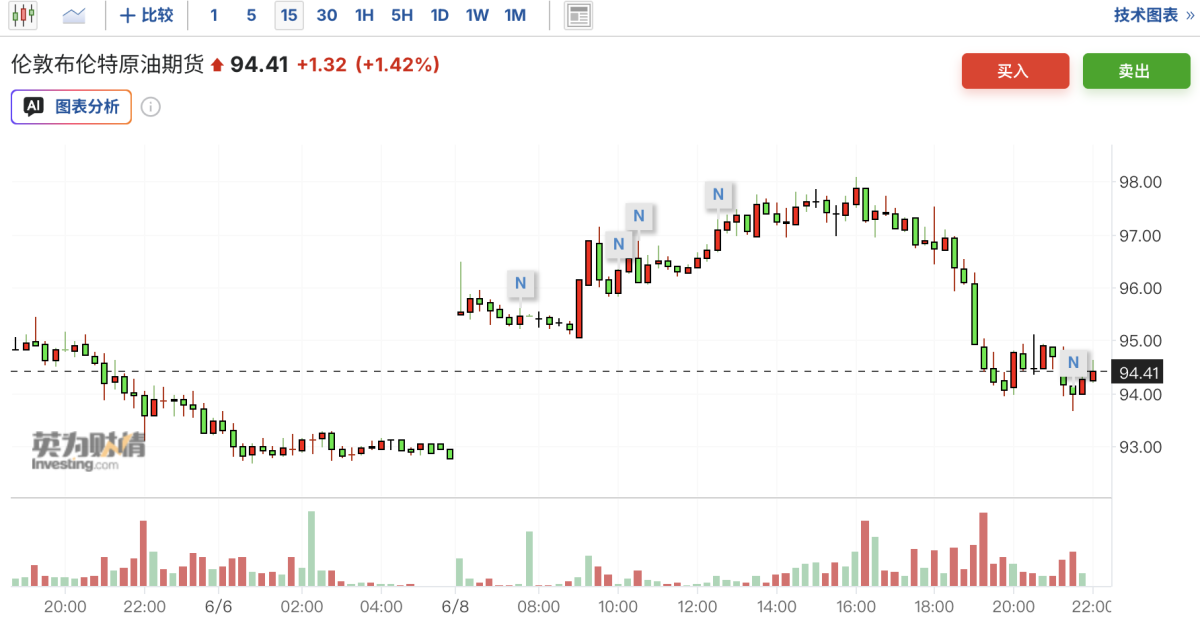
The Houthi armed group in Yemen announced a "comprehensive ban" on Israeli vessels navigating the Red Sea. Following the blockade of the Strait of Hormuz, Saudi Arabia has rerouted over 70% of its daily crude oil exports through the Red Sea port of Yanbu, a route that currently serves as a critical support for stabilizing global oil prices. After the announcement, oil prices halted their decline and rebounded to $94.4 per barrel.
The latest threat from Yemen's Houthi armed group is delivering a fresh shock to the global energy market, which is already under pressure due to the blockade of the Strait of Hormuz.
According to Xinhua News Agency, on the 8th, Yemen’s Houthi armed group stated that it had launched missiles at a 'sensitive target' in the Jaffa area of central Israel, claiming that its 'intended objective has been achieved,' and announced a 'comprehensive ban' on Israeli navigation in the Red Sea.
 This statement directly threatens Saudi Arabia’s critical oil export route through the Red Sea—a key alternative channel adopted after the Strait of Hormuz was blocked. Saudi Arabia has already rerouted more than 70% of its daily crude oil exports via the Red Sea port of Yanbu, a route currently serving as a crucial stabilizer for global oil prices.
Analysts fear that if the Houthis resume large-scale attacks on Red Sea shipping—as they did previously—it would deliver a double blow to global energy supplies.
Following the announcement, oil prices halted their decline and rebounded slightly. As of this report, Brent crude futures rose 1.42% on the day to $94.40 per barrel.
Blockade of Hormuz Has Already Triggered an Energy Crisis; the Red Sea Is Now the Last 'Pressure Relief Valve'
Since Israel and the United States launched attacks against Iran on February 28, Iran immediately closed the Strait of Hormuz, severely disrupting most petroleum and other energy exports from the Gulf region. International oil prices surged sharply thereafter, delivering a major shock to the global energy market.
In this context, Saudi Arabia swiftly adjusted its export strategy, rerouting over 70% of its daily crude oil exports through the Red Sea port of Yanbu. This provided a critical alternative supply channel to the global energy market, helping to partially contain further uncontrolled increases in oil prices.
However, this very 'lifeline' now faces direct threats from the Houthi armed group. Should the group launch sustained attacks on Red Sea shipping lanes or ports, the impact on the global energy market would be incalculable.
A Precedent Set by the Houthis: Their Previous Red Sea Offensive Nearly Paralyzed International Shipping
Following Hamas's attack on Israel on October 7, 2023, the Houthi movement began shelling Israel and targeting international shipping in the Red Sea, citing solidarity with Palestine. This campaign caused significant disruption—major global shipping companies such as Maersk and Hapag-Lloyd were forced to reroute around Africa’s Cape of Good Hope, resulting in longer voyages and substantially higher costs.
The United States subsequently led the formation of a multinational naval escort task force, conducted multiple rounds of strikes against Houthi targets, and intercepted hundreds of drones and missiles in defensive operations. Despite these efforts, some Houthi attacks persisted until last summer and only fully ceased following the entry into force of the Gaza ceasefire agreement in October of last year.
Notably, during its previous campaign, the Houthi movement expanded its targeting criteria to include vessels owned by any company that had previously used Israeli ports. This broad definition deterred numerous international shipping firms, prompting them to voluntarily abandon Red Sea routes.
Who are the Houthis, and what is their relationship with Iran?
The Houthi movement emerged in northern Yemen in the 1990s as an initially integrated military, political, and religious movement, gradually gaining strength through guerrilla warfare against the Sana’a-based government.
The group adheres to Zaydi Shiism. After the **** in 2011, it deepened ties with Iran and, taking advantage of domestic political instability, seized the capital in 2014, disrupting the Gulf-backed political transition process.
Subsequently, a Saudi-led coalition intervened in Yemen’s civil war, aiming to restore the ousted government and expel what it described as Iranian 'proxy' forces. During the conflict, the Houthis repeatedly launched missile and drone attacks on oil facilities and critical infrastructure in Saudi Arabia and the United Arab Emirates. In 2022, Yemeni parties reached a ceasefire agreement, leading to a generally calmer situation.
Regarding its relationship with Iran, Tehran has incorporated the Houthis into its so-called 'Axis of Resistance,' alongside Lebanon’s Hezbollah and Iraqi Shia militias. The United States accuses Iran of supplying the Houthis with weapons, funding, and training, while the Houthis deny being Iranian proxies and insist they independently develop their own weaponry.
It is worth noting that, unlike Hezbollah or various Iraqi factions, the Houthis do not recognize the religious authority of Iran’s Supreme Leader. Their actions are primarily motivated by domestic Yemeni politics, indicating a relatively weaker degree of alignment with Iran.
Why have the Houthis remained relatively quiet during this latest round of hostilities?
Although Hezbollah and Iraqi militias quickly entered the fray following the initial U.S.-Israeli strikes on Iran, the Houthi movement has remained relatively restrained in this round of hostilities involving Iran.
On March 5, the group’s leader, Abdul Malik al-Houthi, stated that his ‘finger is always on the trigger,’ but until this week, its actual involvement had been limited to sporadic missile and drone attacks against Israel between late March and early April.
Analysts believe the Houthis’ restraint may stem from multiple considerations:
First, the Houthis and Iran may seek to pressure Israel and the United States by threatening to ‘shut down another critical energy corridor,’ thereby deterring further escalation; second, compared with Tehran’s other allies, the Houthis may feel less strongly aligned with Iran’s core security interests; third, the group may be reluctant to provoke Saudi Arabia—a powerful neighbor—and risk reigniting domestic conflict.
On June 1, Esmaeil Qaani, commander of the Islamic Revolutionary Guard Corps’ Quds Force, warned that the Houthis have the capability to ‘choke off the Red Sea.’ However, significant uncertainty remains regarding when and at what scale the Houthis might intervene—an ambiguity that itself now hangs over global energy markets like a sword of Damocles.
Editor/Liam