
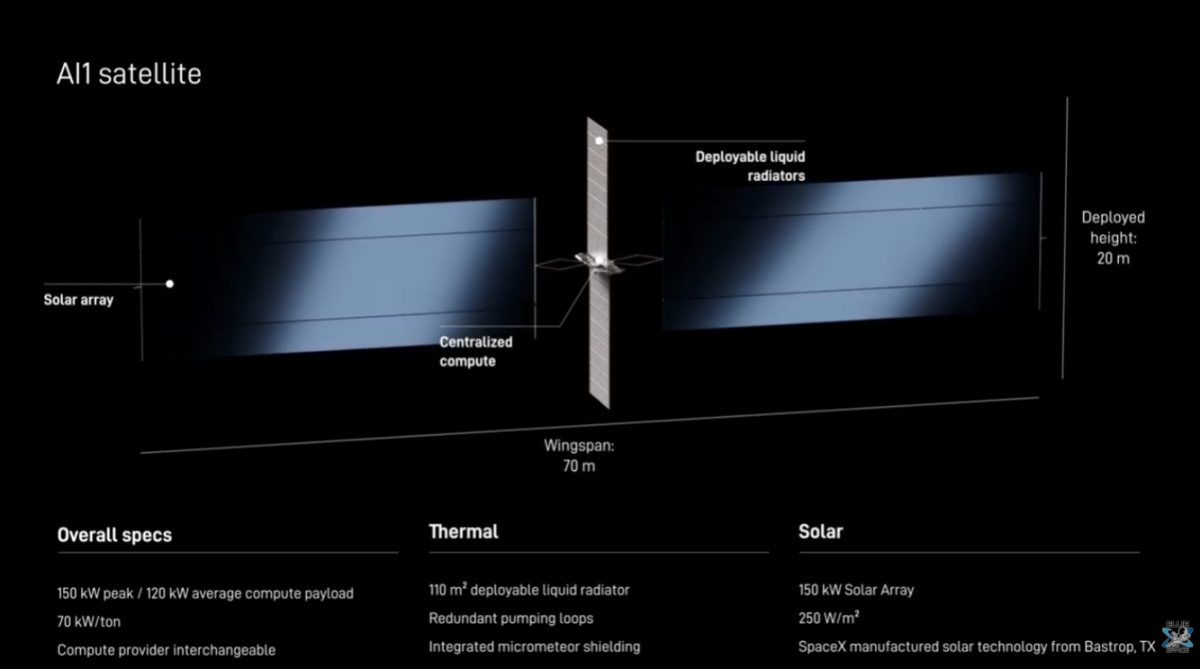
On the eve of SpaceX's IPO, Musk publicly unveiled for the first time the design schematics of the "AI1" satellite. The AI1 satellite features an engineering design even more streamlined than Starlink. This massive computing satellite, with a peak power consumption of 150 kilowatts and a wingspan of 70 meters, is essentially a floating NVIDIA AI server rack in a 600-kilometer orbit, with its solar array power generation density set at 250 W/m². Musk announced plans to deploy an annualized 1 gigawatt of AI computing capacity by the end of 2027, collaborating with Tesla and Intel on chip development and leveraging Starship to disrupt launch costs—directly converting satellite mass-production advantages into a next-generation AI computing moat.
On the eve of SpaceX's IPO, Elon Musk has for the first time detailed the company's orbital AI data center initiative, positioning it as a core growth engine. The plan aims to overcome the limitations imposed by Earth’s power supply constraints on AI industry development by shifting massive computational capacity to low Earth orbit.
In a video released on Monday, Musk unveiled for the first time design sketches and key technical specifications of the first-generation AI satellite, 'AI1.'
 Musk explicitly stated that establishing data centers in space does not require any yet-to-be-invented 'magic,' and the technical challenges involved are even less daunting than those of SpaceX’s existing Starlink business. He emphasized that this is not an insurmountable engineering problem for SpaceX and affirmed the company’s goal of achieving an annual deployment rate of 1 gigawatt (GW) of space-based AI computing capacity by the end of 2027.
This latest statement sends a clear signal to capital markets that SpaceX is seeking to convert its overwhelming scale advantage in satellite mass production and launch capabilities into a moat for next-generation AI computing infrastructure.
Although industry competitors remain cautious about the economic viability of space-based computing power, SpaceX has applied to the U.S. Federal Communications Commission (FCC) to launch up to one million AI satellites. To overcome the high barriers posed by computing and launch costs, SpaceX is advancing its own chip fabrication facility in collaboration with $Tesla (TSLA.US)$and$Intel (INTC.US)$ and other partners, and plans to leverage its Starship heavy-lift rocket to disrupt the existing economics of launch services—directly widening the strategic deployment gap with its competitors.
Targeting the computational bottleneck and a vast potential market
In its IPO filing, SpaceX noted that the total addressable market for AI—estimated at as high as $26.5 trillion—faces severe constraints due to 'Earth’s inability to rapidly expand power generation capacity.' Consequently, solar-powered orbital AI data centers are viewed by Musk and aerospace executives as a critical technology to meet AI companies’ rapidly growing energy demands.
Regarding the project timeline, Musk offered an exceptionally ambitious forecast, stating that SpaceX aims to achieve an annual deployment rate of 1 gigawatt (GW) of space-based AI computing capacity by the end of 2027, with plans to scale up by orders of magnitude each year thereafter, ultimately reaching a total capacity of 1 terawatt (TW).
However, he also cautioned investors to 'take this aggressive timeline with a grain of salt.' The IPO filing presents a more conservative official outlook, indicating a gradual commercial rollout starting in 2028.
Unveiling the AI1 Satellite: NVIDIA Racks in Orbit
In response to external misconceptions that a space-based data center entails 'launching ground-based server rooms into orbit,' SpaceX has clarified the actual hardware configuration. The core engineering challenge lies not in relocating physical infrastructure, but in generating electrical power in a vacuum and efficiently dissipating the waste heat produced by high-performance computing.
The video unveiled, for the first time, quantitative specifications of the AI1 compute satellite. The satellite has a peak power consumption of 150 kilowatts and a sustained average computing power draw of 120 kilowatts.
Musk stated that these figures precisely match the operational power envelope of NVIDIA’s GB300 server racks used in terrestrial data centers—each containing 72 GPUs—effectively placing an entire NVIDIA AI computing module into orbit.
To meet its extreme power and thermal management requirements, the AI1 satellite features a pair of massive wings with a 70-meter wingspan. Its solar array is designed for a power generation density of 250 W/m², while its dual-sided radiator panels achieve a heat dissipation density of 1,400 W/m². In orbit, the satellite will orient itself in a 'blade' attitude directly facing the Sun to maximize thermal radiation.
Streamlined architecture and technology reuse establish a manufacturing moat.
In terms of hardware structure, the AI1 satellite’s engineering design is even more streamlined than that of traditional Starlink satellites.
Existing Starlink satellites require highly complex, large-scale phased-array and parabolic antennas, whereas the AI satellite essentially functions as a pure hardware platform: it primarily comprises expansive solar arrays, oversized radiators, and basic laser inter-satellite links, eliminating the need for sophisticated Earth-facing communication antennas.
Musk and the engineering team emphasized that the majority of the AI satellite’s manufacturing directly reuses SpaceX’s already developed and flight-proven Starlink V3 satellite platform technology.
This means SpaceX can directly leverage its existing capabilities in mass-producing, launching, and operating satellites without requiring fundamental scientific breakthroughs. As the company approaches its IPO, this exceptionally high degree of technology reuse and scalable engineering capability constitutes a distinctive competitive advantage presented to investors.
Ecosystem synergy addresses cost and latency challenges.
In response to concerns about network latency raised by space-based data centers, SpaceX has provided a clear solution.
AI satellites will be deployed in low Earth orbit (LEO) at altitudes of 600 to 800 kilometers, resulting in a one-way network latency of approximately 3 milliseconds. The satellites will integrate inter-satellite laser links with bandwidths as high as 1 terabit per second and will downlink data at high speeds either through Starlink’s existing Ka- and Ku-band antenna networks or directly via satellite-to-ground laser links.
However, there remains disagreement within the industry regarding commercial viability.
Blue Origin, Amazon founder Jeff Bezos, and researchers such as Andrew McCalip have pointed out that expensive AI chips and high launch costs currently pose significant industry barriers, rendering the prevailing economic model unviable at this stage.
To address this, SpaceX is attempting to establish a vertically integrated supply chain to overcome cost barriers: on one hand, leveraging its Starship heavy-lift rocket to significantly reduce launch costs, and on the other, collaborating with partners Tesla and Intel through a program called Terafab to co-develop and manufacture its own AI chips. By controlling both launch capabilities and foundational computing hardware, SpaceX is accelerating the commercialization of space-based computing.
Want to select stocks or get a stock diagnosis? Curious about the opportunities and risks in your portfolio? For all your investment questions,Just ask Futubull AI!

Editor/joryn