
In an interview, Peter Beck poured cold water on the industry: nearly all of the 142 companies that previously attempted to enter the orbital launch market have failed. 'Globally, only SpaceX and Rocket Lab have truly achieved scalable and reliable launches.' Beck was once denied entry to NASA due to lacking a degree and not being a U.S. citizen—an experience that motivated him to start his own company. Today, many aerospace firms receive multibillion-dollar valuations without having built anything tangible, and the sector is rife with exaggerated claims and capital-driven hype.
Amid the ongoing surge in commercial space activity, Sir Peter Beck, founder and CEO of Rocket Lab, offered a succinct assessment: to date, only two companies globally have truly achieved scalable, highly reliable orbital launch capabilities—SpaceX and Rocket Lab. Of the 142 companies he has tracked that attempted the same feat, all others have failed.
On June 7, Beck stated in a recent interview that orbital access remains extremely scarce, with Virgin Orbit serving as a clear example—Richard Branson invested over USD 1.2 billion in the company to pursue the very work Rocket Lab is doing today, yet it still ultimately failed. "Having a lot of money does not guarantee success; near-perfect execution across every dimension is required," Beck said. He was also candid about the inflated valuations of certain current players, noting that one rocket company recently raised USD 200 million at a USD 2.2 billion valuation "without having built anything yet."
 On the performance front, Rocket Lab reported revenue exceeding USD 200 million last quarter, with a backlog of approximately USD 2.2 billion. Its share price has surged by more than 400% over the past year. Analysts project the company will achieve profitability by 2028. Beck stated that the company’s long-term goal is to become one of the few enterprises capable of end-to-end control over the entire space value chain—owning proprietary rockets, building its own satellites, and delivering services directly from orbit—to establish a cost advantage that is difficult for competitors to replicate.
This assessment reflects a deepening bifurcation within the commercial space sector: as investor enthusiasm continues to grow, technological barriers, scalable manufacturing capabilities, and end-to-end vertical integration are emerging as the key differentiators between genuine winners and speculative ventures.

The Failure of 142 Companies and the Success of Two
Beck illustrated the high barriers to entry in the orbital launch market with concrete figures. During the development of Rocket Lab’s Electron small-lift launch vehicle, he systematically tracked 142 companies attempting the same mission—nearly all of which have since exited the field. Virgin Orbit stands out as the best-funded among them, with Richard Branson injecting over USD 1.2 billion into the venture, yet it still failed to cross the threshold into commercial orbital launch operations.
"Anything rare holds inherent value," Beck remarked. He believes that reliable, routine access to orbit is not only a reflection of technical prowess but also a fundamental prerequisite for commercial sustainability. In his view, the future winners will be a select few end-to-end companies—those that own their rockets, build their own satellites, and deliver services directly from space—and these firms will capture the vast majority of the industry’s market share.
Vertical Integration: The Competitive Logic of an End-to-End Strategy
Rocket Lab positions itself as an end-to-end space company, with businesses spanning launch vehicles, satellite manufacturing, spacecraft component supply, and direct service delivery from orbit. Beck noted that roughly 30% of all items launched into space last year bore a Rocket Lab mark somewhere on them. Currently, 50% of the company’s business comes from commercial customers, primarily in Earth observation and communications; the other 50% derives from government clients, including national security missions and civil programs from agencies such as NASA.
Beck’s core rationale is this: companies that can independently build satellites, vertically integrate all components, and launch autonomously will achieve a significantly superior cost structure compared to competitors reliant on third-party procurement. This strategy extends deep into the supply chain—Rocket Lab is now the world’s largest manufacturer of space-grade solar panels and has acquired a leading reaction wheel supplier, scaling its annual production capacity from around 150 units to several thousand per quarter.
In deep space missions, Rocket Lab has already built two spacecraft for NASA and is currently en route to Mars for the 'Escapade' mission. Beck views this as a sign of a leap in commercial space capabilities: 'Prior to this, such missions would have been strictly internal NASA projects and not commercialized.'
Industry Valuation: The Boundary Between Enthusiasm and Bubble
Rocket Lab’s stock price has risen over 400% in the past year, while AST SpaceMobile gained more than 200% and Firefly surged by as much as 600% during the same period. Faced with generally elevated industry valuations, Beck adopts a cautious yet nuanced stance: he acknowledges that some valuations have detached from reality, while maintaining that Rocket Lab’s valuation is underpinned by solid business fundamentals.
His concern about exaggerated claims in the industry points to a structural issue: the high technical barriers and difficulty of external verification in aerospace objectively create fertile ground for misleading statements. 'You see companies promoting the most absurd things, raising massive amounts of capital, then collapsing without ever being held accountable,' he said, 'because it’s too complex and too difficult to conduct due diligence.'
He concludes that sustained capital inflows must be predicated on verifiable execution capability—only companies that have demonstrated proven track records in technological delivery and operational implementation can sustain a healthy financing cycle.
Scaling Up: The Core Structural Bottleneck in the Industry
Beck identifies 'scaling up' as the central challenge that must be addressed to drive sustained industry progress, rooted in the aerospace sector’s long-standing artisanal nature. He cites reaction wheels as an example: when Rocket Lab built its first satellite, suppliers indicated a nine-month lead time for delivery, noting that 'no company in the entire industry was producing reaction wheels at scale.' This directly spurred the company’s vertical integration strategy—acquiring key component suppliers to elevate production capacity from workshop-level to industrial-scale.
He characterizes this industry trait as 'artisanal workshops—highly skilled but with minimal output.' 'When you say, "I need a hundred," you can practically see their minds explode on the spot,' Beck remarked. He believes that unless this structural bottleneck is resolved, any customer aiming to deploy a constellation of thousands of satellites will face severe supply constraints. In his view, scalable manufacturing capability will become the core competitive barrier in the next phase of industry development.
Exploring the Frontier: The Search for Extraterrestrial Life and the Future of Interstellar Travel
Looking further ahead, Beck is optimistic that humanity will discover extraterrestrial life within his lifetime. Rocket Lab is currently advancing a privately funded Venus exploration mission, planning to fly through Venus’s cloud layers in search of phosphine gas—a compound known to be produced only by certain biological metabolic processes. 'If we go there and detect a signal of life, it would mean we are not alone in the universe,' Beck said. 'I truly believe this question will be answered within my lifetime.'
Regarding crewed Mars missions, Beck believes there are no fundamental technological barriers, but he is skeptical about the practicality of the human body in interstellar travel. He proposed a disruptive idea: if a journey takes thousands of years, carrying human consciousness in some non-biological form might be the exploration method truly aligned with cosmic timescales. 'Only by condensing the essence of the human soul into a solid-state existence can we genuinely travel through the solar system,' he said. 'If it takes you thousands of years to reach a destination, it may be more appropriate to undertake the journey in a different form.'
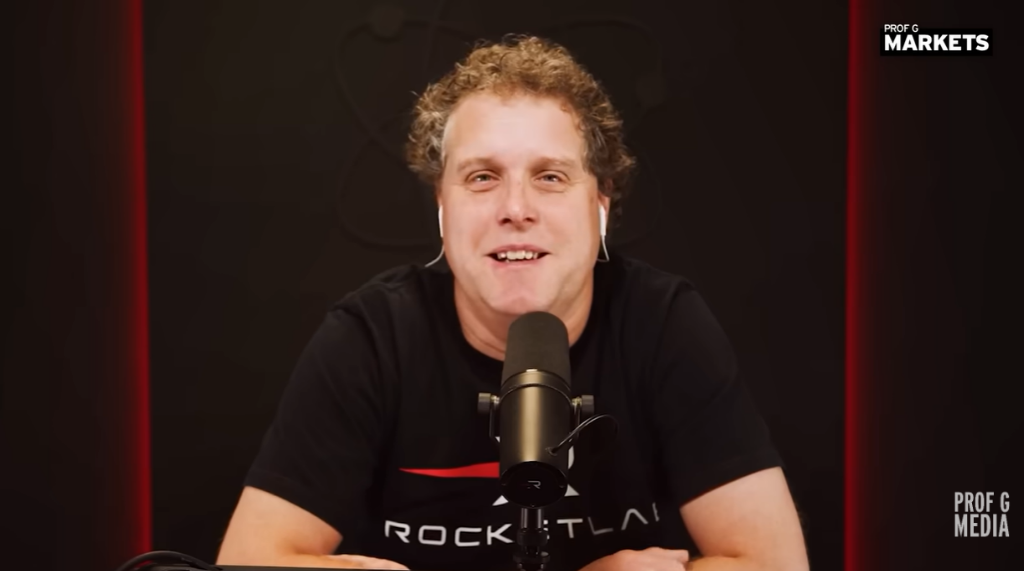
Below is the full transcript of the interview, edited for brevity:
Host Edson:
The global space economy is projected to reach $1.8 trillion by 2035. Once dominated by governments, this industry is rapidly evolving into one of the world’s most significant commercial markets, profoundly impacting national security, communications, scientific exploration, and defense.
My next guest is one of the central figures driving this transformation. The company he founded initially focused on reducing launch costs and increasing launch frequency for small satellites, and has since grown into a comprehensive space systems enterprise. Today, the company designs satellites, manufactures spacecraft components, and provides launch services—collectively shaping the future of the commercial space industry. With revenue exceeding $200 million last quarter and a backlog of orders now totaling approximately $2.2 billion, the company has become a pivotal force in the future of space.
This is my conversation with Sir Peter Beck, founder and CEO of Rocket Lab. Peter, thank you very much for joining us today.
Host: I’d like to start by asking you to explain what exactly Rocket Lab does. You’re clearly in the space business, but that encompasses many different activities—what specific services does Rocket Lab provide?
Sir Peter Beck: Thank you very much—that was a wonderful introduction. What we’re truly committed to building is an end-to-end space company. This means we deliver services directly from space, covering every layer beneath it—launch is the key and the vehicle to access space, while satellites are the systems that deliver those services. At the highest level, it’s the services themselves originating from space.
Our core philosophy is this: if you can build your own satellites, vertically integrate all self-developed components, and further vertically integrate your own launch capability, your competitive advantage in delivering services from space will far exceed that of competitors who must source all their resources from you or third parties.
That is the company’s ultimate goal, and we are steadily progressing toward it step by step. As you mentioned, we are already one of the largest component suppliers in the space industry—approximately 30% of everything launched into space last year bore the Rocket Lab logo somewhere on it. We build satellites, spacecraft, rockets, and all related equipment.
Host: Could you provide some background for our listeners who aren’t very familiar with the space industry? Which companies purchase your products? What kinds of companies buy rocket components or satellites?
Sir Peter Beck: Our customers span the entire industry spectrum. On the launch side, we’ve launched small CubeSats for several high schools in California, and with the same product, we’ve also executed the most critical national security missions—those involving human lives. That’s precisely what makes this industry so compelling; it truly encompasses an extremely wide range of applications.
Overall, 50% of our business comes from commercial customers and 50% from government customers. On the commercial side, it’s primarily Earth observation and communications; on the government side, it includes national security missions as well as civil programs. For example, we recently built two spacecraft for NASA, which are currently en route to Mars.
Host: I think it’s important to distinguish between the different segments within this industry. We often view 'space' as a monolithic sector, but in reality, there are countless distinct use cases and business models. Could you outline the most important categories in today’s space industry?
Sir Peter Beck: Perhaps it’s best to start from a broader perspective—space is essentially infrastructure, albeit infrastructure that happens to be invisible.
People often say, 'All this space stuff is science fiction—it has nothing to do with me.' Then they go home and order a pizza, which arrives right at their doorstep. They don’t realize that during that pizza-ordering process, they likely used space-based communications, and the delivery driver found their address using GPS navigation.
There’s a vast amount of infrastructure operating in orbit—GPS, communications, Earth observation—that everyone uses daily without even noticing. If we break it down into its most fundamental categories, they include the following:
Earth observation—covering visible light, non-visible spectra, and radio frequencies, commonly known as satellite weather monitoring; communications—of which GPS is a part, and the link enabling our conversation across nearly half the globe likely passes through space; emerging fields—such as in-orbit data centers, which sounded implausible just a few years ago but are now a major thrust area; space-based internet, like Starlink or Amazon’s low-Earth orbit broadband, once considered science fiction but now serving millions of users; and direct-to-device connectivity from space, another rapidly advancing domain.
This industry is constantly redefining itself, and as more applications emerge, the space sector continues to grow at an accelerating pace.
Host: The industry’s recent growth rate is indeed astonishing. Rocket Lab’s stock price has surged 400% over the past year, and other space stocks have performed wildly—AST SpaceMobile up over 200%, Firefly up 600%. It truly seems the space industry has entered its era.
But this leaves me a bit confused—you're absolutely right that ordering takeout now involves interacting with space-based infrastructure, and companies like yours are the ones actually launching these systems into orbit. Yet people have been using their phones to order food for years. So here’s the question: why now? What exactly has changed over the past year or two that has suddenly made everyone realize the enormous opportunities in commercial space?
Sir Peter Beck: I think the answer lies in the fact that space was historically government-dominated, and over the past decade or so, we’ve witnessed its complete democratization.
Take GPS, for example. All GPS satellites currently operating in orbit are government-owned assets, originally designed as defense infrastructure. If we were to start from scratch today—decommissioning all existing assets and rebuilding them from the ground up—I believe there’s a 100% chance it wouldn’t be governments doing it, but commercial entities.
Another example is our 'Escapade' Mars mission for NASA. NASA provided us with a technical specification stating, 'We want to accomplish this Mars exploration.' We independently designed and built two spacecraft, which are now en route to Mars to carry out NASA’s mission. Previously, such missions would have been conducted entirely in-house by NASA and never outsourced commercially. Now, even deep-space interplanetary missions are being commercially contracted—partly because the commercial market has matured, specialized skills and expertise have become more widely available, and sufficient capital has been allocated, enabling private companies to genuinely execute these complex missions.
Why Found Rocket Lab
Host: I’d like to talk about your personal story. You founded this company in 2006, and for listeners who may not yet know, you’re from New Zealand. At a time when there were virtually no commercial opportunities in this field, you boldly chose to start your own venture—and now your company generates hundreds of millions of dollars in revenue and is publicly listed. Why did you decide to found this company? Did you truly believe back then that it could become a commercially viable business?
Sir Peter Beck: Well, for starters, NASA wasn’t willing to hire me, so I didn’t really have many options. The only viable path was to start my own company—and I just happened to live in New Zealand.
Rocket Lab is now a global company; the vast majority of our operations are no longer based in New Zealand—though we still maintain some presence there—but are instead distributed worldwide. Put simply, I’ve been building rockets since I was a kid; it’s always been what I wanted to do. One year, I took a 'rocket pilgrimage' to the United States, where I learned several crucial lessons.
Host: Hold on—why wouldn’t NASA hire you? Was it because you weren’t a citizen, or did you apply and simply not get selected?
Sir Peter Beck: I was a foreign national and didn’t have a university degree. Needless to say, that didn’t exactly strengthen my résumé.
Another thing that struck me was visiting those startups in the Mojave Desert, seeing what they were working on, and realizing there was no fundamental difference between what they were doing and what I was doing at home. I thought to myself: Well, there isn’t a huge gap between what I’m doing and what others are doing—maybe I should just go ahead and do it.
How to Start Building Rockets
Host: We’re all curious—how does a young person decide to build rockets, and how do they actually go about doing it?
Sir Peter Beck: One of my earliest memories is standing outside with my father, gazing up at the stars. He was an astronomy enthusiast and told me that most of the stars we could see had planets orbiting them—and perhaps, on one of those planets, someone was standing there looking back at us. That moment felt like a revelation to me: space was grander than anything else, and this was what I wanted to pursue. I had a natural aptitude for engineering, and combining that with my fascination for space made building rockets the obvious path forward.
Host: At what age did you actually start building rockets?
Sir Peter Beck: I became serious about it around the age of 14 or 15 while I was still in school. My metalwork teacher let me use the workshop during lunch breaks and on weekends.
Host: So how did you get from using the school’s metalwork shop during lunch breaks to actually founding your own company?
Sir Peter Beck: There was a journey in between. After leaving school, I took on an apprenticeship in tool and die making instead of going to university—New Zealand didn’t offer aerospace programs, and I always believed I could learn a great deal by building things with my hands. Having those practical skills was crucial for what I wanted to do.
I completed my apprenticeship at Fisher & Paykel, a manufacturer of white goods. After finishing the apprenticeship, I moved into the design department, where I worked on production machinery design—designing machines and robots—and later transitioned into product design and then analytical roles.
After that, I joined a superyacht company as a project engineer, responsible for a 123-foot yacht. That experience was incredibly formative—mornings required clear communication with workshop technicians, some of whom were even illiterate; by afternoon, the yacht owner would arrive by helicopter, and I’d need to communicate effectively with him as well. This experience greatly shaped my ability to operate across diverse contexts.
After that, I joined a national laboratory in New Zealand, where I conducted research on advanced materials and superconductors. There, I gained extensive knowledge of composites and participated in a composite materials project for the America’s Cup sailing team. It was during that period that I traveled to the United States for what I called my 'rocket pilgrimage.' Upon returning, I resigned from my job, hung a sign on the door, and Rocket Lab was born.
Entrepreneurial Journey and Fundraising
Host: At that point in time, what were rocket-building companies actually like? How did you recruit talent? How did fundraising work? How did you convince investors to give you money to build rockets?
Sir Peter Beck: We initially secured a small amount of investment and were largely self-funded. In 2009, we launched our first rocket into space—not into orbit, but it did reach space. After that, I visited numerous people in the United States who were very interested in what we had accomplished within such a short timeframe.
We remained self-funded for a while longer, undertaking advanced technology projects for defense organizations such as Lockheed Martin and DARPA. By 2013, I felt I had built enough credibility and capability to develop an orbital-class launch vehicle. So I flew to Silicon Valley and gave myself three weeks: either return with a check or get kicked out. At the end of those three weeks, we secured our Series A funding from Coastal Ventures.
Host: What kind of pitch did you present to those Silicon Valley investors at the time? Did you focus on current demand for space hardware, or did you paint a vision of a distant future?
Sir Peter Beck: Nobody is interested in what might happen 100 years from now—venture capitalists least of all. I was able to clearly articulate the opportunity and its scale. At that time, small amounts of capital were already beginning to flow into space companies—for example, Coastal Ventures had invested in a company called Skybox, which Google later acquired for $500 million. The team at Coastal Ventures understood firsthand the pain of launch access because they had previously been forced to purchase aging Russian intercontinental ballistic missiles and modify them for launches—an extremely difficult process.
Interestingly, our Series A round was $5 million, which at the time was considered substantial for a rocket company. Just the other day, I saw a rocket company raise $200 million at a $2.2 billion valuation—without having built anything yet. Times have truly changed.
My guiding principle has always been: clearly state what you intend to do, and then do it. We delivered on that promise, which enabled us to quickly close our Series B and Series C rounds. Before long, our rocket was already on the launchpad, we reached orbit, and began serving customers.
Commercial Prospects of the Space Industry
Host: You mentioned those outrageous valuations—one company valued at $2.2 billion before building anything… that’s truly insane. But even companies that are actually building things have astonishing valuations and price-to-earnings ratios, including your own.
It’s worth noting that we haven’t yet seen the space industry proven as a profitable business. Your company is not currently profitable, and analysts don’t expect profitability until 2028. What I’d like to understand is: what is the 'grand prize' attracting these investors—the one big enough to justify such staggering valuations? What will this business look like in 10 or 20 years?
Sir Peter Beck: I think it’s a bit harsh to say the space industry hasn’t truly become profitable yet. Looking back at history, yes, there have been many bankruptcies, but there have also been numerous successful and profitable space enterprises. Regarding valuations, I completely agree that some have detached from reality—but in our case, there are currently only two companies on Earth that have genuinely achieved scaled launch operations with consistent frequency and reliability: SpaceX and us.
The ability to reliably and regularly reach orbit is an extremely rare capability. During the development of the Electron rocket, I tracked 142 companies attempting to do the same thing. Where are those 142 companies now? That tells you just how difficult this is.
Virgin Orbit is a prime example—Richard Branson invested $1.2 billion in that company to do exactly what Electron does today, yet it ultimately failed. Having a lot of money doesn’t guarantee success; you need near-perfect execution across every aspect.
Anything rare holds inherent value. Looking ahead, I believe only a few companies will emerge as winners—those that are end-to-end operators, owning their own rockets, their own spacecraft, and delivering services directly from space. These companies will capture the vast majority of the industry’s market share.
Space-based Data Centers
Host: You previously mentioned space-based data centers—a topic many people are discussing. Are you excited about this direction for the industry? Could this be the next step for space business?
Sir Peter Beck: I believe space-based data centers will absolutely emerge, but likely for reasons different from what most people assume. From my perspective, they make tremendous strategic, national security, and defense sense—placing critical assets in orbit provides an excellent form of 'air-gapped' isolation. Tampering with a data center in orbit is far more difficult than hiding a server in a cornfield. However, I’m somewhat less optimistic about all computing moving off-Earth. I think strategic assets will indeed go to orbit, but probably not everything.
The Most Exciting Thing
Host: What excites you most about the aerospace industry right now?
Sir Peter Beck: For us, it’s about steadily executing our vision and growing the company according to plan. As previously mentioned, the most exciting things in space haven’t even been conceived yet—and we hope we’re the ones who come up with them. But right now, for us, it’s about ensuring all the components and elements are in place to ultimately deliver services directly from orbit.
Host: Is space exploration itself one of your sources of motivation? Personally, I just hope we can land on Mars and achieve interstellar travel. Is that also a significant driving force for you?
Sir Peter Beck: Absolutely. There’s usually always an interplanetary or deep-space mission underway in our clean room. We completed the CAPSTONE mission to the Moon and the ESCAPADE mission to Mars, and we currently have numerous components operating on the Martian surface.
Personally, I’m very passionate about interplanetary missions. We have our own privately funded Venus exploration mission, which I sponsor internally within the company. This mission is openly aimed at searching for signs of life in the clouds of Venus. If you have the capability to explore the universe and unravel its mysteries, it’s almost your obligation to do so.
Will we reach Mars within our lifetime?
Host: Let’s listen to a quote from Neil deGrasse Tyson, and I’d like to hear your reaction—he says the probability of reaching another planet is zero, because history shows that humanity only undertakes large, expensive endeavors when there are geopolitical, economic, or defense-related motivations, not simply because ‘it’s the next thing to do.’ Do you believe we’ll reach Mars within our lifetime?
Sir Peter Beck: It’s technically possible—there’s no technological barrier preventing it from happening. Whether it’s commercially or economically viable is another matter. I believe we’re living in an exceptionally remarkable era in human history—the two wealthiest individuals on Earth are pouring all their resources into space exploration, using their fortunes in a profoundly noble way. The pace of advancement in space exploration today is unprecedented since Apollo, and this time, it’s being driven not by governments but by private investment.
But my view on human interplanetary travel may differ from most people’s—I think our fleshy, water-filled bodies are simply too ill-suited for space travel. If you truly want to explore the solar system, uploading human consciousness onto a silicon chip might be the optimal approach.
Host: Could you elaborate on that? Are we talking about sending AI into space?
Sir Peter Beck: Not exactly. What I mean is, reducing the ultimate essence of the human soul to a solid-state existence is what would enable us to travel through the solar system. Everything in the solar system operates on timescales of millions of years, whereas the human lifespan is only a few decades—these two are fundamentally incompatible. Even if you could accelerate to near light speed, your body would have to endure years of continuous gravitational acceleration, which isn’t just uncomfortable—it’s simply unfeasible. But if you could somehow convert yourself into a silicon chip, that chip could drift through space for hundreds of thousands of years without issue, aligning perfectly with cosmic timescales.
Host: In other words, if we could upload our brains onto chips and send those chips out into space, that would be the future of interstellar travel—and also how we’d discover life on new planets? Have I understood you correctly?
Sir Peter Beck: That’s one way to think about it. I’m approaching this from a practical standpoint—if it takes you thousands of years to reach a destination, it might make more sense to undertake the journey in a different form. As AI becomes increasingly pervasive, you’re already standing in front of AI-generated virtual avatars that are nearly indistinguishable from real humans. So at some point, we must confront this question: Are we merely biological computers? And if so, can we transform this biological computer into another form?
Reflections on the Pace of Space Exploration
Host: I get the sense that this deeply drives you—that we must venture outward and truly understand what’s happening in the universe. From your vantage point, that must also feel somewhat frustrating—because we may never know the answers to these questions.
Sir Peter Beck: You need to stay optimistic—that’s a bit too pessimistic. Take our Venus mission, for example. Phosphine gas is predicted to exist in Venus’s clouds, and as far as we currently know, phosphine can only be produced by some form of biological metabolism. Our Venus mission aims to fly directly into those clouds carrying what you could call a ‘life indicator’—a turbidimeter. If it shows a green light, that means life is present; if it shows red, then there’s no life.
Imagine if we went there and received a green light confirming the presence of life—what would that signify! It would mean we’re not alone in the universe. Right now, we have zero scientific evidence proving that we aren’t the only life in the cosmos. While I consider that unlikely, it remains a scientific fact.
I believe that within our lifetimes—whether through Rocket Lab or other companies—we will confirm the existence of life beyond Earth, whether it existed in the past or still exists today. This is one of the most profound questions humanity, as a species, can ask and answer: Are we unique, or are we not? If we are unique, we’d better take that responsibility seriously and think deeply about how we manage our resources. If we’re not, that’s equally fascinating. I truly believe this question will be answered within my lifetime.
Host: Do you really believe we’ll know within our lifetimes whether extraterrestrial life exists?
Sir Peter Beck: Yes—extraterrestrial life, but also a more fundamental question: Is life a phenomenon exclusive to Earth? Right now, there are soil samples already drilled from the Martian surface that very likely contain traces of ancient life. We simply need to retrieve them and analyze them. I believe this will happen within our lifetimes.
The pace of advancement in the aerospace industry
Host: What kind of pace of advancement are we witnessing right now? As someone at the forefront, how rapid does this progress feel to you?
Sir Peter Beck: It’s astonishingly fast. The flywheel is spinning at incredible speed.
Host: Is it due to the amount of capital being invested? What has changed in this industry?
Sir Peter Beck: It’s the result of many factors working together. Capital allocation is certainly critical, but capital doesn’t appear out of thin air—it comes from results and execution. There are at least a few companies in the industry performing very well on both these metrics, and as long as that continues, everything will snowball.
Moreover, access to computing power and various tools is becoming increasingly democratized—resources that were once available only to nations are now accessible to commercial companies and even individuals working from home. This represents a democratization of the industry’s toolset.
The significance of public attention
Host: The Polaris Dawn mission successfully splashed down on April 10, generating significant public interest. How important is public understanding of and enthusiasm for space to a company like yours? Does it matter to you that so many people are simultaneously focused on this space event?
Sir Peter Beck: Absolutely, it matters. If people are excited and interested in space, they can now become shareholders in this industry. Exploration is an innate human instinct—the first thing we ever did was design and build vessels to sail into the unknown, and now we’re doing the same with spacecraft. People have a natural curiosity, and let’s face it—this stuff is just incredibly cool.
There’s something unique about the space industry—even though it’s companies or nations carrying out these missions, as human beings, we all share in their achievements. You can go anywhere in the world and ask someone, and they’ll say, ‘We landed on the Moon,’ not ‘Buzz and Neil landed on the Moon.’ It’s a collective human achievement—a shared ‘we did it’ moment for all humanity. That’s precisely what space enables: when you accomplish these extraordinary feats, they resonate with all of humankind.
The Biggest Misconception in the Space Industry
Host: What do you think is the biggest misconception about the space industry today? What’s something that many people believe but you consider inaccurate?
Sir Peter Beck: The great and terrible thing about the space industry is the same: anyone can stand up and make the most outrageous claims. Because this industry is so difficult to understand, verify, and cross-check, everyone just applauds enthusiastically.
The positive outcome is tremendous enthusiasm and ambition; the negative outcome is that vast amounts of capital get allocated to projects that are fundamentally illogical. You see companies promoting the most absurd ideas, raising huge sums of money, and then collapsing. Maybe they learn something along the way, but this is indeed a core challenge of the space industry—because it’s so hard to understand and conduct due diligence, many people make foolish promises they can’t deliver on, yet never face accountability.
The Most Critical Unsolved Problem in the Space Industry
Host: In your view, what is the single most important and difficult problem that must be solved to enable continued progress and exploration in the space industry?
Sir Peter Beck: The glib answer is launch—because without launch, everything else is just talk. But honestly, we and several other companies have largely gotten launch under control.
I believe the more fundamental issue is scalability. When we started building our first satellite, we went looking for reaction wheel suppliers and were told we’d have to wait nine months—which was completely unreasonable. I didn’t have nine months to wait for a single reaction wheel. Looking around, we found no company was producing reaction wheels at scale. That was the starting point of our vertical integration strategy—we eventually acquired the best reaction wheel company, which previously produced 150 units per year; now we produce thousands every quarter.
A defining characteristic of the space industry has been small workshops producing exquisitely engineered hardware—but all operating at minuscule scale. When you show up and say, ‘I need a hundred of these,’ you can literally see their brains short-circuit. We’ve been working hard to bring scalability to the industry—we’re now the world’s largest manufacturer of space-grade solar panels and one of the top global suppliers at scale for small launch vehicles and a range of components. This is essential, because if someone says, ‘I want to build a constellation of thousands of satellites,’ it simply can’t be done without a scalable industrial base behind it.
Advice for Those Aspiring to Enter the Space Industry
Host: I believe there are listeners, especially young people, who want to enter the space industry, launch their careers, or even start companies. What advice do you have for them?
Sir Peter Beck: Congratulations—you’re living in the most exciting era in the history of the space industry. When I was growing up, I always felt it was a shame I hadn’t been born during the Apollo era, as I considered that the golden age of space exploration. But now I’d say the present moment is even more exciting.
Standing before you is someone who came from the very bottom of New Zealand—from a place with absolutely nothing in between—and now runs a major space company. If that’s possible, then anything is possible.
If you want to work in the space industry, please visit rocketlabcareers.com. If you’re thinking about starting a company, my advice is this: don’t become enamored with building cool technology for its own sake. Too many space companies fall in love with a particular technology first and then go searching for a market for it. The right approach is to identify a major problem that everyone in the space industry is struggling with—and solve that problem.
Host: Peter, thank you very much for your valuable time.
Sir Peter Beck: Thank you—it’s been a pleasure speaking with you.
Editor/Lee