
Elon Musk has stirred both excitement and anxiety in financial markets: SpaceX’s IPO has already attracted over $250 billion in investor demand, reaching 3.5 to 4 times its targeted fundraising amount. Retail investors have been allocated 30% of the shares and are scrambling to sell existing holdings to raise cash for the offering. The market is concerned: Could such massive supply drain liquidity?
$Space Exploration Technologies (SPCX.US)$The upcoming initial public offering (IPO) is attracting unprecedented market attention. On Tuesday, multiple informed sources revealed that investor subscription interest in the offering has exceeded $250 billion, compared to the company’s originally planned fundraising target of $75 billion—indicating demand is approximately 3.5 to 4 times the size of the offering.
As the roadshow has not yet concluded, order levels may still change. Sources familiar with the transaction arrangements noted that some large institutions typically submit their subscription requests only as pricing approaches; thus, current figures reflect intent rather than final allocations. The final allocation size will depend on specific conditions during the pricing process, which is expected to occur on Thursday afternoon.
 During the roadshow, company executives are intensively engaging with potential investors. According to informed sources, on Tuesday, SpaceX President Gwynne Shotwell and Chief Financial Officer Bret Johnsen are scheduled to attend a luncheon in Midtown Manhattan, New York, hosted by Morgan Stanley and attended by approximately 300 institutional investors. The event will be chaired by Morgan Stanley co-president Dan Simkowitz.
Another source mentioned that Elon Musk briefly participated in some Zoom meetings with investors. SpaceX declined to comment on this matter.
The Business Narrative Behind Oversubscription
In its roadshow materials and prospectus, the company emphasizes two core business segments. The first is its launch services, where SpaceX states that over the past three years, it has accounted for the vast majority of total mass delivered to orbit. The second is its Starlink internet business, which is viewed as a key pillar for future growth.
Meanwhile, the company positions artificial intelligence as a potential long-term growth engine. In its materials, SpaceX states that its related offerings address a market opportunity of approximately $23 trillion and highlights its unique capability: deploying data centers and computing infrastructure into space to overcome terrestrial limitations and meet future large-scale computing demands.
In this narrative, the company also notes that the United States has fallen behind in power generation capacity and computing resource expansion, partly due to constraints in implementing large-scale projects. SpaceX argues that launching infrastructure into space can help close this gap.
The company stated in its materials: 'By dramatically lowering the cost of access to space, we have been able to expand our mission to address some of Earth’s most pressing challenges, including bridging the digital divide by connecting more than 3 billion unconnected people to the internet and humanity’s collective knowledge.'
Market Volatility and Portfolio Reallocation Pressures
Amid the ongoing IPO process, financial market volatility intensified. The Nasdaq Composite Index declined on Tuesday, following its steepest single-day drop in over a year last Friday.
Some analysts believe one reason for the market pullback could be investors selling other assets to raise cash in anticipation of participating in SpaceX’s IPO.
This impact was particularly evident in the technology sector. Since early June, tech stocks have faced persistent pressure. According to FactSet data, the S&P 500 Information Technology sector fell 1.8% on Tuesday, extending Friday’s 5.8% decline;$Marvell Technology (MRVL.US)$shares dropped nearly 8%,$PHLX Semiconductor Index (.SOX.US)$down 1.9%.
Regarding the cause of the market correction, Steve Sosnick, Chief Strategist at Interactive Brokers, acknowledged that the increased equity supply from SpaceX could indeed prompt some investors to raise cash and create 'psychological pressure' on the market, but he does not consider this the primary driver. He noted that Friday’s sell-off had already exposed 'cracks' within the tech sector, and the absence of a rebound further exacerbated the selloff.
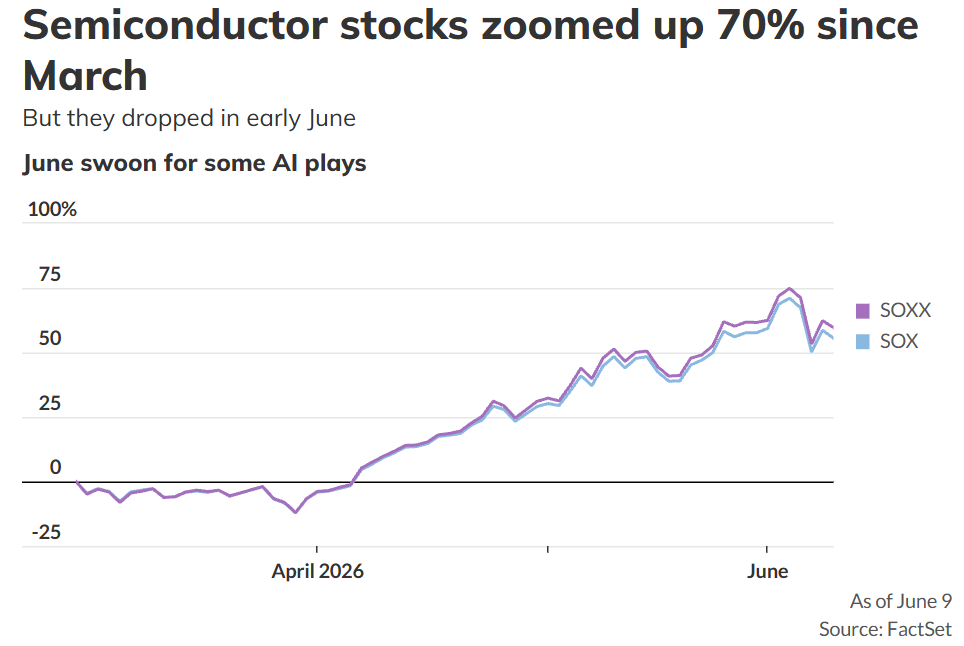
The semiconductor sector has risen approximately 70% cumulatively over the past two months.
Shifting capital flows are reshaping market structure. Ryan Detrick, Chief Market Strategist at Carson Group, pointed out that despite the weakness in tech stocks, nine of the S&P 500’s eleven sectors advanced on Tuesday, with real estate rising 2.1%.
He added that the semiconductor sector’s roughly 70% cumulative gain over the past two months makes a short-term pullback expected, and sector rotation is a crucial mechanism for sustaining a bull market.
Mark Hackett, Chief Market Strategist at Nationwide Investment Management, offered an interpretation from an asset allocation perspective. He suggested institutional investors may be reducing their exposure to tech stocks to prepare for a series of potential large-scale equity offerings, including a possible stock issuance by Meta and IPOs by SpaceX, OpenAI, and Anthropic.
He also noted that approximately 30% of the shares in this SpaceX IPO will be allocated to retail investors, which could prompt some individual investors to reallocate funds in advance. 'For those who are unable to participate in the IPO, many may buy in after the listing,' he said.
Macroeconomic Data Intertwined with Policy Expectations
Market attention is not limited solely to the IPO itself. Wall Street is also awaiting the May Consumer Price Index (CPI) report due Wednesday, followed by the Producer Price Index (PPI). The market widely expects inflation to exceed 4%.
In a Tuesday report, FHN Financial macro strategist Will Compernolle stated that if core CPI—excluding food and energy—comes in below expectations, the Federal Reserve could maintain its policy rate within the 3.5% to 3.75% range, 'with no urgency to move in either direction, remaining confident in labor market resilience while monitoring the risk of future energy price pass-through into core inflation.'
Conversely, if inflation data continues to rise, it could reinforce market expectations of rate hikes in 2026 and further strengthen hawkish positions within the Federal Reserve.
Detrick, however, believes that rising inflation not only compresses room for rate cuts but also reflects improving economic activity—an environment that favors a broadening of market participation beyond narrow hotspots, such as into value stocks.