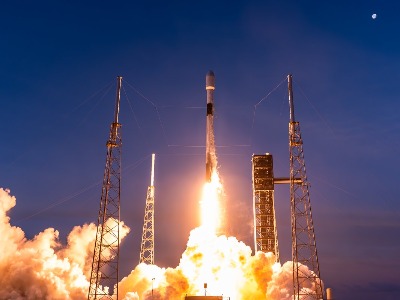
To overcome Earth's power constraints, SpaceX will build a mega-factory named "Gigasat" and fully enter the space-based AI computing market.
The company plans to mass-produce 'AI1' orbital data center satellites, leveraging Starlink technology and reducing costs through vertical integration of its supply chain. It aims to deploy 1 GW of space-based computing capacity by 2027, scale up to 100 GW by 2030, and begin gradual commercialization starting in 2028.
SpaceX is fully pivoting its mass production advantage in satellites toward the space-based AI computing capacity sector.
 The aerospace company led by Elon Musk$Space Exploration Technologies (SPCX.US)$announced the construction of a 11-million-square-foot satellite mega-factory named "Gigasat" in Bastrop, Texas, dedicated to manufacturing orbital AI data center satellites. The goal is to achieve an annualized deployment rate of 1 gigawatt (GW) of space-based AI computing capacity by the end of 2027, scaling this figure to 100 gigawatts by 2030.
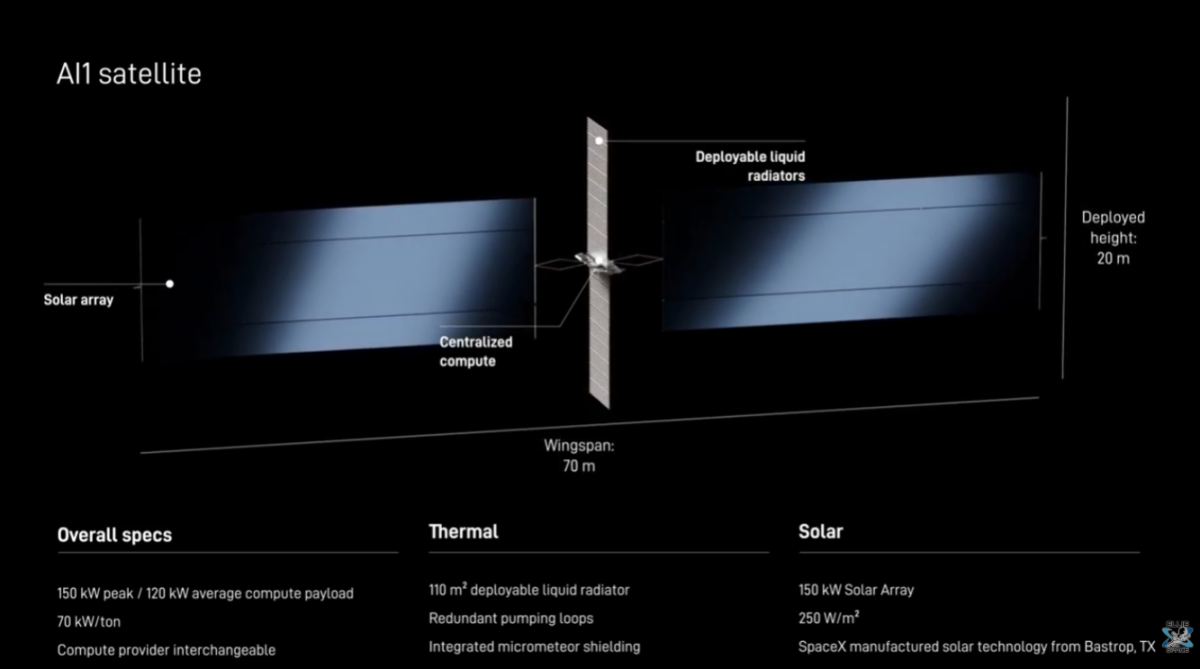
In an internal interview video posted on X on June 8, Musk unveiled for the first time design sketches and core technical specifications of the first-generation AI satellite, "AI1," explicitly stating that the technical challenges of establishing data centers in space are even lower than those faced by its existing Starlink business, adding, "This is not an exceptionally difficult engineering problem for SpaceX."
Analysts note that this statement sends a clear signal to capital markets: SpaceX is seeking to convert its scale advantages in satellite mass production and launch capabilities into a core competitive moat for next-generation AI computing infrastructure.
According to an article by Wall Street News, this disclosure comes just ahead of SpaceX’s anticipated IPO. Musk has positioned orbital AI data centers as the company’s central growth engine, aiming to overcome Earth-based power constraints on AI industry development by relocating massive computing capacity to low Earth orbit.
In its IPO filing, SpaceX noted that the total addressable market for AI—estimated at up to $26.5 trillion—is severely constrained by Earth’s inability to rapidly expand power generation capacity. Solar-powered orbital AI data centers are seen as a critical technological pathway to meet AI companies’ growing energy demands.
Gigasat Factory: More Than Ten Times Larger Than the Current Largest Aerospace Manufacturing Facility
The Gigasat facility spans 1,000 acres with a total building area of 11 million square feet—more than ten times the size of$Space Exploration Technologies (SPCX.US)$the largest existing aerospace manufacturing complex, Starfactory. This facility will enable highly vertically integrated production of AI1 satellites within a single campus, covering the full manufacturing process from solar ingots and wafers, solar cells, printed circuit boards (PCBs), silicon-based electronic components, user terminals, ground gateways, to complete AI1 satellite assembly.
The campus will also include satellite R&D and testing facilities, warehousing and logistics infrastructure, and high-volume AI satellite production lines. Musk revealed that construction of the solar manufacturing facility is already underway, and groundbreaking for the AI satellite production building is imminent, with “substantial-scale” volume shipments expected by the end of 2027.
AI1 Satellite: An NVIDIA Server Rack in Orbit
The AI1 satellite represents$Space Exploration Technologies (SPCX.US)$a concrete implementation of the orbital data center concept. With a wingspan of approximately 70 meters, it features large-area solar arrays delivering a power generation density of 250 W/m², a peak computing power draw of 150 kilowatts, and a sustained average computing power consumption of 120 kilowatts.
According to an article by Wall Street News, Musk stated that this power consumption profile precisely matches the operational power envelope of$NVIDIA (NVDA.US)$NVIDIA’s GB300 server rack (equipped with 72 GPUs), effectively launching an entire NVIDIA AI computing module into space.
To address its extremely high thermal dissipation requirements, the AI1 satellite employs vertically oriented dual-sided radiators achieving a heat rejection density of 1,400 W/m². In orbit, it will adopt a 'blade' orientation directly facing the Sun to maximize thermal radiation, with its computing payload centrally mounted within the structural core.
Architecturally, the AI1 satellite is significantly more streamlined than conventional Starlink satellites. Existing Starlink satellites require complex, large-scale phased-array and parabolic antennas, whereas the AI1 satellite is essentially a large hardware assembly comprising expansive solar arrays, oversized radiators, and basic laser inter-satellite links—eliminating the need for sophisticated Earth-pointing communication antenna systems.
Technology Reuse Creates Manufacturing Barriers
$Space Exploration Technologies (SPCX.US)$The core competitive logic lies in technology reuse. Musk and the engineering team emphasized that the vast majority of technologies required to manufacture the AI1 satellite are directly reused from SpaceX’s already developed and validated Starlink V3 satellite platform. This means the company can leverage its existing experience in mass-producing, launching, and operating satellites without needing breakthroughs at the fundamental scientific level, effectively transferring this expertise to its AI satellite business.
To achieve an annual deployment of 1 gigawatt of AI computing capacity in space by the end of 2027, SpaceX would need to launch more than 6,000 AI1 satellites in a single year. For context, as of June 2026, Starlink had approximately 10,500 active satellites in orbit.
The Scale of a Hundred Gigawatts: Equivalent to Building 20 Meta-Scale Hyperscale Data Centers Annually
Musk has outlined an exceptionally ambitious expansion roadmap for this initiative: reaching 1 gigawatt of annualized computing capacity by the end of 2027, scaling by an order of magnitude each year thereafter—10 gigawatts by 2029 and 100 gigawatts by 2030—with terawatt-scale space-based computing capacity as the ultimate goal, contingent on concurrent advances in chip manufacturing technology.
What does a scale of 100 gigawatts signify? The largest AI data center project announced to date is$Meta Platforms (META.US)$Hyperion in Louisiana, with a designed capacity of up to 5 gigawatts and an investment exceeding $100 billion. Its first phase, delivering 2 gigawatts, is not expected to be completed until 2030.
xAI’s Colossus 2 facility in Memphis has just been expanded to nearly 2 gigawatts, equipped with 555,000 GPUs at a cost of approximately $18 billion, making it the world’s largest single-site AI infrastructure to date. One hundred gigawatts is roughly equivalent to building 20 Hyperion facilities or 50 Colossus 2 facilities annually.
Despite its massive scale, the commercial viability of space-based computing remains a subject of debate within the industry.
According to an article by Wall Street News, Blue Origin, Amazon founder Jeff Bezos, and researchers such as Andrew McCalip have pointed out that expensive AI chips and high launch costs currently pose major obstacles, rendering existing economic models unviable at this stage.
In response, SpaceX is attempting to overcome cost bottlenecks through vertical integration of its supply chain: on one hand, relying on the Starship heavy-lift rocket to significantly reduce per-launch costs, and on the other, advancing a planned facility called Terafab to co-develop and manufacture its own AI chips with$Tesla (TSLA.US)$and$Intel (INTC.US)$partners, aiming to produce chips equivalent to 1 terawatt of computing power annually—approximately 100 million to 200 million advanced-node chips—within a 1-million-square-foot factory. However, the Terafab initiative itself faces widespread skepticism: none of the three partners has prior chip manufacturing experience, yet they are directly targeting the cutting-edge 2-nanometer process node.
On the issue of latency, SpaceX has proposed a clear technical solution: AI1 satellites will operate in low Earth orbit at altitudes of 600 to 800 kilometers, achieving one-way network latency of only about 3 milliseconds. They will be integrated with inter-satellite laser links offering up to 1 terabit per second of bandwidth and will utilize either Starlink’s existing Ka- and Ku-band antenna networks or satellite-to-ground laser links for high-speed data downlink.
Elon Musk himself has advised investors to remain cautious about aggressive timelines. SpaceX’s IPO filing presents a more conservative official outlook, projecting a gradual commercial rollout beginning in 2028.
Want to select stocks or get a stock diagnosis? Curious about the opportunities and risks in your portfolio? For all your investment questions,Just ask Futubull AI!

Editor/melody