
Fourth-quarter revenue rose 21% year-over-year to $19.2 billion, exceeding the expected $19.09 billion. Cloud infrastructure revenue surged 93% year-over-year to $5.8 billion. The company reported a record backlog of $638 billion, an increase of $85 billion from the previous quarter. First-quarter revenue growth is expected to accelerate to 27%–29%, and full-year FY2027 non-GAAP earnings per share guidance was raised to $8.05. The company plans to raise an additional $20 billion through debt and equity financing, sparking market concerns and causing its after-hours share price to drop more than 7%.
$Oracle (ORCL.US)$ Announced fourth-quarter and full-year results as of the end of May 2026, with strong growth in cloud infrastructure driving multiple financial metrics to record highs. The company simultaneously raised its full-year earnings guidance and expects cloud business growth to accelerate to nearly 60% in the next fiscal quarter.
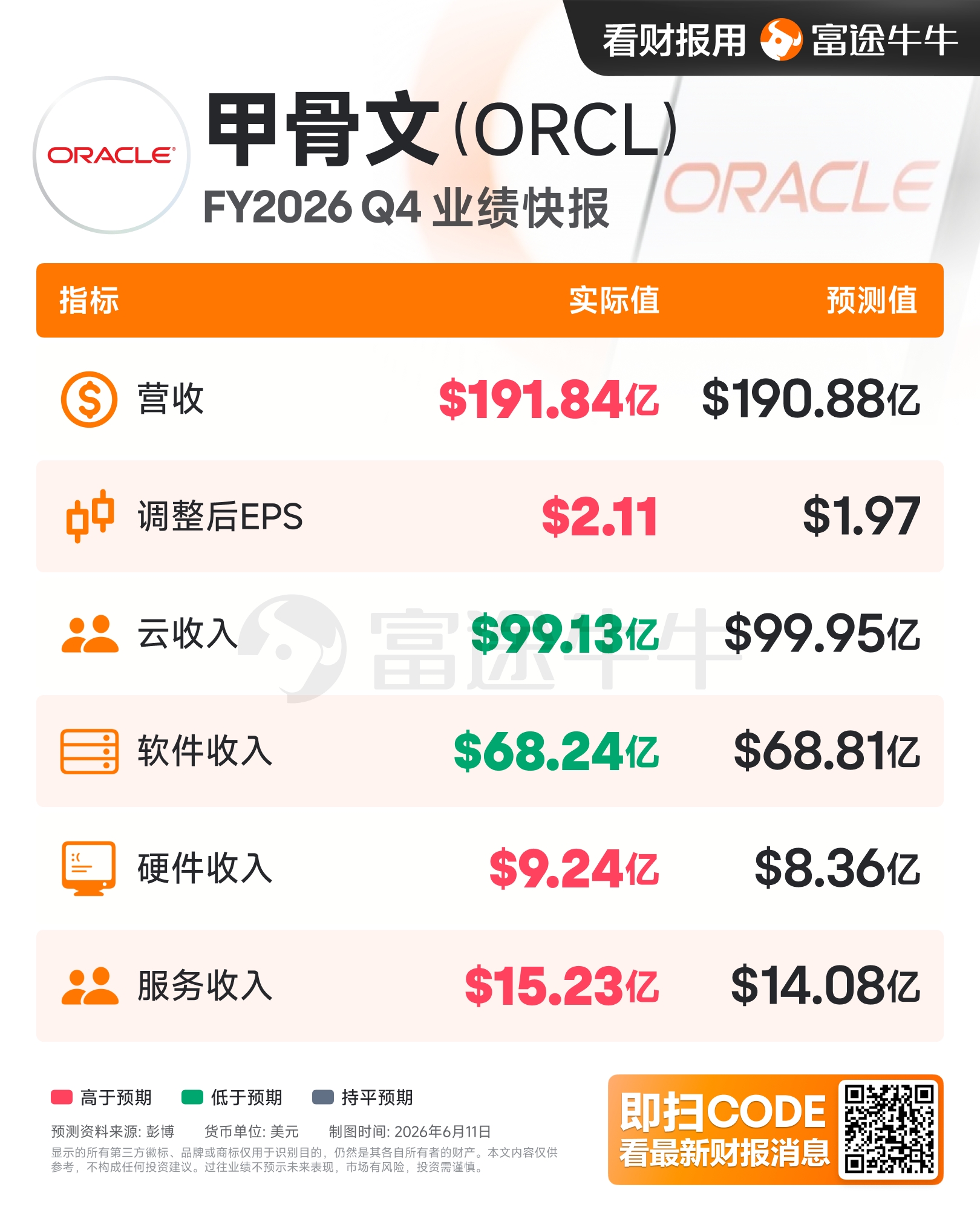
Total revenue for the fourth quarter rose 21% year-over-year to $19.2 billion, exceeding the consensus expectation of $19.09 billion. Cloud infrastructure revenue surged 93% year-over-year to $5.8 billion, serving as the primary driver of overall performance.
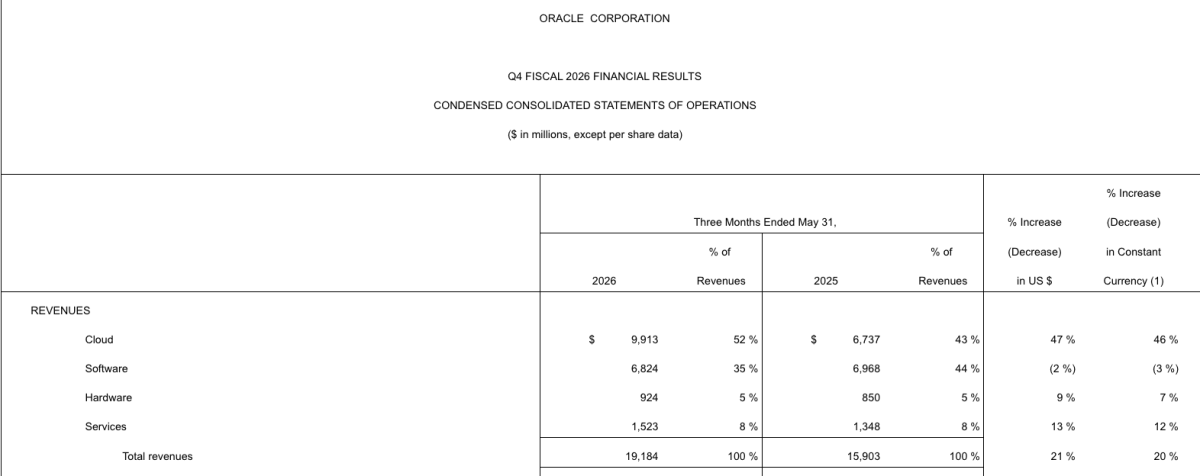
 More significantly, as of quarter-end, the company’s remaining performance obligations (RPO) increased by a net $85 billion from the prior quarter, reaching a record $638 billion—a 363% year-over-year increase—highlighting substantial market demand for AI-powered cloud services.
In its forward guidance, Oracle projected first-quarter total revenue growth to accelerate to 27%–29%, with cloud revenue growth further rising to 57%–64%. The company maintained its full-year FY2027 revenue target at $90 billion but raised its non-GAAP earnings per share guidance to $8.05, representing an approximate 18% year-over-year increase.
Oracle stated it expects to raise $40 billion through debt and equity financing, including the previously announced $20 billion stock offering. The announcement sparked investor concerns, sending its after-hours share price down by more than 10%.
Record-breaking revenue across all segments, led by cloud business
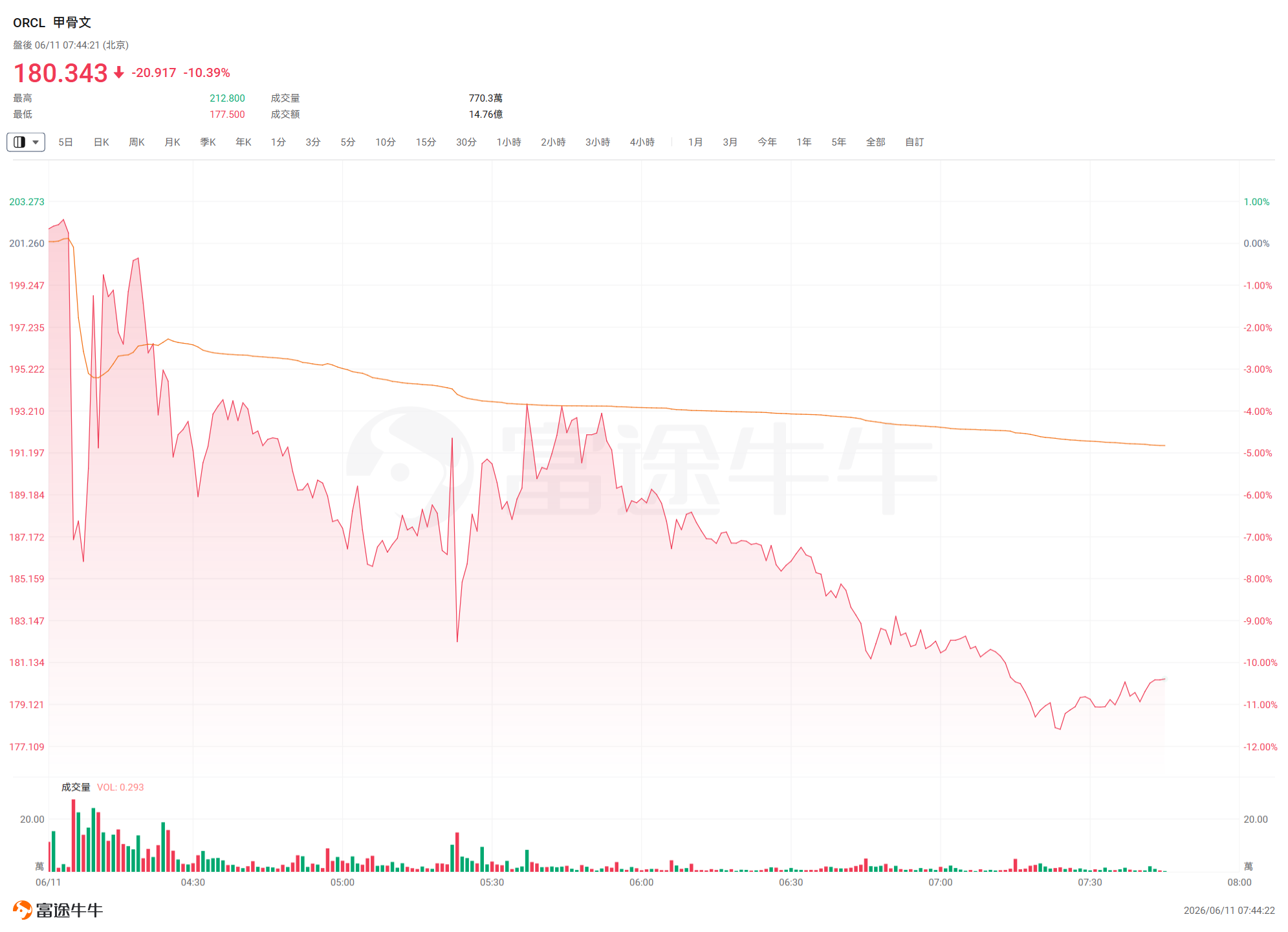
In the fourth quarter, Oracle’s total revenue grew 21% year-over-year to $19.2 billion, with combined cloud revenue (IaaS + SaaS) increasing 47% year-over-year to $9.9 billion—marking the first time it surpassed the $10 billion threshold.
By segment, cloud infrastructure (IaaS) revenue surged 93% year-over-year to $5.8 billion, emerging as the fastest-growing core engine; cloud applications (SaaS) revenue rose 10% year-over-year to $4.1 billion. Traditional software revenue declined 2% year-over-year to $6.8 billion, reflecting ongoing customer migration to the cloud. Services revenue totaled $1.3 billion, up 13% year-over-year, while hardware revenue reached $900 million, a 9% year-over-year increase.
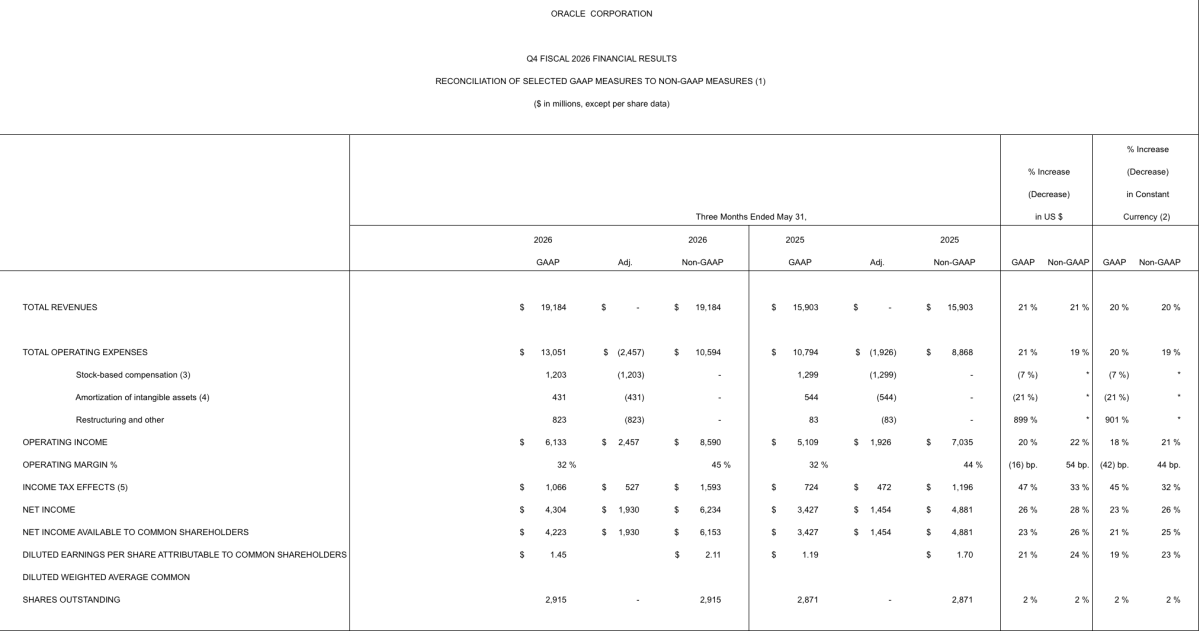
On profitability, fourth-quarter non-GAAP operating income rose 22% year-over-year to a record $8.6 billion, and non-GAAP earnings per share increased 24% year-over-year to $2.11. GAAP earnings per share rose 21% year-over-year to $1.45.
For the full year, FY2026 total revenue grew 17% year-over-year to a record $67.4 billion, with cloud revenue up 39% year-over-year to $34 billion. Full-year operating cash flow increased 54% year-over-year to a record $32 billion, underscoring strong cash-generating capacity. However, due to sustained large-scale investments in cloud infrastructure, free cash flow for the year was negative $23.7 billion.
In its earnings report, Oracle highlighted its strategic AI initiatives in the healthcare sector. The company stated it will launch a new AI-powered version of its Cerner hospital and clinic patient management system, which is expected to drive double-digit growth for Oracle Health’s overall business by fiscal year 2027.
The company also noted that its AI-driven molecular design models could accelerate new drug development, and its newly launched AI clinical trial system aims to help regulatory agencies review and approve clinical trial results more quickly, thereby reducing patients’ waiting time for access to new therapies.
Surge in Large AI Contracts Drives Record-Breaking Backlog of Revenue Yet to Be Recognized
RPO (Remaining Performance Obligations) was one of the most closely watched metrics in this earnings report. As of the end of the fourth fiscal quarter, Oracle’s RPO reached $638 billion, with a net addition of $85 billion during the quarter, representing a year-over-year increase of 363%.
The company disclosed that the substantial RPO growth in the third and fourth fiscal quarters primarily stemmed from large-scale AI contracts. These contracts feature a unique structure: either customers prepay for Oracle to procure GPUs, or customers purchase GPUs themselves and provide them to Oracle for use. To date, the combined amount of such prepayments and customer-provided hardware totals $75 billion.
Oracle stated that this arrangement has significantly reduced the amount of capital the company needs to raise to build out its AI data centers.
Also noteworthy is Oracle’s Multicloud AI Database business, which grew 404% year-over-year in the fourth fiscal quarter, making it the fastest-growing business line in the company’s history.
Heavy Capital Expansion: $48 Billion Raised in FY2026, Additional $40 Billion Planned for FY2027
To support the large-scale expansion of its AI cloud infrastructure, Oracle has entered an intensive financing cycle. In fiscal year 2026, the company raised $43 billion through debt financing and $5 billion through equity financing, totaling $48 billion.
Looking ahead to FY2027, the company expects to raise approximately $40 billion through a combination of debt and equity financing, including a previously announced $20 billion at-the-market (ATM) equity offering program. The company also stated it will not issue any additional debt financing within calendar year 2026.
Persistently negative free cash flow reflects the high intensity of capital expenditures during the current expansion phase. The company has introduced a clean energy solution centered on natural gas fuel cells in its data center construction and is leveraging high-performance networking, advanced security architecture, and autonomous software as key differentiators.
Guidance for next quarter indicates revenue growth of 27% to 29%.
In its forward guidance, the company expects total revenue for the first fiscal quarter to increase by 27% to 29% year-over-year; cloud revenue is projected to grow by 57% to 64% year-over-year; and non-GAAP earnings per share are expected to range from $1.72 to $1.76, representing a 17% to 20% year-over-year increase.
For the full fiscal year 2027, the company maintains its total revenue target of $90 billion and has raised its non-GAAP earnings per share guidance to $8.05.
The company noted that, excluding the one-time investment gains from the sale of its Ampere chip business and Bloom Energy warrants in FY2026, non-GAAP earnings per share growth for FY2027 is expected to be approximately 18%.
Oracle's Board of Directors announced a quarterly cash dividend of $0.50 per share, payable on July 24, 2026, to shareholders of record as of July 10, 2026.
Want to select stocks or get a stock diagnosis? Curious about the opportunities and risks in your portfolio? For all your investment questions,Just ask Futubull AI!

Editor/joryn