
① Zhipu AI and MiniMax were officially added to the Hang Seng Tech Index on June 8, marking a pivotal adjustment reflecting a strategic tilt toward hard-tech weighting.
② Compared with Anthropic, the market has assigned both Hong Kong-listed AI leaders a valuation premium above that of leading global AI companies.
③ With the global listing window opening for large AI model firms, the valuation logic for Zhipu AI and MiniMax is expected to shift toward value validation.
 Against the backdrop of HK$1.35 trillion in share lock-up expirations scheduled for this year in the Hong Kong market, $KNOWLEDGE ATLAS (02513.HK)$and$MINIMAX-W (00100.HK)$both companies were officially included in the Hang Seng Tech Index on June 8, yet face the expiration of their initial public offering (IPO) lock-up shares in early July—a narrow time gap drawing significant market attention.
On June 8, the Hang Seng Tech Index and Stock Connect underwent concurrent constituent adjustments. Zhipu AI and MiniMax were newly added as index constituents, while Kingdee International and Kingsoft Corporation were removed. Zhipu AI, structured under a standard equity framework, was simultaneously included in Stock Connect upon its addition to the index. MiniMax, due to its weighted voting rights structure, is expected to enter Stock Connect no earlier than August. The inclusion failed to bolster share prices: following declines on June 9, Zhipu AI and MiniMax closed down 7.75% and 2.71%, respectively, as of June 10.
Expectations of enhanced liquidity from index inclusion intersect with multiple catalysts: the July lock-up expiration window, the global wave of AI mega-IPOs, and both firms’ parallel initiatives to pursue secondary listings on China’s A-share market. The valuation framework for Hong Kong-listed AI assets is undergoing a critical transition—from scarcity-driven pricing to fundamentals-based validation.
Inclusion of Zhipu AI and MiniMax boosts the 'AI exposure' of the Hang Seng Tech Index
On June 8,$KNOWLEDGE ATLAS (02513.HK)$and$MINIMAX-W (00100.HK)$they officially joined the list of constituent stocks of the Hang Seng Tech Index. Industry analysts view this inclusion as formal recognition of large AI model enterprises entering the core technology benchmark of the Hong Kong stock market. From an index composition perspective, this move is also seen as a key attempt by the Hang Seng Tech Index to pivot toward core hard-tech assets.
In terms of price performance,$Hang Seng TECH Index (800700.HK)$the index has posted a year-to-date decline of nearly 13%, consistently underperforming both the Hang Seng Index and other global technology indices, and remaining virtually 'invisible' amid the broader AI rally. Analysts attribute this weakness not to broad-based selling but rather to structural divergence within the market.
Currently, the index’s weighting and core holdings remain concentrated in traditional internet platforms, whereas this year’s global tech rally has been led by hard-tech segments such as AI computing power and semiconductors. This misalignment has disconnected the index from the prevailing global tech narrative. Additionally, Hong Kong equities are highly sensitive to shifts in overseas liquidity conditions; fluctuating risk appetite among international investors and persistent outflows of northbound capital from key index constituents have likely exacerbated valuation pressures.
Against this backdrop, a key focus following their inclusion is whether the addition of these two new large-model companies can meaningfully improve the sectoral diversification of the Hang Seng Tech Index.
According to research by Dongwu Securities, the Hang Seng Tech Index in June this year may continue its pattern of “supported by low valuations, lacking upward momentum, and experiencing repeated range-bound volatility.” Low valuations, index rebalancing, and AI industry catalysts help stabilize the downside; however, overseas inflation, FOMC uncertainty, weakening liquidity conditions, and profit realization among core heavyweight constituents still constrain the index’s potential for a sustained uptrend.
Currently,$KNOWLEDGE ATLAS (02513.HK)$、$MINIMAX-W (00100.HK)$The two newly listed stocks carry relatively low actual weightings in the index, and uncertainties—including elevated valuations, July share lock-up expirations, and potential equity dilution from potential A-share listings—limit their immediate upside impact on the index’s overall trajectory. The Hang Seng Tech Index needs not only new AI entrants but also its core heavyweights to reassert their commercial viability and revenue-generating capacity in the AI era.
Global mega-cap AI IPO windows may reshape valuation anchors
The liquidity expectations stemming from index inclusion and Stock Connect eligibility have not fully offset valuation pressures. In the second half of 2026, Anthropic, OpenAI, and SpaceX are expected to enter the public listing process sequentially, with a combined valuation exceeding USD 1 trillion. Once these global premier AI assets become publicly traded, valuation benchmarks for Hong Kong-listed large language model (LLM) companies may shift from scarcity-driven narratives to fundamentals-based, verifiable metrics.
Taking Anthropic as a reference, its latest funding round valued the company at approximately USD 965 billion, with annualized recurring revenue (ARR) of about USD 47 billion, implying a price-to-ARR (P/ARR) multiple of roughly 20x. The company is also expected to achieve profitability by Q2 2026.
In contrast, the two Hong Kong-listed companies show significantly higher valuation multiples. Zhipu AI currently has a market capitalization of approximately USD 64 billion, with ARR between USD 250 million and USD 500 million, resulting in a P/ARR multiple of 128x–270x. Even if it achieves its year-end target of USD 1 billion in ARR, its P/ARR would remain elevated at 64x. MiniMax has a current market cap of around USD 27.4 billion and ARR of approximately USD 300 million, yielding a P/ARR of about 60x. The company aims to reach stable annual revenue of USD 1 billion by year-end, which would reduce its P/ARR to roughly 19x.
By comparison, the market has$KNOWLEDGE ATLAS (02513.HK)$and$MINIMAX-W (00100.HK)$assigned both companies valuation premiums higher than those of leading global AI firms, a premium largely driven by the prior scarcity of AI large-model listings on the Hong Kong stock exchange. As more global AI large-model companies go public, this scarcity will diminish, putting downward pressure on the elevated valuations of these two Hong Kong-listed large-model firms.
From a business model perspective, the valuation divergence between the two companies also reflects the market’s differential pricing of B2B certainty versus B2C uncertainty. Zhipu AI primarily serves enterprise clients, with over 70% of its revenue derived from customized AI services and on-premise deployments for domestic enterprises and government entities—characterized by stable client relationships and strong payment capacity. MiniMax, by contrast, has pursued a more application-layer, consumer-facing (B2C) strategy; however, its recent adjustment to API pricing triggered backlash from developer communities, ultimately requiring public apologies and compensation—a clear indication of the fragility of B2C commercialization models in achieving sustainable monetization.
As more large language model companies enter public markets, AI valuation logic may shift toward hard metrics such as revenue growth rates, gross margins, compute cost efficiency, and the pace of loss reduction.
July share lock-up expirations approach
More pressing than valuation narratives is the upcoming peak in lock-up expirations in July. According to Wind data, 29 Hong Kong-listed companies will see share lock-ups expire in July, among which$KNOWLEDGE ATLAS (02513.HK)$、$MINIMAX-W (00100.HK)$rank among the highest in terms of market value of shares to be unlocked.
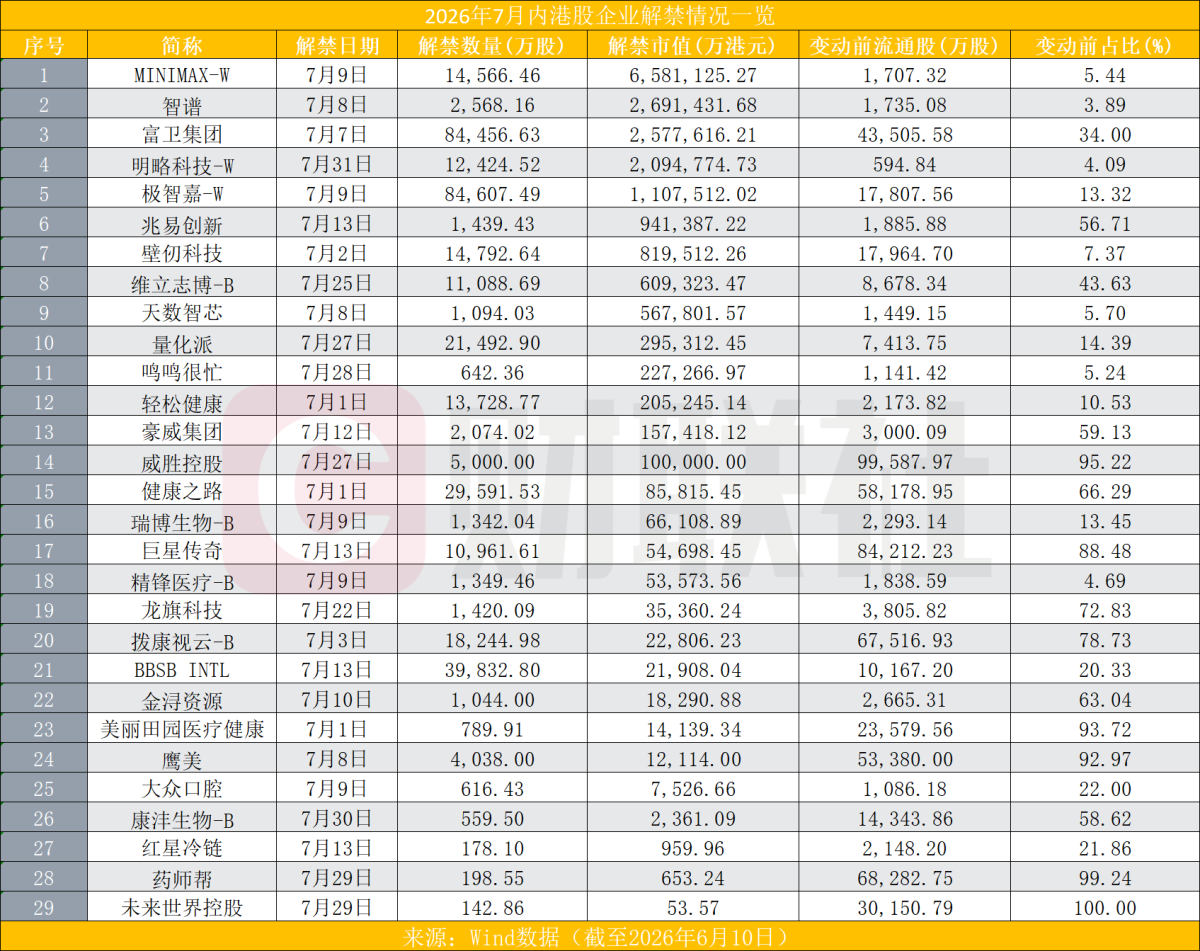
Zhipu AI will be the first to experience its initial post-IPO lock-up expiration. On July 8, 25.6816 million shares will become tradable, representing a current market value of approximately HK$26.914 billion. Prior to this release, its freely tradable shares amounted to only about 17.3508 million, or less than 4% of total issued shares.
One day later,$MINIMAX-W (00100.HK)$faces even greater unlocking pressure. On July 9, 146 million shares will become tradable, corresponding to an estimated unlock market value of approximately HK$65.811 billion at current prices. More critically, a significant proportion of these shares are held by financial investors who have already realized substantial unrealized gains since the IPO; thus, the unlocking window often intensifies their incentive to take profits.
July 9 marks the single day with the highest concentration of lock-up expirations in the month, as five Hong Kong-listed companies will simultaneously release shares. In addition to MiniMax, Dazhong Stomatological, Geekplus-W, Ribo Biopharma-B, and Jingfeng Medical-B will release 6.1643 million, 846 million, 13.4204 million, and 13.4946 million shares, respectively.
Overall, multiple companies across the AI supply chain will see their locked-up shares released concurrently in July. This wave of expirations could serve as a critical test of the underlying quality of AI-related assets listed in Hong Kong.
Both companies announce plans to list on the A-share market simultaneously, shifting focus from valuation to value validation.
As the lock-up expiration window approaches, both companies have nearly simultaneously announced their intentions to pursue A-share listings. Rather than seeking higher valuations, these financing plans appear to be driven more by intensifying industry competition—a strategic necessity under mounting pressure.
The global AI race has now entered a phase of capital expenditures measured in hundreds of billions of dollars. Google has raised its projected capital spending for 2026 to between USD 180 billion and USD 190 billion, while its parent company Alphabet plans to raise USD 80 billion through equity issuance to fund AI infrastructure development. Against this backdrop of massive investment by global leaders, unprofitable Hong Kong-listed large-model companies face undeniable financing pressures.
Developing large AI models requires sustained, intensive investment in computing power.$KNOWLEDGE ATLAS (02513.HK)$Its R&D expenditure in 2025 is projected to reach RMB 3.18 billion, more than four times its revenue for the same year; MiniMax is expected to report an adjusted net loss of approximately USD 250 million in 2025, and with the surge in token consumption driven by the rapid adoption of Agent technologies, its future funding requirements will only continue to grow.
As scarcity-driven premiums fade, whether Zhipu AI and MiniMax can transition their valuations from speculative positioning to fundamental value validation may become a key indicator for the broader Hong Kong AI sector.
Editor/melody