
A series of alternative measures are helping keep international oil prices below $100 per barrel. Among these, an increasing number of Gulf energy-producing countries are secretly shipping crude oil and other energy products to international markets, alleviating supply disruptions.
According to Zhitong Finance, since the outbreak of Middle Eastern hostilities in late February led to the closure of the Strait of Hormuz—a critical global energy transit chokepoint—the global energy market has faced its most severe supply shock in history, with over 1 million barrels per day of Middle Eastern crude supply disrupted. Nevertheless, a series of alternative measures are helping maintain international oil prices below $100 per barrel, sharply contrasting earlier industry pessimism that prices could surge to $200 per barrel. A key alternative measure involves an increasing number of Gulf energy producers secretly exporting crude oil and other energy products to international markets, thereby mitigating the supply shock.
Middle Eastern Crude Oil Secretly Navigates the Strait of Hormuz
 It is reported that Kuwait recently used a tanker under its control to transport a shipment of liquefied petroleum gas (LPG) out of the Persian Gulf through the Strait of Hormuz. According to traders, Kpler Ltd., and vessel-tracking data, the 'Gas Umm Al Rowaisat,' operated by the shipping division of Kuwait Petroleum Corporation (KPC), transited the Strait of Hormuz and transferred its LPG cargo to another vessel, which is currently en route to India.
Specifically, according to Kpler data, the 'Gas Umm Al Rowaisat' loaded LPG at Kuwait’s Mina Al-Ahmadi refinery on May 28 while its Automatic Identification System (AIS) was deactivated. The vessel reappeared near Sikka off India’s northwest coast on June 7. Traders, vessel-tracking data, and Kpler indicate that the 'Gas Umm Al Rowaisat' subsequently transferred its cargo via ship-to-ship (STS) transfer to the Very Large Gas Carrier (VLGC) 'Badrinath,' leased by KPC. This vessel turned off its positioning signal after completing loading last month and reappeared near Indian waters last Sunday. It is now showing Paradip Port in India as its destination.
Kuwait is not an exception. Major energy-producing countries including the UAE, Saudi Arabia, and Qatar are increasingly adopting this covert method to export crude oil and liquefied natural gas (LNG).
Ciaran Tyler, Chief Research Analyst at Kpler, stated: 'In recent weeks, UAE cargoes have successfully been transported using this method, so it’s unsurprising that other countries are following suit.' He noted that the UAE began employing this strategy last month to ensure uninterrupted LPG supplies to its key buyer, India.
Over the past weekend, sixteen tankers gathered near the Omani coast to conduct ship-to-ship transfers of several million barrels of crude oil previously stranded in the Persian Gulf. These tankers first moved the crude out of the Strait of Hormuz with their positioning transponders switched off, then transferred the cargo via ship-to-ship operations onto other vessels destined for Asia and other regions. Sources familiar with the matter revealed that some vessels crossed the strait at night with lights extinguished, and crews were instructed to maintain radio silence throughout the passage.
Notably, these tankers are predominantly owned by Gulf energy-producing governments, enabling them to avoid paying exorbitant freight rates demanded by the few private shipowners willing to risk transiting the Strait of Hormuz. These government-owned vessels are forming an expanding network of a 'shadow fleet,' restoring crude flows that had nearly come to a standstill.
Larry Johnson, Head of Freight at commodities trader Mercuria Energy Group, commented: 'We are indeed observing an increase in this trend. The vessels successfully navigating the strait appear to be primarily—if not exclusively—government-owned.' He added, 'These vessels seem to have access to certain communication channels and methods ensuring safe passage.'
Meanwhile, according to U.S. President Trump, the U.S. military has secretly assisted more than 200 commercial vessels in transiting the Strait of Hormuz. On June 10, Trump posted on social media that he had ordered the U.S. military last month to carry out a covert operation to support oil tankers and other commercial ships passing through the Strait of Hormuz. He stated that this operation has already enabled 'over 100 million barrels of crude oil to successfully transit the strait and enter the open market, with more than 200 commercial vessels safely passing through.' He further asserted that 'it is the United States—not Iran—that controls the Strait of Hormuz.'
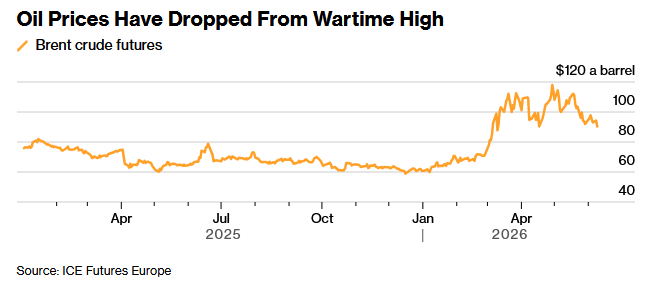
Additionally, speaking to the media at the White House, Trump said the U.S. 'has been shipping out millions of barrels of oil—something Iran didn’t know about until just recently.' He added that this was the reason why oil prices are currently around $85–90 per barrel rather than soaring to $250 per barrel.
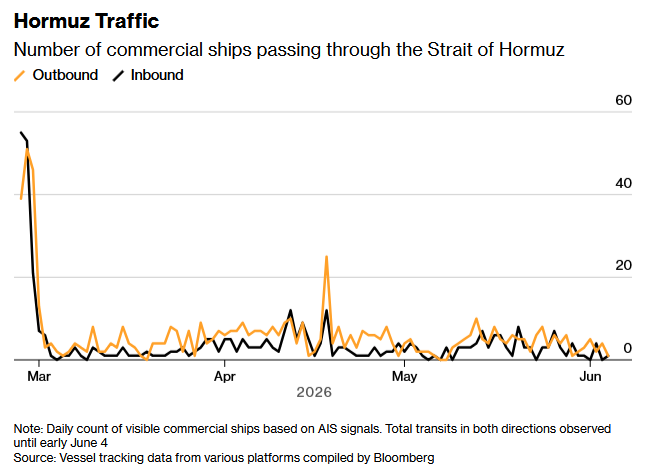
Although traditional vessel tracking data shows little change in shipment volumes, shipping executives, Asian crude buyers, and satellite imagery paint a starkly different picture: restrictions on the Strait of Hormuz have significantly eased, transit has become more stable, and shipping volumes are increasing. TankerTrackers.com, which uses satellite-based vessel tracking, reported that on June 6 alone, it observed 12 vessels carrying non-Iranian Middle Eastern crude conducting ship-to-ship transfers outside the Strait of Hormuz.
Shipping data indicate that, prior to the recent wave of 'stealth voyages,' approximately one-quarter of the large non-Iranian tankers stranded inside the Persian Gulf had already managed to break free. Georgios Sakellariou, a freight analyst at Signal Maritime, noted that around 90 large tankers remain stuck in the Persian Gulf, down from roughly 160 in early April. He stated, 'An increasing number of vessels are disabling their tracking systems to cross the strait. This trend is clearly evident from the declining volume of crude oil held up inside the Persian Gulf.' However, he added, 'Current shipping volumes are still insufficient to return to pre-conflict levels.'
Oil Prices Withstand Historically Largest Supply Shock, but Risks of Price Rebound Cannot Be Ignored
Further signs have recently emerged indicating that Middle Eastern crude continues to flow steadily into international markets. Over the past few days, both Kuwait and the UAE have offered crude sales with delivery terms outside the Strait of Hormuz. Satellite imagery shows that major crude export terminals in the UAE have been continuously loading vessels over the past several weeks.
Market traders also report that Asian buyers are now receiving an increasing number of offers for Middle Eastern crude that has successfully transited the strait, with expectations of even more supply becoming available in the coming days to weeks.
Data show that at least two very large crude carriers (VLCCs), each capable of transporting 2 million barrels of crude, successfully transited the Strait of Hormuz at the end of last month and have since begun transmitting positioning signals off the coast of Kuwait. An unnamed shipowner stated that their company has contracted to transport crude transferred from Kuwaiti vessels that successfully crossed the strait. Other sources indicated they believe Kuwait has secured safe passage arrangements for at least two VLCCs.
Iraq is also accelerating crude loading at its main export terminals and increasing the volume of oil shipped out of the Persian Gulf. Tanker tracking data show that so far this month, approximately 7 million barrels of Iraqi crude—either loaded at southern Basra port or observed exiting via the Strait of Hormuz—have been recorded. This figure already matches the total crude loading and export volumes for both April and May combined. Previously, a group of tankers carrying Iraqi crude that had been stranded for an extended period began departing in late May.
Although current shipment volumes remain far below pre-conflict levels, energy consultancy Rapidan Energy Group estimates that approximately 2 million barrels per day of crude oil and related products are now being exported from the Persian Gulf through various means.
This additional supply indicates that, despite the Middle East conflict triggering the largest supply disruption in crude oil market history, the market has successfully delivered sufficient crude to buyers. Combined with a surge in U.S. crude exports and alternative pipeline routes spanning hundreds of miles across the Middle East, international oil prices have fallen nearly 30% from their wartime peaks. Pre-existing oversupply also partially cushioned the shock, as did coordinated government releases of strategic petroleum reserves on an unprecedented scale, which further alleviated market pressure.
Maria Angelicoussis, CEO of Angelicoussis Group—one of Greece’s largest shipowning groups—previously stated: 'After more than three months of conflict, the world has shown surprising resilience. Commodity prices rose by 50% to 60%, and Asian LNG prices surged by 90%, but they did not reach the extreme highs that I, at least personally, had initially anticipated.'
Currently, oil prices remain far below the $200-per-barrel level that many analysts initially feared, leaving room for Trump to negotiate with Iran. Although Trump has repeatedly emphasized that a peace agreement is within reach, should oil prices experience another sustained spike, the White House would face mounting pressure to finalize a deal swiftly to avoid inflicting damage on the global economy.
Meanwhile, global crude oil inventories are declining at a record pace, making the market increasingly vulnerable to new supply disruptions. As spare capacity continues to dwindle, even relatively minor production outages could trigger sharp price spikes.
According to calculations by Goldman Sachs, global crude oil inventories stood at 101 days of demand as of the end of April, falling to 98 days by the end of May—breaking below the '100-day warning threshold.' This '100-day line' is widely regarded by the industry as a critical psychological and practical benchmark for energy security. Once breached, it signifies a significant erosion of the market’s buffer capacity, increasing the likelihood of oil prices oscillating at elevated levels. In a low-inventory environment, any additional supply disruption could provoke severe price volatility.
Against the backdrop of persistent geopolitical tensions disrupting global energy markets, the U.S. Strategic Petroleum Reserve (SPR) is declining at a pace rarely seen in recent years, while commercial stockpiles are also approaching multi-decade lows. According to data from the U.S. Energy Information Administration (EIA), the SPR has declined by approximately 10% since this spring, falling to around 374 million barrels—the lowest level since July 2024.
Toril Bosoni, Head of the Oil Industry and Markets Division at the International Energy Agency (IEA), warned that if global crude inventories continue to decline at the current rate, stock levels could hit a critical threshold before the summer peak demand season arrives. This could prompt the IEA to coordinate another emergency release of reserves. However, Bosoni noted that such emergency drawdowns are only temporary measures and cannot resolve underlying supply shortages. The scale of lost crude supply is so substantial that demand must contract significantly to restore balance.
Greg Sharenow, head of the commodities investment team at Pacific Investment Management Company (PIMCO), stated: 'Each week that passes, the system loses another 70 to 80 million barrels of inventory. You simply can’t sustain that indefinitely.' He added, 'Over the coming months, conservatively speaking, you’ll be dealing with a system that has markedly reduced flexibility, as these buffer stocks have already been heavily depleted.'
S&P Global Energy estimates that shipping restrictions in the Strait of Hormuz have disrupted the potential flow of over 1.2 billion barrels of crude oil. Tom Baker, head of Vitol Bahrain—one of the world’s largest independent oil traders—noted that regardless of how quickly production recovers, 'there will ultimately be a gap—call it what you will—that represents a missing 1 billion barrels of oil.'
Moreover, recent renewed hostilities between the United States and Iran have cast doubt on the prospects for negotiations between the two countries. Over two consecutive days of clashes, the scale and scope of U.S. military operations have expanded, while Iran’s stance and actions have grown increasingly assertive.
In the early hours of June 11 local time, the Islamic Revolutionary Guard Corps (IRGC) Navy announced that the Strait of Hormuz had been closed indefinitely due to repeated U.S. violations of the ceasefire agreement. The IRGC warned that no vessels were permitted to depart from their anchorages in the Persian Gulf and the Gulf of Oman, and any attempt to approach the Strait of Hormuz would be regarded as 'collaboration with the enemy.' Iran also dismissed U.S. claims regarding vessel transits through the Strait. On June 11 local time, the IRGC Navy stated that two vessels attempting to illegally pass through the Strait of Hormuz had been struck. Iran has not yet released further details about the incident.
If Iran tightens its control over the Strait of Hormuz, disrupting covert crude oil shipments from Gulf producers, and global crude inventories continue to dwindle, the oil market may be forced to confront what could become the largest supply shock in history, potentially driving international oil prices higher once again.
Editor/Deng