
Following reports that OpenAI is considering a significant reduction in token prices, Gary Marcus—a long-time skeptic of the large language model industry—warned that the company could be heading toward a "WeWork moment." This move exposes the commercial dilemma faced by AI giants: lacking sustainable competitive advantages and relying on burning cash to retain customers. The price war not only pressures OpenAI's IPO prospects and its high-valuation narrative but could also ripple through$NVIDIA (NVDA.US)$upstream segments of the ecosystem.
Long-standing doubts about the existence of a defensible moat in the AI industry are now coming to the fore amid an intensifying price war. After reports emerged that OpenAI is contemplating a sharp cut in token pricing, Gary Marcus characterized the move as a "sign of weakness" and reiterated his prediction from several years ago—that OpenAI might be approaching a "WeWork moment."
According to prior media reports, OpenAI is evaluating a plan to substantially lower token pricing for its AI services, directly targeting rival Anthropic. Marcus promptly warned on social media that this tactic amounts to "burning money to retain customers," further evidence of OpenAI’s mounting difficulties, and predicted that if OpenAI begins to falter, $NVIDIA (NVDA.US)$ 、 $Oracle (ORCL.US)$ and$CoreWeave (CRWV.US)$companies across its ecosystem could face significant spillover effects.
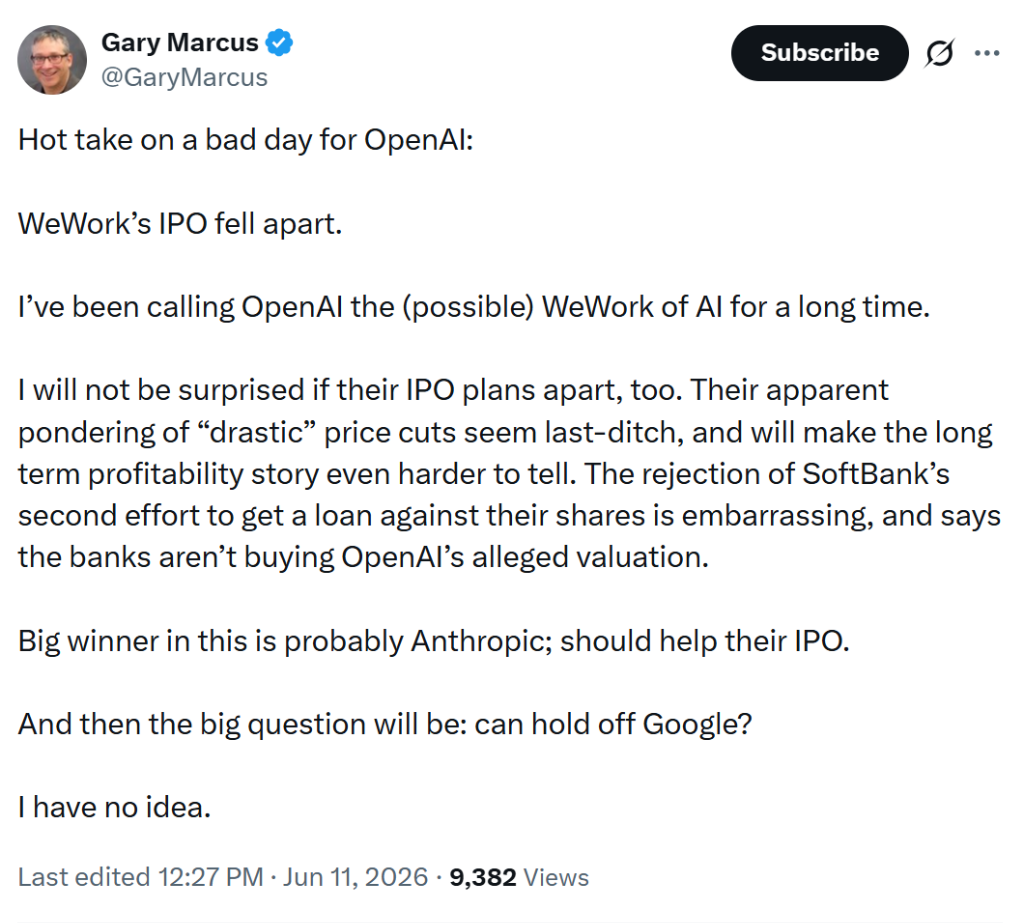
 This situation poses a particularly thorny challenge for OpenAI’s IPO prospects. The company secretly filed its listing application this week, and investors will closely scrutinize whether its price-cutting strategy can effectively capture market share without exacerbating losses—this will be central to assessing its valuation at IPO. Meanwhile, SoftBank’s second attempt to secure a loan using OpenAI shares as collateral was reportedly rejected by banks, raising further questions about the reasonableness of OpenAI’s current valuation. Marcus believes Anthropic may emerge as the biggest beneficiary of this unfolding dynamic.
The shadow of the price war reflects a shared business model dilemma among leading AI firms: both are sustaining billions of dollars in continuous losses due to enormous compute costs, while the high substitutability of their products results in minimal switching costs for customers, casting persistent doubt on the durability of any competitive moat.
Price War Confirms the 'No Moat' Thesis
More than two years ago, Gary Marcus explicitly forecast that the large language model industry would fall into a pattern of "no moat, thin margins, and price wars," laying out specific predictions at the time. Today, successive developments are increasingly validating his assessment.
According to reports, OpenAI is currently evaluating a significant reduction in token pricing. OpenAI CEO Sam Altman recently acknowledged at an event that the cost of AI usage has become "a huge problem," adding, "We’ll have many ways to help users get more value for less spending." Related discussions remain fluid and subject to change.
Marcus characterized the aforementioned developments on social media as "indicators of weakening strength," directly citing the WeWork IPO collapse as a precedent and stating he "would not be surprised if OpenAI’s IPO plans ultimately fell through." He also noted that although critics habitually label him as "always making wrong predictions," many of his judgments are gradually being validated by the market.
Anthropic faces intensifying competitive pressure as corporate spending enthusiasm cools
The immediate trigger for OpenAI’s recent discussions about price cuts is the mounting competitive pressure from Anthropic.
Anthropic’s programming tool, Claude Code, has rapidly gained popularity among software engineers, significantly boosting the company’s revenue and propelling its valuation to surpass OpenAI’s for the first time recently. In response, OpenAI has designated its own programming tool, Codex, as a key strategic focus.
However, enterprise clients are becoming more cautious about AI-related expenditures. Some companies that previously made significant investments in Anthropic’s products have begun seeking ways to rein in costs. Earlier this year, an Uber executive stated that the company had already exhausted its autonomous AI usage budget for 2026; last month, another company executive remarked that it was difficult to directly link improved AI programming efficiency to the successful delivery of new customer-facing features. Such comments have sparked widespread discussion and reflection in Silicon Valley about the rationale behind "tokenmaxxing"—the practice of consuming as many tokens as possible without regard to return on investment in hopes of boosting productivity.
SoftBank loan rejection undermines IPO narrative
The price war will serve as an early stress test for both companies’ business models, as each approaches a closely watched initial public offering.
OpenAI secretly filed its IPO application this week, and Sam Altman indicated in a recent Slack message to employees that the company aims to complete its listing "within the next year." However, Marcus pointed out that SoftBank’s second attempt to secure a loan using OpenAI shares as collateral was rejected by banks—a detail he described as "embarrassing," suggesting that lenders do not buy into OpenAI’s valuation narrative.
Investors have already identified a potential risk: OpenAI and Anthropic offer highly substitutable products, and the switching costs for customers between the two are relatively low. In its confidential filing, OpenAI stated that "certain activities may be more conveniently conducted as a private company," though it provided no further elaboration. If price-cutting strategies further erode their already narrow profit margins, both companies will find it increasingly difficult to articulate compelling long-term profitability narratives during their IPO roadshows.
Knock-on effects: NVIDIA and Oracle may be impacted
Marcus’s concerns extend beyond OpenAI itself. He explicitly stated that if OpenAI begins to falter, ecosystem partners deeply tied to it—such as NVIDIA, Oracle, and CoreWeave—are likely to suffer repercussions as well.
OpenAI and Anthropic currently capture the lion’s share of revenue in the emerging AI product market, fueling their rapid growth. Both companies continue to incur multi-billion-dollar losses due to the enormous computational costs required for their AI systems to process queries and execute tasks. If a price war further compresses their revenue, the resulting pressure will inevitably be transmitted upstream to their computing infrastructure suppliers.
Marcus believes Anthropic stands to benefit the most from this reshaping competitive landscape, potentially boosting its IPO prospects. However, he also raises a larger uncertainty: whether Anthropic can withstand Google’s aggressive competition. On this point, he candidly admitted, "There is no answer."
Editor/Deng