
Retail investors are selling large-cap tech stocks to raise funds for purchasing SpaceX shares.
According to Zhitong Finance, the artificial intelligence (AI) and semiconductor sectors—long-time favorites among retail investors—are currently experiencing a sharp outflow of capital. Aggregated data from Wall Street indicates that non-professional traders are taking profits at the fastest pace in two years. However, this does not mean the 'army of retail investors' is ready to concede defeat and exit the market. On the contrary, multiple signs suggest they are actively liquidating their long positions to amass cash for the upcoming mega IPO of a tech titan— $Space Exploration Technologies (SPCX.US)$ ’s initial public offering (IPO).
Chip Stocks Become a 'Cash Machine': Retail Investors Post Longest Selling Streak Since the 2020 Pandemic
 A recent report from Vanda Research, a leading authority tracking retail investor flows, has revealed a striking signal: as of this Wednesday, U.S. retail investors have recorded net stock sales for three consecutive trading days—the first time such decisive 'three-day selling' behavior has occurred since the global liquidity crisis triggered by the pandemic in March 2020.
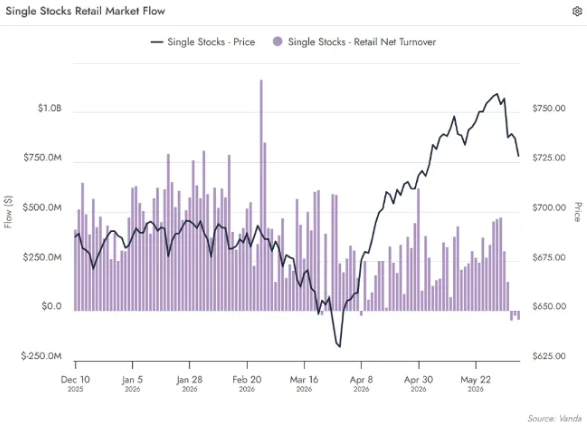
Monday’s outflow from individual stocks reached its highest level since November 2023. Even on Tuesday, when tech stocks led the S&P 500 lower and presented a clear dip-buying opportunity, retail investors—who typically 'buy the dip'—unusually chose to stay on the sidelines.
The epicenter of this sell-off has been the AI hardware supply chain, which saw the most explosive gains over the past year. According to Vanda Research, selling pressure has been heavily concentrated among chipmakers and companies that previously led the AI rally,$Marvell Technology (MRVL.US)$with semiconductor stocks such as these bearing the brunt. On the five-day chart,$Qualcomm (QCOM.US)$fell more than 6%,$Broadcom (AVGO.US)$、 $Arm Holdings (ARM.US)$ dropped over 5%,$Taiwan Semiconductor (TSM.US)$、$Micron Technology (MU.US)$、 $Advanced Micro Devices (AMD.US)$ declined more than 4%,$NVIDIA (NVDA.US)$and slid 3.7%.
Viraj Patel, Global Macro Strategist at Vanda Research, stated: 'Current indicators suggest retail investors may be stockpiling cash ahead of a major upcoming IPO. Typically, retail trading activity should be significantly higher at this time of year—but clearly, some more compelling magnet is restraining their participation in the existing secondary market.'
Institutional Analysis: How SpaceX Became the Ultimate Retail Magnet Through 'Lowered Barriers + Reserved Allocation'
BNP Paribas’ research report frames this capital rotation around a 'stock-switching-for-funding' logic. Greg Boutle, Head of U.S. Equity Derivatives Strategy at BNP Paribas, noted that Micron Technology’s recent price decline 'may be linked to individual investors withdrawing capital from recent top-performing stocks and leveraged products.' In May, Micron attracted approximately $6.5 billion in net retail inflows, driving its share price up by 87% for the month.
In contrast to the semiconductor sell-off, Gil Luria, Head of Technology Research at DA Davidson, explicitly attributed market behavior to IPO preparation: 'Investors will need to free up capital from all their holdings in publicly traded companies—especially in the tech sector, including the largest firms—to fund their allocations in these IPOs.'
Boutle further speculated that SpaceX’s allocation of up to 30% of its offering to retail investors is reshaping individual portfolio strategies, compelling holders to unwind existing high-leverage tech exposures. The case of Micron—where $6.5 billion in retail inflows in May fueled an 87% surge—now serves as the clearest benchmark for the current wave of outflows. BNP Paribas estimates this stock-switching-driven selling pressure could trigger concentrated unwinding demand worth approximately $50 billion.
Meanwhile, space-themed investments are absorbing some of the outflows. Data show that global space-themed ETFs have recorded net inflows of approximately USD 8 billion year-to-date. Vanda Research also noted that retail investor demand for space-related equities has reached its highest level since 2024.
In the short term, the shift of retail capital from AI holdings to IPO candidates like SpaceX has already been confirmed by actual trading data. Few companies have generated such a tsunami-like frenzy even before officially listing. In anticipation of this aerospace company—highly reputable yet not yet consistently profitable—major Wall Street brokerages have already launched an aggressive battle to attract clients.
To cater to Elon Musk’s vast fan base, Fidelity Investments has officially slashed the minimum threshold for retail brokerage accounts to participate in IPO subscriptions to just USD 2,000. The most direct catalyst driving retail investors to liquidate positions is SpaceX’s highly unusual decision to reserve as much as 30% of its IPO shares specifically for individual retail investors.
By comparison, traditional large-scale IPOs typically allocate more than 90% of shares to large institutions and hedge funds. Musk’s move has undoubtedly ignited collective euphoria among high-net-worth individuals and Reddit retail traders alike. Currently, space economy-related stocks have become one of the few sectors on the U.S. equity market experiencing strong逆势 gains and remaining insulated from prevailing risk-off sentiment, with retail demand for aerospace assets surging to its highest point since 2024.
Wall Street’s concern: A historic wave of mega-IPOs could trigger 'indigestion' in U.S. equities and elevate short-term volatility
However, this frantic reallocation of retail capital—selling existing positions to fund new bets—is creating noticeable ripple effects in the already elevated and volatile U.S. equity market.
Douglas Beath, global equity strategist at Wells Fargo & Co’s Investment Institute, issued a warning in a phone interview. He noted that U.S. households’ stock holdings now account for nearly 35% of their financial assets—the highest level on record—meaning retail investors have little excess “dry powder” (cash piles) left.
Beath stated, 'Retail traders account for a significant portion of what the market considers “fast money.” To buy new IPO shares, they must aggressively sell their existing holdings—particularly profitable positions in tech giants like NVIDIA and Micron Technology. This could very likely lead to significant market indigestion and heightened volatility for the remainder of the year.'
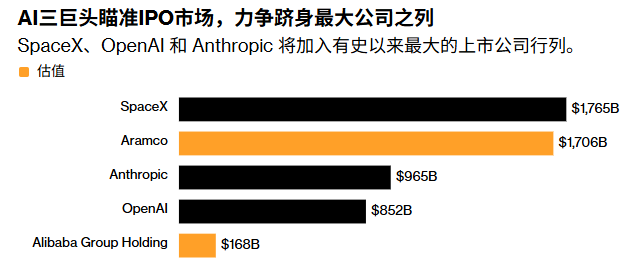
Compounding analysts’ concerns, SpaceX is merely the 'opening course' in this massive capital harvest. Gil Luria, Head of Technology Research at DA Davidson & Co., noted that following SpaceX’s record-breaking IPO, several other unicorns—including Anthropic and OpenAI, led by Sam Altman—are already lined up on this year’s super-IPO calendar.
Previously, Anthropic filed its IPO application under joint bookrunners Goldman Sachs and Morgan Stanley, with a latest post-money valuation of USD 965 billion. OpenAI is set to follow closely behind, also led by Goldman Sachs and Morgan Stanley, with an estimated valuation of around USD 850 billion and a potential listing as early as October. Investment banks estimate that as many as 12 major AI companies are currently under SEC review, with the total pipeline of AI IPOs exceeding USD 3 trillion.
Although first-quarter data show that retail investors’ share of total U.S. equity trading volume has declined from 21% last year to 17%, the localized surge in retail capital during these 'super IPO chain explosions'—which carry quasi-religious fervor—remains powerful enough to shake the broader market.
In the long run, abandoning chip giants whose performance has already been proven, and instead pouring tens of billions of dollars overnight into aerospace and generative AI private markets—which are in a phase of high capital expenditure—may ultimately prove either a great triumph or an aggressive bubble swap. This remains an uncertain gamble. What is certain, however, is that until SpaceX’s pricing is finalized next week, traders across global fixed-income and equity markets will have to endure the severe volatility caused by this retail investor 'great migration.'
Patel of Vanda Research offered a longer-term perspective: 'Last week’s sell-off and the short-term peak in artificial intelligence sentiment gave retail investors an opportunity to take profits and sell their outperforming stocks.' However, for a market that has already exhausted its FOMO (fear of missing out) sentiment, a core question affecting the valuation of all risk assets will be whether current investment themes can still provide sufficient liquidity for investors to exit as they chase the next wave of opportunities.
Editor/Deng