SpaceX could act as a powerful amplifier of the AI-driven super bull market rather than its bubble-burster. This also implies that SpaceX’s record-breaking IPO suggests the global bull market centered around the AI computing power supply chain—and the broader 'AI super bull market' sweeping global equity markets—may be far from over.
Zhitong Finance APP has learned that the shadow market is currently pricing the sensational, record-breaking initial public offering of this U.S. tech giant founded by Elon Musk, which focuses on 'AI + space exploration'. $SpaceX (SPCX.US)$ The pricing indicates that this integrated mega-cap company—encompassing Starlink satellite communications, space-based AI data centers, high-frequency commercial aerospace launches, defense and military space systems, AI computing infrastructure platforms, and artificial intelligence applications—is expected to see its share price rise by at least 35% following its Nasdaq debut, with its market capitalization potentially surging from its already staggering current level of USD 1.77 trillion to USD 2.4 trillion.
With index-tracking funds—specifically index ETFs—expected to generate several billion dollars in new demand for SpaceX stock, coupled with the ongoing, fervent global rollout of AI-computing-related infrastructure investments projected to reach $3 trillion, some Wall Street analysts view SpaceX not as a bubble-burster but rather as a powerful amplifier of the AI super bull market. This suggests that SpaceX’s record-setting IPO may signal that the AI-driven global equity rally, centered on the AI computing supply chain, is far from over.
 On the eve of SpaceX’s landmark IPO, Oppenheimer, a prominent Wall Street investment bank, issued an 'outperform' rating on the stock with a price target of $190. Based on the preliminary IPO price of $135 per share, this target implies approximately 41% upside potential, corresponding to a market valuation of roughly $2.5 trillion. At the core of Oppenheimer’s bullish thesis is a strategic redefinition of SpaceX—not as a traditional commercial aerospace company, but as a vertically integrated AI infrastructure platform. This platform combines rocket launch capabilities, the Starlink satellite network, and advanced manufacturing with large language models, AI agents, terrestrial AI data centers, cloud-based inference computing resources, and future orbital AI data centers.
As the world’s wealthiest individual to date, Musk has previously accomplished feats many deemed impossible: building a commercially viable high-frequency rocket launch business through SpaceX, mainstreaming electric vehicles via Tesla—the global EV leader—and deploying internet connectivity infrastructure from space through Starlink. However, some investors remain skeptical about whether Musk can truly realize his latest ambition unveiled in Austin: an 'epic-scale' semiconductor initiative and his visionary blueprint integrating artificial intelligence, autonomous driving, humanoid robotics, and space-based AI data centers.
SpaceX’s highly anticipated IPO prospectus, released last month, estimates the company’s total addressable market (TAM) at a staggering $28.5 trillion. If this 'space-AI empire' vision is ever fully realized, it would approach the total annual economic output of the United States. In its IPO filing, the company stated it has 'identified the largest executable total addressable market opportunity in human history,' primarily driven by AI-powered software, with significant contributions also expected from the space sector.
Shadow Market Signals 35% Surge on SpaceX Debut as 'Space-AI Empire' Nears $2.4 Trillion Valuation
According to available information, derivatives offered by the well-known online brokerage platform IG International indicate that as of Friday morning Singapore time, the company’s implied market value stood at approximately $2.4 trillion. This represents a potential gain of over 35% compared to its preliminary IPO price of $135 per share and the corresponding $1.77 trillion valuation based on that offering price.
On the crypto trading venue Hyperliquid, perpetual futures contracts linked to SpaceX—futures contracts with no expiration date—are trading at around $180, implying a valuation exceeding $2.3 trillion. Over the past 24 hours, trading volume in this instrument surpassed $143 million, with open interest now exceeding $208 million, underscoring strong bullish sentiment in the market.
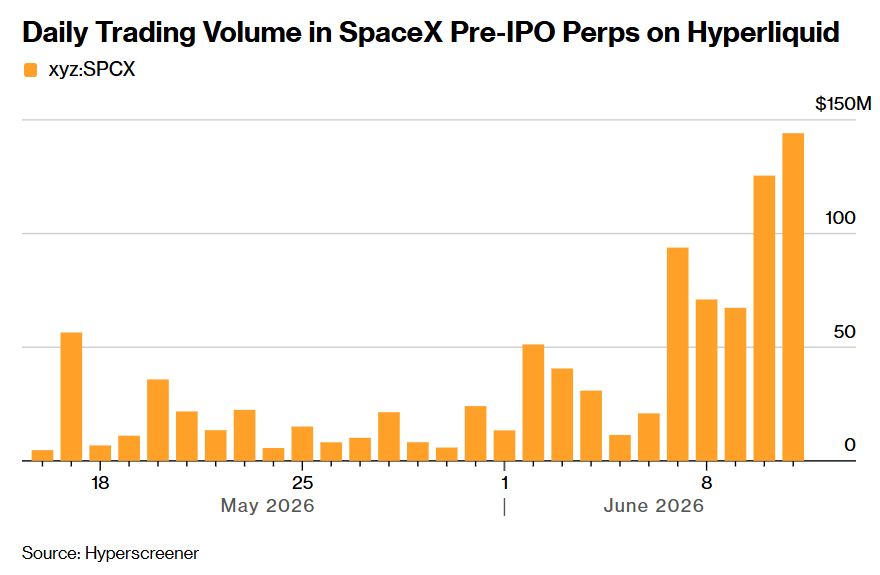
The chart above shows daily trading volume for pre-IPO SpaceX perpetual futures contracts on Hyperliquid. Source: Hyperscreener.
Prediction markets have further reinforced bullish expectations ahead of SpaceX’s U.S. stock market debut. On Polymarket—a platform specializing in real-money prediction and betting markets—traders’ wagers indicate a probability exceeding 70% that SpaceX’s market capitalization will close above $2 trillion on its first day of trading.
Although these signals indicate a certain degree of enthusiasm, they do not necessarily translate directly into actual share price movements in the secondary market. Shadow markets are typically less liquid and less transparent than public markets, so prices can be highly volatile and may be driven by a small number of traders,share distributionleveraged capital, or large-scale short-term speculation, rather than broad-based investor demand.
Nevertheless, this pricing underscores just how voracious investor appetite has become for equity assets positioned at the intersection of artificial intelligence applications, AI computing infrastructure platforms, commercial spaceflight, and space exploration.
If SpaceX’s market debut delivers a strong first-day rally, it could bolster the IPO prospects of OpenAI and Anthropic PBC, providing investment banks with positive evidence that public markets can absorb trillion-dollar valuations that would have seemed unimaginable just a few years ago.
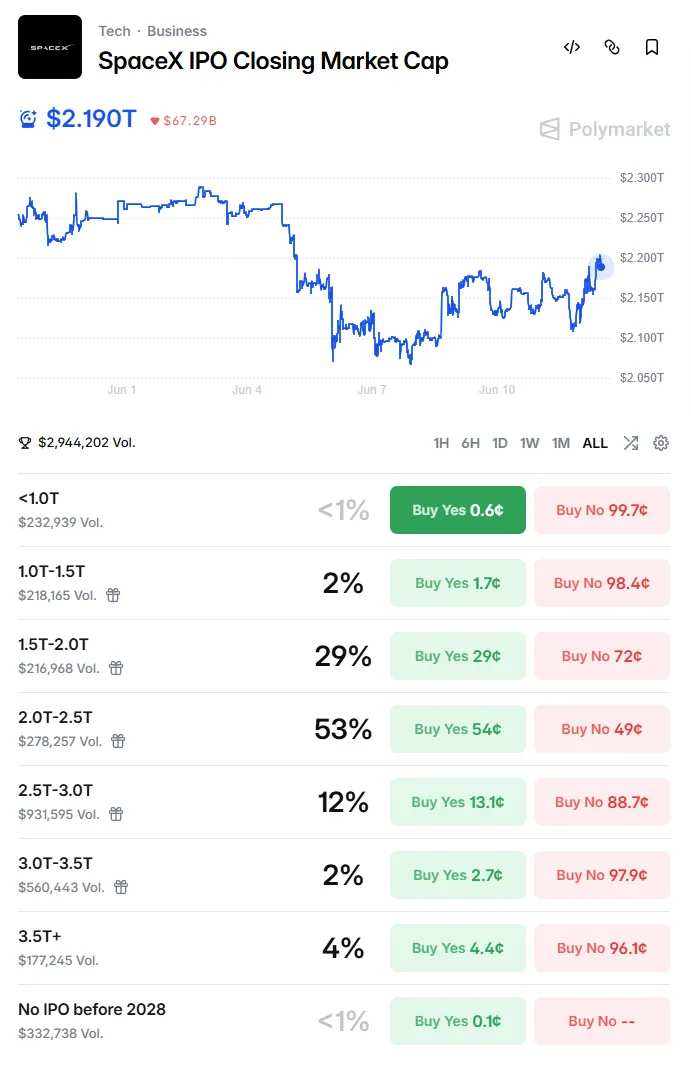
As shown in the chart above, prediction markets signal a strong post-listing rally for SpaceX—bets on Polymarket appear highly optimistic.
Fabien Yip, Senior Market Analyst at IG, stated: “Demand for the SpaceX IPO has been extremely robust, with significant investor interest already evident in pre-listing trading.” She added that this constitutes “by far the most popular pre-listing shadow trading we’ve encountered, even though its valuation already appears stretched. If the pre-listing pricing momentum continues, it will set a precedent for the next wave of mega-IPOs.”
In the near term, however, a strong SpaceX debut could draw substantial capital away from the so-called ‘Magnificent Seven’ U.S. tech stocks—and even from Tesla (TSLA.US), the electric vehicle and robotics leader helmed by Elon Musk—while simultaneously boosting core suppliers tied to Musk’s AI, rocketry, and space exploration ventures, as well as peer companies in the commercial space sector and investment vehicles holding stakes in these firms globally.
Soaring activity in shadow markets, the proliferation of high-leverage and inverse ETFs, and over $100 billion in retail oversubscription have collectively propelled Musk’s ‘space-AI empire’ skyward.
With SpaceX reportedly pricing its shares at $135 each to raise approximately $75 billion—making it one of the largest IPOs in history and implying a valuation of roughly $1.77–1.8 trillion—the AI super-bull market may have reached its ‘SpaceX moment.’ This offering is no longer merely the IPO of a traditional commercial space company; rather, it represents a bullish frenzy in global capital markets, pricing in bundled assets including high-frequency commercial rocket launches, the Starlink satellite internet network, AI infrastructure platforms, future orbital AI data centers, defense and national security assets, and the premium attached to Musk’s AI ecosystem.
According to the latest mainstream views on Wall Street, despite significant recent pullbacks in global AI computing supply chain stocks—including ARM, Micron, SK Hynix, and Samsung—there is currently no prevailing consensus that the 'AI super bull market' has ended. Instead, the opposite trend is emerging: an increasing number of major investment institutions are raising their year-end targets for benchmark equity indices, with nearly all citing the AI capex wave, robust AI infrastructure development, and AI-driven earnings expansion as key justifications.
Goldman Sachs, the Wall Street financial giant, has recently raised its year-end target for South Korea’s KOSPI benchmark index multiple times, betting that the Korean equity market—which has surged 100% year-to-date amid high volatility—can continue its rally. Goldman Sachs has lifted its KOSPI target from 8,000 to 9,000 and now to 12,000 points (compared with Friday’s closing level near 8,100). Its core rationale stems not from macroeconomic stimulus or monetary policy, but from the prolonged upcycle in memory storage and the sustained surge in demand for AI memory and storage chips—sectors where Korean leaders like SK Hynix and Samsung Electronics stand among the world’s key beneficiaries in the AI compute supply chain.
The most vivid manifestation of this bullish fervor is undoubtedly the fact that shadow markets and perpetual crypto futures have already priced in a ‘first-day pop’ above the IPO price, alongside ETF issuers rushing to launch products ahead of the listing. BlackRock and other Wall Street titans, along with pension funds, sovereign wealth funds, family offices, retail investors, crypto traders, and ETF providers, have all poured in—retail subscriptions alone exceeding $100 billion. This demonstrates that the market is not buying a single year’s earnings, but rather a long-term call option encompassing the ‘Musk ecosystem + AI infrastructure + Starlink global network + future orbital economy.’
ETF issuers rushing to launch products ahead of schedule signals that Wall Street is already poised to rapidly productize SpaceX into a highly volatile trading instrument. Firms such as ProShares, Themes, and Direxion are launching or planning leveraged ETFs tied to SpaceX, including 2x long and 2x inverse products, with some aiming to begin trading as early as Monday. The ProShares Ultra SpaceX ETF is designed to track twice the intraday performance of SpaceX, while Themes also plans to roll out both 2x leveraged long and 2x leveraged short offerings. This mirrors the 2024 Bitcoin spot ETF product race but carries even higher risks—initial post-listing volatility, retail sentiment, gray-market premiums, and ETF/options rebalancing dynamics could amplify one another, potentially turning ordinary stock swings into intraday stampedes or feedback-driven surges for highly leveraged capital.
On the funding front, SpaceX is shaping up to become a rare 'market-wide consensus trade': retail investors, sovereign wealth funds, global asset managers, family offices, crypto traders, and ETF issuers are all vying for access to the same IPO entry point. Major institutional players like BlackRock, Middle Eastern sovereign wealth funds, family offices, and global pension funds have also participated aggressively. This capital structure indicates that SpaceX has evolved into a cross-asset, cross-regional, and cross-risk-preference consensus trade. Notably, BlackRock alone submitted an IPO order for at least USD 5 billion, signaling substantial unmet demand that will likely spill over into secondary-market buying—potentially driving a strong first-day rally but also risking extreme post-listing volatility.
Long-term investors focus on decade-plus horizons, betting on massive Starlink cash flows, a near-monopoly in high-frequency commercial rocket launches, SpaceX’s role as a gateway to AI computing infrastructure, and its full integration into Elon Musk’s AI ecosystem empire. Retail investors, meanwhile, believe they are buying into what could become 'the next Tesla-style wealth creation story.' Crypto market participants are trading short-term premiums and volatility, while ETF issuers are primarily chasing trading volume.
SpaceX is accelerating its transformation from a 'commercial aerospace and space exploration company' into a 'global AI computing infrastructure operator and AI applications behemoth.' The USD 250 billion in subscription orders—far exceeding expectations—and USD 100 billion in retail commitments clearly demonstrate market acceptance of this growth narrative. This trend will continue reinforcing the view that 'SpaceX’s record-breaking IPO is expanding the boundaries of the AI super bull market rather than draining liquidity from it.'
From the perspective of global capital flows, the current phase appears to mark the second stage of the AI super bull market. The first stage was driven by hyperscale AI training clusters centered on GPUs and ASICs; the second stage is now broadening into a comprehensive expansion across the data center power chain, HBM/DRAM/NAND memory, advanced packaging, liquid cooling, data center CPUs, optical communications and interconnects, high-performance Ethernet and DCI (data center interconnect) infrastructure, as well as AI end-user devices—including PCs, wearables, humanoid robots, autonomous vehicles—and even new AI hubs represented by SpaceX’s space-based computing infrastructure.
According to analysts at Bank of America, another Wall Street financial giant, AI computing infrastructure is entering a more durable and expansive capital expenditure cycle. Around the same time, Morgan Stanley, yet another Wall Street powerhouse, published a research report indicating that the AI computing arms race has entered a phase of system-level expansion, with demand for AI infrastructure displaying an unusual 'inelastic' trend—meaning that regardless of cost curves, major tech firms continue to ramp up investments in AI data centers. This 'demand inelasticity' is expected to further bolster U.S. economic resilience and drive overall earnings growth for the S&P 500. The report forecasts that nearly $3 trillion in AI-related infrastructure investment will flow through the global economy by 2028, with over 80% of that spending still ahead.