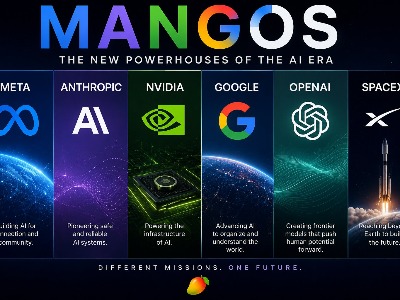
On its first day of listing, SpaceX’s valuation surged past $2 trillion, directly challenging the dominance of the Magnificent Seven (Mag 7) and prompting Wall Street to reconfigure its classification system for tech stocks. New acronyms such as 'MANGOS' have quickly emerged, aiming to include SpaceX alongside soon-to-be-public AI giants OpenAI and Anthropic.
$SpaceX (SPCX.US)$ With the largest IPO in history, it has made a powerful market debut, posing an unprecedented challenge to Wall Street's long-standing "Magnificent Seven" (Mag 7) label.
SpaceX’s valuation surpassed $2 trillion on its first day of listing, overtaking Mag 7 members $Tesla (TSLA.US)$ and $Meta Platforms (META.US)$ to become one of the world’s most valuable technology companies. This sudden shift has prompted analysts and investors to reassess whether the 'Mag 7' can still serve as an effective proxy for market leadership when one of the most significant tech firms lies outside this grouping. Meanwhile, trillion-dollar AI unicorns such as OpenAI and Anthropic are also lining up for IPOs, further intensifying pressure to update market labels.
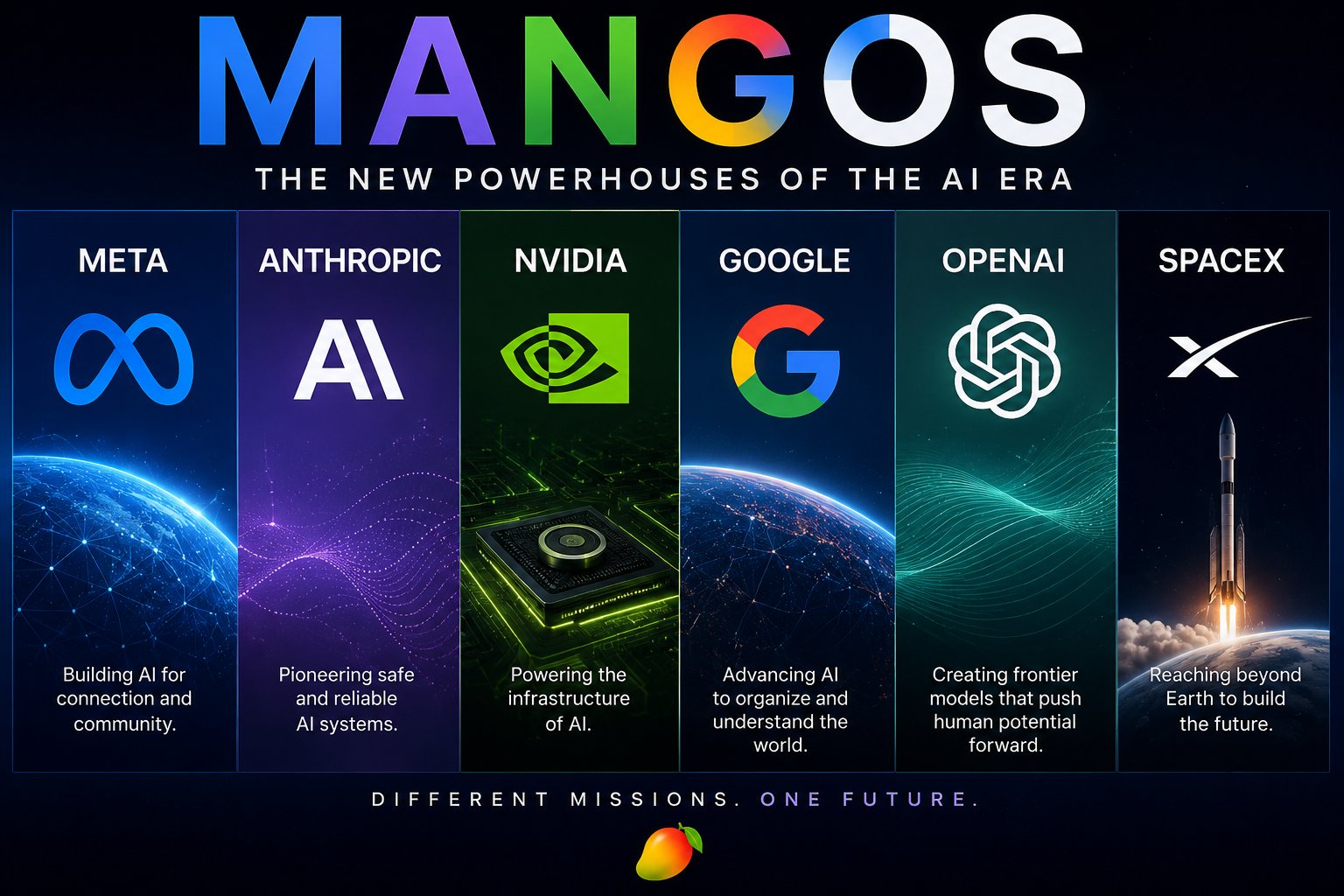
 Currently, a new acronym is rapidly gaining traction in the market—'MANGOS,' referring to $Meta Platforms (META.US)$ , Anthropic, $NVIDIA (NVDA.US)$ 、 $Alphabet-A (GOOGL.US)$ / $Alphabet-C (GOOG.US)$ , OpenAI, and $SpaceX (SPCX.US)$ . Some asset management firms have indicated they are already adopting this term internally. However, others in the industry believe the 'Mag 7' brand is too deeply entrenched to be fully replaced in the short term, suggesting that naming conventions may evolve through layering rather than outright substitution.
SpaceX’s IPO Disrupts the Existing Market Order
SpaceX completed its IPO on Nasdaq on June 12, achieving a valuation exceeding $2 trillion and setting a record for the largest IPO in U.S. history. This valuation immediately placed it ahead of Mag 7 members Tesla and Meta, securing its position among the highest-valued U.S. companies.
Shay Boloor, Chief Market Strategist at Futurum Equities, stated, "With SpaceX’s arrival, it becomes very difficult to continue using the Mag 7 as a concise proxy for market leadership, because one of the world’s most important companies will instantly fall outside this label."
The Mag 7 label was coined by Michael Hartnett, Chief Investment Strategist at Bank of America Global Research, in late 2023, encompassing NVIDIA, Apple, $Amazon (AMZN.US)$, Alphabet, Meta Platforms, Tesla, and$Microsoft (MSFT.US)$the seven mega-cap technology stocks. This label is not a formal market classification but rather a shorthand coined by strategists, investors, and the media to capture the strongest large-cap stocks during a specific period.
MANGOS: A New Acronym Competes for Market Narrative Dominance
SpaceX’s IPO has triggered a race among market participants to coin new acronyms. On X (formerly Twitter), the term "MANGOS"—representing Meta, Anthropic, NVIDIA, Alphabet, OpenAI, and SpaceX—has garnered significant attention. However, this grouping is not yet standardized; some interpret the "A" as Apple rather than Anthropic, which remains a private company.
Aga Kuplinska, Senior Vice President of Product Development at Tidal Financial Group—which primarily assists asset managers in launching ETF products—stated, "We’ve already started using this term internally, and the industry is following suit."
Dan Boardman-Weston, CEO of BRI Wealth Management, proposed an alternative concept—"Magna Atoms"—which adds SpaceX, OpenAI, and Anthropic to the original Magnificent Seven to form a portfolio of ten stocks.
The Evolution of Market Labels: From FANG to the Magnificent Seven
The iterative rebranding of market labels is nothing new. From the "Nifty Fifty" of the 1960s and 1970s to the "Four Horsemen" during the late-1990s dot-com bubble, Wall Street has long had a penchant for attaching catchy labels to the most dominant groups of stocks.
The evolution in recent years is equally clear: FANG included Facebook, Amazon,$Netflix (NFLX.US)$and Google; FAANG added Apple to this group; the Magnificent Seven removed Netflix and included Microsoft, NVIDIA, and Tesla—each adjustment reflecting structural shifts in market leadership.
In its research report dated May 22 of this year, Bank of America introduced the "AI Big 10" concept, adding three companies to the original group of seven stocks.$Broadcom (AVGO.US)$、$Micron Technology (MU.US)$and $Advanced Micro Devices (AMD.US)$ , to reflect the semiconductor sector's strong performance over the past year. According to LSEG data, this group collectively accounts for$S&P 500 Index (.SPX.US)$a combined weighting of over 40%.
Dustin Thackeray, Chief Investment Officer at Crewe Advisors, stated, "The 'Mag 7' label has been around for several years now—perhaps the market is ready for something fresh."
"Mag 7" May Not Be Retiring Just Yet
Despite growing calls for new labels, not everyone believes the Magnificent Seven will fade into history.
Dave Mazza, CEO of Roundhill Investments, explicitly stated, "The 'Mag 7' label isn’t going away—it’s deeply entrenched in how investors and the media perceive the leadership of large-cap tech stocks. What’s more likely is the emergence of layered new terminology rather than a direct replacement."
As IPO expectations heat up for AI unicorns like OpenAI and Anthropic, debates over market labels are likely to intensify. Yet regardless of which acronym ultimately prevails, the naming contest itself already reflects a deeper reality: the AI wave is reshaping the power dynamics of the tech sector, and the boundaries of market leadership are being rapidly redefined.
Editor/Jayden