
① This timing is earlier than originally planned; ② Samsung Electronics has already begun delivering the industry’s first 12-layer 48GB HBM4E samples to major global customers; ③ Industry insiders expect supply competition between Samsung and SK hynix to intensify further in the second half of this year;
June 13 (Editor: Song Ziqiao), The STAR Market Daily — Following Samsung Electronics’ delivery of the world’s first HBM4E samples, SK hynix is also expected to accelerate its sample delivery schedule.
According to South Korean media reports, industry sources disclosed on the 12th that SK hynix is preparing to provide HBM4E samples to key customers, with shipments potentially commencing as early as this month (June) or no later than next month.
 This timing is earlier than originally planned. SK hynix previously stated during its first-quarter earnings call that it had an “internal plan to provide samples in the second half of the year.”
Industry insiders believe that, given HBM4E is scheduled for mass production next year, customer validation and optimization must be completed in the second half of this year, making imminent sample deliveries highly likely.
HBM (High Bandwidth Memory) is a core component paired with AI accelerator chips, and its bandwidth and capacity directly determine the efficiency of AI training and inference. Currently, the HBM market is dominated by Samsung, SK hynix, and Micron, with SK hynix holding the leading market share.
HBM4E is the seventh-generation HBM. SK hynix’s HBM4E is expected to be used in NVIDIA’s next-generation AI accelerator, 'Rubin Ultra,' which is slated for launch next year. On June 2, Jensen Huang visited SK hynix’s booth at COMPUTEX TAIPEI 2026 in Taiwan and inscribed on an HBM4E wafer: 'Please produce more.'
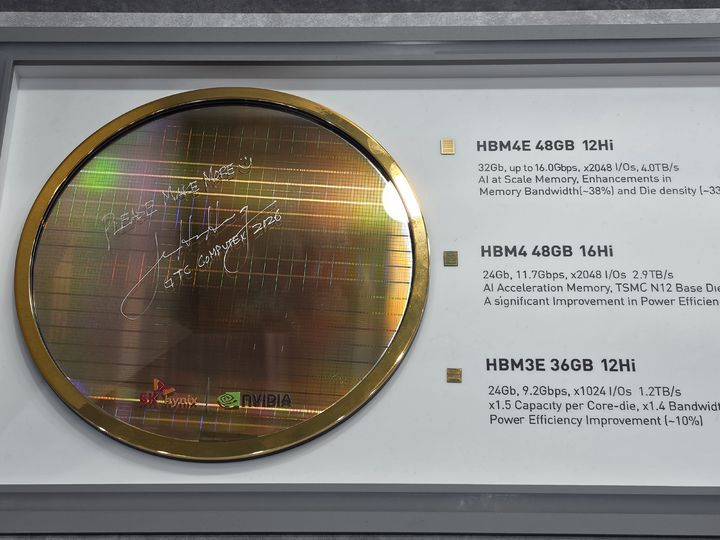
It is reported that SK hynix will use its 1c-nanometer process for the core die of its HBM4E, while the base die will be manufactured by Taiwan Semiconductor using a 3-nanometer process. At COMPUTEX, SK Group Chairman Choi Tae-won stated, 'We are ready whenever our customers are.' He added, 'Currently, we have only one HBM4E customer.'
In the HBM market, the timing of sample deliveries is critical. Since next-generation HBM is custom-produced according to specific customer requirements, faster sample delivery enables customers to validate performance and complete optimization sooner, thereby gaining a competitive edge in the eventual mass production race.
On May 29, Samsung Electronics announced that it had started delivering the industry’s first 12-layer 48GB HBM4E samples to major global customers. Following initial sample delivery and optimization, Samsung plans to commence mass production of HBM4E based on customer schedules.
An industry insider stated, 'For HBM, not only is performance critical, but also the timeline—including shipment schedules and customer certifications—is crucial.' He added, 'In the second half of this year, supply competition between the two companies—Samsung and SK Hynix—will intensify further.'
Moreover, Micron’s HBM4 capacity ramp-up is progressing smoothly, with mass production of HBM4E scheduled for 2027. According to reports, its HBM4E will utilize Micron’s sixth-generation 1γ (1-gamma) process node at the 10-nanometer class—a first for Micron in adopting EUV lithography equipment in a mass-production process—and the base die will be manufactured by Taiwan Semiconductor.
TrendForce previously noted that these three major suppliers are gradually shifting their strategic focus from yield competition toward pricing power and leadership in next-generation specifications. Although traditional DRAM profitability has temporarily surpassed that of HBM in the short term, suppliers are maintaining a balanced product portfolio and remain optimistic about rising long-term contract prices for HBM. In cross-sectional comparison, current DDR and consumer-grade memory products—excluding HBM—have already reached relatively high price levels following multiple rounds of prior increases, whereas the price appreciation potential for HBM has yet to be fully realized.
Editor/Jayden