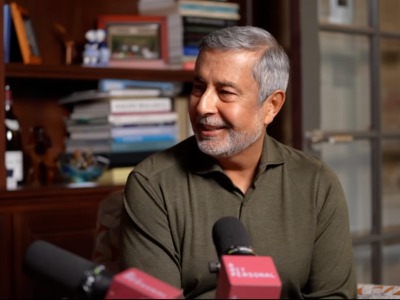
Source: Smart Investors
Key Insights
1. Without semiconductors, there would be no AI. And memory is the backbone of AI—the critical foundation enabling its continuous evolution.
 2. As models grow larger and inference demand continues to rise, the need for memory will only intensify—requiring greater capacity, higher performance, and lower power consumption.
3. Back in 2021, we already stated that the industry needed new wafer fabs built from the ground up. No one, however, truly anticipated how rapidly AI would explode.
4. Supply constraints across the entire industry will persist beyond 2026 and continue for a considerable period thereafter.
5. Memory is an extremely challenging technology. No one should underestimate the depth of technical expertise and engineering capability required to manufacture it. In certain aspects, memory is even more complex than other segments of the semiconductor industry.
6. A leader must not only see the big picture but also dive into the details when necessary—only then can a company unlock its full potential.
7. Investment decisions must never be made blindly; they must be disciplined and grounded in data. You need to understand the technology, the applications, and where those applications are headed. You must also collaborate closely with customers to understand their future direction and Micron’s role within it.
Listening to Micron Technology (MU.US) Sanjay Mehrotra, CEO, speak about memory conveys a sense of calm confidence.
Micron is a global leader in memory and storage solutions and the only U.S.-based manufacturer of DRAM. Just before last week’s 'Black Friday,' the company’s market capitalization had already crossed into the 'trillion-dollar club.'
Jensen Huang, founder of NVIDIA, currently on a business trip in South Korea, signed a collaboration agreement with SK Hynix—one of the world's leading memory manufacturers—while optimistically stating, “There are no signs yet that the memory shortage is ending.”
Against this backdrop, listening to Sanjay’s in-depth conversation becomes even more meaningful.
Sanjay Mehrotra’s career spans the entire flash memory revolution: he joined Intel in 1980 and later co-founded SanDisk, playing a pivotal role as flash memory transitioned from a niche technology to a mainstream one.
Since becoming CEO of Micron Technology in 2017, he has spearheaded the company’s systematic transformation from a follower to a technology leader and announced a $200 billion investment plan for domestic U.S. manufacturing.
Most recently, Micron’s expanded fabrication facility in Manassas, Virginia, produced its first wafers; meanwhile, advanced-node wafer fabs in Boise, Idaho, and Syracuse, New York, are progressing in parallel.
The moderator of this conversation is Jodi Shelton, co-founder and CEO of the Global Semiconductor Alliance, who has spent decades immersed in the semiconductor industry and maintains long-standing professional relationships with the leadership teams of virtually every top-tier chip company.
In January of this year, she launched the podcast 'A Bit Personal,' dedicated to in-depth interviews with semiconductor leaders. Guests already featured include the former CEO of Taiwan Semiconductor, the CEO of MediaTek, and the president of Broadcom’s semiconductor business group. It is precisely this accumulated rapport that enables her to steer conversations into far more personal territory than typical earnings calls or conference keynotes.
The interview was recorded at Sanjay’s home. While his media appearances typically focus on business strategy and industry outlook, occasions where he voluntarily discusses his personal journey are exceedingly rare—this conversation is an exception.
Jodi noted that, rather than the scale of the business Sanjay oversees, she is more interested in questions such as: How does one shoulder responsibility in such a position? What kind of discipline and long-term mindset must a leader cultivate in a highly cyclical and intensely pressured industry? And how does one stay grounded while standing at the center of global demand?
These questions all find answers within the dialogue.
The discussion covered a range of topics—from the supply-demand fundamentals of memory storage and the technical challenges of high-bandwidth memory, to the ramp-up timeline for building a wafer fab from scratch, criteria for assessing an AI bubble, and the strategic rationale behind Micron Technology’s $200 billion investment.
There was also a deeply personal thread running through the conversation. An engineer who grew up in a middle-class Indian family had his visa denied three times—until his father intercepted the consul returning from lunch and passionately argued his son’s case for a full 20 minutes, finally securing him a chance to go to the U.S. After 42 years in an arranged marriage, his wife once told him, 'Your smile is very nice—smile more often,' a remark that changed how he has presented himself in every public appearance since… These are the kinds of stories you’ll never find in earnings reports or strategic documents.
This was not just a conversation about technology—it was also a conversation about leadership under pressure. Presented in full by Smart Investor (ID: Capital-nature). Enjoy it~
1. Impressions from joining the White House delegation to China
Jodi: I’m truly honored to be here—at your home, in such a beautiful house, and now in your office. Those bookshelves behind you must hold quite a few stories. Is there a particular book among them that you especially like?
Sanjay: Actually, there are quite a few—really, many.
We also enjoy collecting local books whenever we travel to different places, so many of these books are tied to those travel experiences.
For example, here’s a book on the Bhagavad Gita—one of the sacred texts of Hinduism. It’s quite interesting to flip through a few pages every now and then.
Jodi: We were originally supposed to do this interview several weeks ago, but I got ‘scooped’ by Trump.
You were invited to join the White House delegation to China. So tell us—what was that experience like? What did it feel like when you got that call? And what was it actually like going on the trip?
Sanjay: It is, of course, a great honor and a very special opportunity to represent Micron Technology in this engagement—a truly rare experience.
That morning, I was also present when President Trump hosted CEOs of companies in Washington. Overall, I believe it is a positive development to see the United States and China sitting together and working toward building communication for a more stable relationship.
This benefits everyone.
Jodi: Dialogue itself is a good thing, even if there are not yet concrete outcomes.
Sanjay: I couldn’t agree more.
Jodi: So, what would you hope this leads to?
Sanjay: As a business leader, I naturally hope to see an environment that encourages innovation, provides a platform for it, and enables all enterprises to benefit.
At the same time, I also hope for greater stability, predictability, and certainty in investment conditions.
Jodi: Right. Did you get to ride on Air Force One?
Sanjay: I certainly did not.
Jodi: Alright. I was actually going to ask if you’d taken any souvenirs from the plane.
Sanjay: Really, I didn’t.
2. Storage is becoming a critical foundation for artificial intelligence.
Jodi: I’ve been really looking forward to this conversation, because today—both you and Micron, along with the entire storage industry—are essentially at the center of this era.
Nowadays, any discussion about artificial intelligence inevitably revolves around three issues: computing power, storage, and energy. In other words, your importance has perhaps never been as visibly recognized by the outside world as it is today. How do you personally view this moment? What does it feel like to be right in the middle of it?
Sanjay: I’ve been in this industry for over 45 years. I can honestly say this is the most exciting moment the industry has ever seen during my career.
And I truly believe the best is yet to come.
Today, storage is no longer just a component inside devices like smartphones or PCs—it’s becoming a critical foundation for artificial intelligence. In other words, storage isn’t just enabling devices to function; it’s underpinning the very 'intelligence' within AI and helping artificial intelligence become smarter.
Therefore, the opportunity ahead for the storage industry is enormous. This is undoubtedly an incredibly exciting moment.
I’m also immensely proud of the Micron team. Micron is the only U.S.-based company engaged in semiconductor memory manufacturing.
For decades, our team has been advancing both the storage technology roadmap and product roadmap to reach this point—where storage has become a core component of the AI revolution.
I’ve always believed that Micron is a 'national treasure.' Now, especially amid this AI revolution, the world is beginning to see why Micron is such an important national treasure.
Jodi: Every decision you make right now sends ripple effects throughout the entire industry—and could even impact the global economy.
How do you handle that pressure? Do you have any daily habits, rituals, or beliefs that help you stay grounded and clear-headed?
Sanjay: I think the most important thing is the team.
I’m very fortunate to have worked alongside many team members for a long time. As I just mentioned, Micron is a national treasure, and the company is home to many exceptionally strong leaders who were already there when I joined.
At the same time, there are also leaders who were colleagues of mine back in my early days at SanDisk.
Bringing these individuals together has formed what I genuinely believe is the best team in the semiconductor industry. They possess deep industry experience. For me personally, this is the most valuable asset—it helps me seize opportunities in the business and industry, as well as navigate the challenges that inevitably arise.
Jodi: We’re currently at your home, and I just met your wife. This place feels incredibly peaceful.
So that must be part of the reason, right? If someone comes from a calm and stable home environment, they may be less likely to buckle under immense external pressure.
Sanjay: Absolutely correct.
The support provided by my family is extremely important. My wife has always been a vital source of my strength, calmness, and composure.
The memory and semiconductor industries have experienced far too many ups and downs. Therefore, having such a supportive system at home is undoubtedly a significant advantage and a critically important pillar of support.
3. Supply constraints across the entire industry will persist for a considerable period of time.
Jodi: Let’s talk about these cycles.
You’ve been in this industry for a long time and have lived through many cycles. The semiconductor industry is inherently cyclical, and within semiconductors, memory is the segment with the most pronounced cyclicality. Today may be a peak of prosperity, but tomorrow could already mark the beginning of a downturn—a pattern you’ve certainly witnessed many times.
Clearly, today marks a moment of great celebration for you. You’ve joined the trillion-dollar club, hold substantial cash reserves, and your company’s stock price—or valuation—has doubled in just 48 days.
Looking back on this journey, it truly is remarkable.
Do you believe this is simply another memory cycle—albeit on a larger scale—or do you think AI could genuinely alter the cyclical nature of this industry?
Sanjay: I believe there can be no AI without semiconductors—and memory is the backbone of AI, serving as the critical foundation that enables its continuous evolution.
As models grow larger and inference demand continues to rise, AI is shifting from training to inference and from data centers to the edge, driving storage requirements ever higher.
It requires greater capacity, higher performance, and lower power consumption.
Only with these capabilities can artificial intelligence advance from one generation of models to the next and evolve from one inference application to another, continuously enhancing its intelligence.
Now, with the emergence of agentic AI, orchestration has become increasingly complex as it evolves, leading to a significant surge in storage demand.
Whether on GPU, TPU, or ASIC platforms, the need for storage continues to grow.
Therefore, we must first examine demand. Storage is a critical enabler of AI intelligence. At its core, intelligence is data—and data cannot exist without storage.
If you consider token economics, it too is heavily dependent on storage. As token usage increases, context windows lengthen, KV cache requirements grow, and models themselves expand—AI needs not only computational power but also the ability to 'remember.'
It requires more storage—and higher-performance storage.
Thus, from the demand side, we are still at a very, very early stage. We believe AI still has a long road ahead.
Yet, on the other hand, the supply side is equally important. To fully understand the dynamics of this industry, one must consider both demand and supply simultaneously.
On the supply side, supply is currently extremely tight relative to demand.
The reason is that high-bandwidth memory and high-performance memory—not just HBM, but also future products such as LP6 DRAM—are critical components for data centers and various edge devices.
These products all require large quantities of wafers. Because higher performance typically means larger die sizes, which in turn require more wafers.
Supporting this demand requires substantial new greenfield wafer fabrication capacity.
Building a wafer fab takes a long time. Even after the facility is constructed, equipment installation, line qualification, and gradual ramp-up to full production also require considerable time.
Therefore, you must examine both the demand and supply sides simultaneously. On both dimensions, the fundamental dynamics of our industry have already shifted.
Jordy: But once supply catches up and the industry reaches a certain equilibrium, the situation typically reverses—potentially leading to oversupply. Do you think this could happen within the next five years? If this remains a cyclical trend and we are currently in the upswing phase, the subsequent correction could also be very sharp.
Sanjay: What I would say is that AI is still in its early stages.
As AI, intelligence, and agent-based AI continue to evolve, demand for memory will keep growing. Meanwhile, supply remains far below demand.
I cannot predict exactly when supply will truly catch up with demand. However, we see that supply constraints across the industry will persist beyond 2026 and continue for a considerable period.
You still need to return to the fundamentals.
How will supply increase? Primarily through new greenfield wafer fabs. From groundbreaking to the first output of wafers, it typically takes three to four years. After that, production must continue ramping up to gradually reach full capacity.
Of course, capacity ramp-up will also be guided by the latest assessment of demand.
Another critical factor is that the technology itself is becoming increasingly complex. The productivity gains from each new generation—specifically, the incremental bit output per wafer—are diminishing.
Taken together, these factors indicate that the industry’s supply-demand fundamentals will remain healthy in the foreseeable future.
Jodi: When did you first realize that AI would not just be another routine technological shift?
Sanjay: The emergence of ChatGPT in the fall of 2022 changed the world and created a significant inflection point in the demand environment.
But even as early as around 2020, we were already seeing AI begin to build momentum. At that time, we were already having serious discussions about how memory would become a core enabler of AI.
By around 2021, Micron was already publicly discussing this issue and signaling that more supply would be needed in the future.
Because by then, we had already recognized that products like high-bandwidth memory—and their future roadmaps—would require an increasing amount of silicon.
At that time, high-bandwidth memory accounted for only a very small share of the overall memory industry—approximately 1%.
However, we could already see that future generations of high-bandwidth memory would require substantial silicon wafer capacity, and HBM itself would experience significant growth, profoundly impacting the supply landscape.
That’s why as early as 2021, we stated that the industry would need new fabs built from the ground up. It’s just that no one truly anticipated AI would explode at such a rapid pace.
Whether it’s logic chips or memory chips, no one predicted demand would surge this quickly.
Jodi: Yes. I was in China last October—that was the first time I distinctly heard voices suggesting the market could face a severe memory shortage.
I recall ChangXin Memory Technologies mentioned at the time that its capacity for the next two years was already fully booked. That was the first time I genuinely heard such a statement. Of course, there had been some scattered comments prior to that.
For you, when did you start realizing, “Alright, we might be heading into a serious capacity crunch”?
Sanjay: I think we already discussed during our earnings call in December 2023 that supply for leading-edge memory would begin tightening in 2024.
By 2025, we’re seeing this supply tightness intensify further. And it’s not just leading-edge memory—products with longer lifecycles, such as DDR4, are also becoming constrained. These products are used in automotive, industrial, and networking applications.
So, this is a fairly broad-based tightness across the board.
From late 2023 into 2024, we have already seen these trends begin to take shape and started discussing them externally.
However, as I mentioned earlier, we had actually already begun planning related investments around 2021 and 2022.
Jodi: However, 2023 was an extremely challenging year for the entire semiconductor industry. It was precisely at that time that some new capacity investments were slowed down.
Sanjay: Yes.
4. Embracing and leveraging AI is critically important.
Jodi: Our industry frequently talks about technology and innovation, but relatively less about the responsibilities these technologies entail. So, what is Micron Technology’s view on its responsibility regarding AI? Are you personally concerned about AI?
Recently, there has also been some societal pushback. For example, commencement speakers who mention AI are sometimes met with boos from the audience. How do you view this unease?
Sanjay: I understand these concerns, especially regarding whether jobs will be affected by AI.
But I believe we must also recognize the other side: AI will unleash tremendous innovative potential. Many long-standing problems now have a real chance of being solved. And every major innovation creates new opportunities.
Looking further at demographics—particularly in developed countries—populations are aging. I believe the productivity gains driven by AI will become a crucial force enabling these countries to sustain GDP growth.
Regarding Micron’s responsibilities, I believe there are primarily two dimensions: one is to our customers, and the other is to our own team.
Over the past few years, we have been driving Micron’s transformation, aiming to position Micron as a clear technology and product leader in the memory industry. Today, Micron already possesses the most comprehensive portfolio of technologies and products in the industry—a result of the dedication of tens of thousands of team members.
Meanwhile, our customers will continue investing in AI. Over the next few quarters, the industry’s total capital expenditures could reach the trillion-dollar level.
Therefore, we must consistently introduce advanced products and provide supply that meets our customers’ needs to support their AI innovation. This is a significant responsibility—and one that our entire team is actively working toward.
Jodi: This morning, I saw Erin Brockovich—an American environmental activist widely known for exposing water contamination—on a morning talk show.
She mentioned that many communities were not genuinely involved in decision-making processes but later found data centers being built right next to their neighborhoods, leading to higher electricity bills and increased water usage pressure.
So I’m wondering—could AI face growing societal backlash as well?
Sanjay: Absolutely, societal concerns must be taken seriously. AI development should benefit local communities and broader populations alike.
I believe that as AI continues to advance, it will bring about many changes we cannot yet imagine today and create new opportunities. In the long run, these changes will ultimately benefit communities.
Of course, jobs will also evolve. New roles will emerge, while others will disappear.
Therefore, embracing AI and leveraging AI is extremely important. Everyone needs to learn how to harness AI to unlock their full potential.
5. The influence of family and certain key individuals
Jodi: Let’s go back to your childhood—before Micron, before SanDisk, before Berkeley, and even before you came to the United States.
Could you walk us through what childhood was like in the Mehrotra household? How did your family environment shape the person you are today?
Sanjay: I came from very modest beginnings. I grew up in a middle-class family in India.
We didn’t have a television or a telephone at home when I was young. Our first refrigerator arrived around the time I entered adolescence.
So, it truly was a very humble start.
My parents lived under many constraints, but they always put their children first—especially when it came to education.
I was raised in an environment that placed tremendous importance on family. Family always came first, and family values were paramount.
My father was a man of unwavering conviction. Whatever values he believed in, he upheld them steadfastly, no matter how difficult the circumstances. My mother, on the other hand, was remarkably calm and composed.
My family was not wealthy and went through many ups and downs, including financial hardships. But no matter how difficult the circumstances, my parents always focused on their children and consistently prioritized education above all else.
Jodi: You just mentioned that your father held firmly to certain values, even when doing so wasn’t easy.
Could you elaborate on what those values were? Were there times when it would have been easier to compromise, yet he still chose to stand firm?
Sanjay: For him, equality was extremely important. For example, men and women should be treated equally.
Keep in mind, I’m talking about India in the 1960s.
We had two brothers and two sisters. But during that era, my father would say he had four sons—not two sons and two daughters.
In 1960s India, he sent my sister to engineering college. At the time, our extended family thought he must have lost his mind—female students were extremely rare in Indian engineering colleges back then.
That was one of the values my father steadfastly upheld.
Another thing was that once he believed something was right, he would stick to it.
Growing up in India, I witnessed all kinds of corruption in society. But my father never took part in any of it. Even if it meant facing personal hardship, he would never support corrupt practices.
He indeed got into trouble many times because of this, but he never wavered.
Jodi: That explains a lot about you. It also explains why you’ve always supported women’s rights and consistently advocated for more women to enter our industry. Hearing this story helps me understand you better, so I’m glad you shared it.
So, how did your parents define 'success' in your household?
Sanjay: In our home, success first meant staying together as a family, respecting and caring for one another, and maintaining close ties.
Success also meant respecting elders and honoring the values cherished by the family.
Of course, for children, success also meant receiving a good education.
Jodi: I see. So all four of you children ended up receiving excellent educations?
Sanjay: Yes.
Jodi: Did you all eventually become engineers?
Sanjay: Three of us started out as engineers. The fourth initially studied nutrition—courses related to becoming a dietitian—but later switched to engineering.
So all four of us later became engineers and have all worked in engineering-related roles.
Jodi: Wow, that’s impressive.
Were you a particularly serious child and a very diligent student when you were young? I’d love to hear if you have any mischievous stories from back then.
Sanjay: Overall, I was a very conscientious student and fairly quiet.
Of course, there were times when I got into trouble because of my mischief.
Especially during university in India—I first studied for two years in India before transferring to Berkeley to complete my undergraduate degree.
Back then, if a professor’s lecture was particularly dull but attendance was mandatory, we would sometimes sign the roll call sheet and then slip out through a window or exit the classroom to avoid enduring the rest of the class.
I did things like this with my friends. Sometimes, it was even a collective decision by the entire class to skip the lecture.
Jodi: Aside from family members, who or what—people, places, or events—have significantly influenced you and helped shape the path you’re on today?
Sanjay: There’s one key event I often talk about.
That was after I had completed two years of university in India. I was 18 years old at the time. My father had always dreamed of sending me to the United States for higher education.
He actually did not have sufficient financial means, nor did he have a clear plan for how to support this endeavor. Yet, he held firmly to his dream of sending me to the U.S.
Of course, I must also thank my older brother. He was already in the United States at that time and supported my father’s dream, saying he would do his best to help me. Keep in mind, he was quite young himself—probably in his late twenties.
So, I went to the U.S. embassy with my university admission letter—and my visa application was denied three times.
After this happened, my father refused to accept the outcome. He said he wanted to speak directly with the consular officer on duty.
That consular officer had just stepped out for lunch. When he returned, my father essentially intercepted him.
I must say, the consular officer was very kind, and we were quite fortunate—he actually let us into his office.
For the next 20 minutes or so, my father delivered a statement on my behalf.
In that moment, he was not only my father but also my lawyer and my coach.
With great passion, he spoke continuously for a full 20 minutes without pause. He asked the consular officer why they would deny me this opportunity to come to the United States—didn’t they realize how tremendous a loss this would be for me?
He also said that if they rejected me, the United States would lose an exceptionally talented student.
Twenty minutes later, the consular officer picked up my passport and stamped it with a visa.
Jodi: Wow.
Sanjay: For me, that was a once-in-a-lifetime lesson taught through action. I witnessed it firsthand and learned a great deal from it.
It was at that very moment that I realized: if you want to succeed, you must first possess resilience—the determination never to give up.
My father simply refused to give up.
Of course, I’ve always understood how fortunate we were. Had the consular officer not returned at that moment or been unwilling to listen to him, he could have easily dismissed us outright.
So, while resilience is certainly crucial, luck undoubtedly played a significant role as well.
There were also others who profoundly influenced me—for example, my professor at Berkeley. It was 1979; I had just completed my master’s degree and was looking for a job. He offered me extensive guidance and steered me toward Intel.
I later joined the team of George Perlegos—an early non-volatile memory expert at Intel who went on to found Atmel—and he became my mentor.
George was a star in Intel's non-volatile memory business at the time. I learned a great deal from him.
As early as the early 1980s, he taught me one important lesson: engineering is not just about design.
I studied design engineering and began my career as a design engineer. But he told me that when designing chips, engineers must also pay attention to testing, manufacturability, and quality—responsibilities that every chip design engineer must embrace.
I learned this discipline from him very early on. To this day, I remain grateful to him for shaping me into a good engineer.
Later, Eli Harari—one of SanDisk’s principal founders and a key figure in advancing the flash memory industry—helped me transition from an engineer and engineering manager into a business leader.
Thus, my father, my professor at Berkeley, my first boss in the industry George Perlegos, and Eli Harari, a primary founder of SanDisk, all profoundly shaped my professional journey.
I should also add that my wife has played an incredibly important role in my life’s journey. Without her sacrificing her own career to raise our daughter, I would never have reached where I am today.
She was once a highly respected accountant and served as a finance executive in the technology industry. However, in the late 1990s, she stepped away from her career to support our child.
This allowed me to focus more intently on my own professional path.
Jodi: That’s great. Very interesting. In our industry, there are many leaders of Indian origin. They seem to share certain common traits: they are highly ambitious, driven, disciplined, and resilient.
Do you think these traits also apply to other Indians you’ve worked with in the industry?
Have these traits helped you? For example, as someone who came to the U.S. from abroad, have these experiences and personality traits actually been beneficial to you?
Sanjay: A person’s background undoubtedly shapes who they are. It shapes your character and influences your leadership style.
There is no doubt that many Indians entering the U.S. technology ecosystem have experienced extremely intense competition—first in India, striving to get into the best schools, and later in the U.S., aiming to enter top institutions here.
Therefore, competition—and surviving and thriving within it—is deeply ingrained in us.
India has a population of 1.4 billion. Even at the school or high school level, competition is already extremely fierce.
Additionally, India is a developing country with significant resource constraints. Many of us come from relatively modest beginnings—middle-class families—just as I described earlier about my own upbringing.
So, learning to operate effectively under constraints, I believe, eventually becomes embedded in our DNA in some way.
If you think about it carefully, this is precisely a crucial aspect of running a business.
Another point: India is an incredibly diverse country. Growing up in such a multifaceted environment naturally teaches you to respect different perspectives and listen to diverse voices—which ultimately proves helpful.
Finally, think about those of us who came to the United States as students. We left our familiar surroundings and arrived in a completely unfamiliar new place. Adaptability thus becomes extremely important.
When I first came to Berkeley, I didn’t know a single person, and I hadn’t even arranged for a place to stay yet.
In that situation, you have to learn to adapt. Coming to a foreign country, entering a new education system, and adjusting to a new cultural environment will inevitably push you out of your comfort zone.
These experiences foster a kind of cultural flexibility.
Therefore, when you consider all these factors together, they genuinely contribute to running a business.
Moreover, when you arrive here as an international student, you are highly focused on achieving stability and establishing your footing. You also possess a strong sense of hunger—something that is always beneficial in business.
Jody: That makes sense. And it’s not just limited to the semiconductor industry. If you look globally, you’ll find that many large companies today are led by executives of Indian origin. That truly is a fascinating phenomenon.
Did your siblings eventually come to the United States as well?
Sanjay: Yes, they all came.
Jody: Did your parents eventually move to the United States too?
Sanjay: My parents also came to the United States later in the 1980s.
Jodi: So they also witnessed part of your professional success?
Sanjay: Certainly, while I was at SanDisk, they saw some of my professional achievements.
Jodi: Were they proud of you?
Sanjay: Yes. Both my father and mother were very proud of me.
I know that if they were still with us today, seeing Micron enter the trillion-dollar market capitalization club, they would surely continue cheering for me and for Micron.
My father was sometimes so proud that it embarrassed me. He would tell others about me and my siblings, making me feel so uncomfortable sitting there that I’d occasionally have to leave the room.
6. Micron is investing $200 billion in the United States.
Jodi: The past few years have been truly fascinating for our industry. Around 2016, the semiconductor sector started gaining real attention from the outside world.
By 2020, even ordinary consumers understood just how important semiconductors were—because they couldn’t buy the cars or refrigerators they wanted.
Today, semiconductors occupy a position of high importance for everyone and every country, including with regard to national security.
What is your view on this shift in perception regarding the semiconductor industry?
Are you concerned that governments—whether the U.S. government, the Indian government, or others—might become overly involved in this industry?
Sanjay: Micron is investing $200 billion in the United States to bring leading-edge memory manufacturing, as well as production of memory products with longer lifecycles, back to the U.S.
Just last Friday, our factory expansion and modernization project in Manassas, Virginia, began producing its first wafers. This project primarily focuses on products with longer lifecycles.
We are also investing in the construction of leading-edge memory wafer fabs in Boise, Idaho, and Syracuse, New York.
It is therefore evident that the importance of semiconductors—and certainly of memory—and how critical memory is to AI, is now fully recognized not only by the U.S. government but by governments around the world.
This is undoubtedly a very strong position for the semiconductor industry.
Of course, it also means we carry significant responsibility.
Wherever we have offices and conduct operations, we must support the development of local teams, contribute to local communities, and ensure the sustainable growth of our local businesses.
Jodi: So what do you think about how the U.S. is currently performing in terms of global competitiveness?
Sanjay: I think the U.S. is doing very well.
From Micron’s perspective, we are the leading memory company in the United States and the only memory manufacturer in the Western Hemisphere. Micron is doing very well right now.
The U.S. still leads in innovation and technology. You can see this clearly in how AI models are evolving and how inference solutions are advancing.
Of course, such an exciting opportunity inevitably brings intense international competition. China is certainly one source of that competition.
But I believe the U.S. is in a strong position and has the capability to maintain its leadership.
7. Leaders must be able to see the big picture and, when necessary, dive into the details.
Jodi: It’s also been fascinating over the years to observe how leadership styles in the semiconductor industry have evolved. It’s not just the leaders themselves who have changed—their leadership approaches have shifted significantly as well.
In the past, management styles in this industry were quite tough—even harsh at times. Think of Morris Chang’s experience during his time at Texas Instruments. I’m sure you may have encountered a similar style early in your career at Intel.
But today, leadership appears to have become more empathetic and human-centered.
Do you agree with this statement? If so, why do you think this change has occurred?
Sanjay: I believe that in its early days, the semiconductor industry was indeed a very fast-paced and highly competitive sector.
Technological advancement was rapid, product innovation was constant, and applications expanded from personal computers to mobile phones and then to cloud computing. It was truly a high-velocity industry.
However, I believe the industry gradually came to realize that a company is not just about technology, products, manufacturing, business, revenue, and profit—it is also deeply rooted in culture.
The semiconductor industry has placed increasing emphasis on culture, which has indeed led to a shift in leadership approaches across the sector.
Jodi: Yes. You’ve built an outstanding culture at Micron Technology, and clearly done so intentionally. How would you describe your leadership style?
Sanjay: My leadership style begins with the ability to dive into details when necessary. I am fundamentally engineering-driven and place strong emphasis on data.
At the same time, I rely heavily on my team, stress rapid execution, and maintain a strong customer focus.
I can tell you that when I first took on leadership roles at SanDisk, some people might have described me as micromanaging because I was deeply involved in numerous operational details.
Even today, some might still say that when necessary, I continue to manage at a very granular level.
But personally, I believe that in our industry, technology evolves very rapidly, products change quickly, customers shift constantly, and competition transforms just as fast. Therefore, a leader must not only see the big picture but also be able to dive into the details when necessary. Only in this way can a company realize its full potential.
I truly believe this balance is essential, and I am capable of driving it.
But to achieve this, you must stay close enough to engineering while also having a very strong leadership team—and placing full trust in those leaders.
Ultimately, everything still comes down to the team. My leadership style is largely built upon a strong team.
Jodi: You yourself are quite quiet and low-key. Is that deliberate, or is that just your natural personality?
Sanjay: That is indeed part of my personality. I have always been relatively quiet.
Of course, in certain situations, I also consciously choose to listen first—gather information, analyze, reflect, and then make decisions.
I believe listening is extremely important.
Jodi: Right. How would you describe Micron’s culture?
Sanjay: Micron’s culture is one where everyone feels empowered to express their views.
We often say that we hope to hear all ideas and let the best ones prevail.
We work very hard to encourage everyone to speak up. When they see something that can be done differently, better, faster, or at lower cost—or when they spot something wrong or an opportunity for improvement—we want them to raise their hand and say so.
Micron is a highly resilient company. Surviving in the memory industry for 47 years certainly requires exceptional resilience. Thus, 'resilience' is a value deeply embedded in Micron.
"People-first" is also one of Micron's core values.
I believe this traces back to the company’s early founders in Boise. Even as Micron grew into a global company, this emphasis on caring for and understanding people—particularly the ability to collaborate effectively across different cultures—remains a vital part of Micron’s culture.
Innovation, of course, is also deeply rooted in Micron.
Consider this: there used to be dozens of companies in the memory industry. Today, only a few remain. In the DRAM segment, there are truly only three major players—and Micron is the only U.S.-based DRAM company.
This is undoubtedly due to Micron’s consistent ability to innovate and translate that innovation into competitive advantage.
We have transformed Micron’s culture from that of a follower and survivor into that of a clear leader today. Micron is not just aiming to survive—it is determined to truly thrive.
The Micron team is now intensely focused on one thing: winning.
8. People underestimate the difficulty of manufacturing memory.
Jodi: I’ve always felt that Micron is a very forward-thinking company. That’s not easy for a company with such a long history.
And it operates in the memory industry. In the past, people might have thought memory wasn’t exactly a ‘sexy’ technology. Of course, that’s certainly no longer the case today.
Sanjay: That’s actually something I’d like to clarify.
This is also where people commonly misunderstand memory—they underestimate how difficult it is to manufacture.
Consider this: manufacturing these memory chips involves physics, chemistry, materials science, and immense engineering capabilities. You have to design the chips, mass-produce them at scale, ensure their reliability, quality, and testability, and ramp them up to high-volume manufacturing.
And you must guarantee that every single bit—trillions of them within one product—functions correctly.
There are numerous physical and scientific challenges involved. It’s hard—truly, extremely hard.
And now, it’s becoming even harder. Today’s challenge isn’t just about process scaling; it’s about delivering performance that genuinely supports AI. From data centers to edge devices, you need to provide higher capacity and higher performance across all required packaging formats.
That’s precisely what I believe people often underestimate.
Storage is an extremely challenging technology. No one should underestimate the level of technical expertise and engineering capability required to produce storage solutions.
It is no easier than any other segment of the semiconductor industry. In some respects, I would even say storage is more difficult.
9. Team selection always prioritizes capability and performance at its core.
Jodi: Alright, we accept the correction. Thank you.
There is now an increasingly pressing question: Should inclusion translate into genuine opportunity, or remain confined to gestures and slogans?
You have consistently supported the Women’s Leadership Initiative of the Global Semiconductor Alliance and repeatedly emphasized that for the semiconductor industry to sustain its growth, it cannot afford to overlook half of its potential talent pool. This has never been about lowering standards; rather, it’s about encouraging more people to enter the industry—and ensuring they stay and thrive once they do.
How do you think we’re doing right now? What can we do to turn inclusion into real opportunity, rather than letting it remain superficial?
Sanjay: I believe you just hit on the key point—it has never been about compromising on standards of capability.
In the semiconductor industry, if your team isn’t composed of the very best people—if you don’t place capability and performance at the core—you simply cannot succeed.
This has always been a priority for Micron.
As I mentioned earlier, if you want to drive innovation and achieve the best possible outcomes for the business, you must hear all ideas.
Allow all ideas to surface, and then decide which ones are most worth pursuing.
It’s critically important to foster an environment where everyone can express their views, engage in debate around those views, and move forward together.
This is also a natural part of Micron.
At Micron, the company now holds more than 61,000 patents. We are a truly innovation-driven enterprise and one of the world’s leading innovators.
Micron has an inventor who now holds more patents than Einstein.
Jodi: Wow.
Sanjay: I believe he ranks among the top five inventors in the United States.
Innovation is thriving very well at Micron.
On the topic of women innovators, we launched a Women Innovators program several years ago, and the number of women innovators at Micron continues to grow steadily.
We place great importance on this, because intellectual property is a competitive advantage. Intellectual property and innovation are precisely what differentiate your technologies and products.
We have invested significant effort to ensure that a clear message is communicated to all team members across the company: innovation matters, and intellectual property matters.
And innovation is not limited to technology or product innovation alone. It also includes business processes—how to do things better and how to approach tasks in new ways.
Especially now, as we drive AI transformation within the company, there are numerous opportunities for innovation.
This is not about simply grafting AI onto existing business processes. Now is the time to reimagine what we are doing—and then integrate AI elements into it.
All of this is part of Micron’s culture.
None of this would happen if we did not foster an inclusive culture—one where everyone feels empowered to speak up, share their perspectives, and listen to others.
Jodi: If there are young women currently pursuing STEM fields in university—perhaps excelling in electrical engineering or physics—what would you say to them? How would you encourage them to join the semiconductor industry?
Sanjay: I would say, come join Micron.
Now is the best time to be in the semiconductor industry, with countless exciting opportunities ahead.
Join this industry and become part of it. Participate in the upcoming changes and transformation within our sector.
And I don’t just want to say this to those already studying semiconductor-related courses at university.
I also want to reach younger students—middle schoolers and high schoolers—and strongly encourage them to be inspired to pursue STEM.
Over the past few years, Micron has been bringing our 'Chip Camp'—a semiconductor outreach and hands-on program for middle school students—to communities across the United States, especially in areas where we have operational facilities.
We engage our team members to visit middle and high schools, introducing students to fundamental concepts about chips and semiconductors, helping them recognize the power of semiconductors and sparking their interest in science and STEM fields.
This is truly, truly critical to building the future workforce here in the United States.
Our $200 billion investment will create approximately 90,000 new jobs across the entire ecosystem.
Therefore, Micron must take responsibility and invest in bringing more people into the semiconductor workforce—not only women, but also veterans and individuals from all backgrounds.
We need more people to join, because we are also facing a talent shortage here.
10. Maintain financial discipline, adaptability, and agility.
Jodi: You just mentioned that Micron will invest $200 billion in the U.S. over the next few years. Such a major decision ultimately rests with you.
Earlier, we also discussed how the memory industry often oscillates between periods of 'feast' and 'famine.' And quite often, it’s precisely during the industry's toughest, most 'famine-like' moments that you must make these large-scale investment decisions.
How do you come to terms with taking on this kind of risk? Do you ever doubt yourself when making such decisions?
Sanjay: I’ve been in the memory industry for over 45 years.
I love this industry and have always believed in its potential. I firmly believe the best is yet to come.
I’m truly excited to be working alongside our customers to drive AI forward right now. And clearly, investment is essential to achieving that.
But investment is never made blindly—it must be disciplined and grounded in data.
You need to understand the technology, the applications, and where those applications are headed. You also need to collaborate closely with customers to understand where they’re going and what role Micron plays in that journey.
All of this ultimately informs our forecast of future demand, which we then align with our customers’ own projections.
Of course, forecasts aren’t always perfect. Sometimes there’s oversupply; other times, there’s undersupply.
However, in the area of AI, we believe this demand environment will persist.
Therefore, what we need to do is work closely with customers to understand applications, understand demand trends, and grasp the value proposition of storage, then shift our product portfolio toward higher-value solutions.
Building on the continued implementation and success of this strategy, we will make corresponding investments based on data while consistently maintaining investment discipline.
I emphasize this point repeatedly because it is a critically important part of Micron’s strategy.
Today, we are investing in constructing a new set of wafer fabs from the ground up. The first step is to build the facilities and infrastructure.
Once these facilities are completed, we will still maintain discipline when installing equipment and ramping to actual production capacity.
By discipline, we mean continuously evaluating demand forecasts, assessing how much bit growth technological advancements can deliver, analyzing how product demand may evolve, and understanding how these changes will affect the supply landscape.
We will consider all these factors together to manage risk prudently and allocate capital expenditures in a highly efficient manner.
All of these are key priorities that our entire team is closely focused on.
Jodi: Have you ever doubted yourself?
Sanjay: We have no self-doubt. We are absolutely confident in the opportunity in memory, and that is very clear today.
Of course, in our business, it has always been important to maintain adaptability and agility.
Micron has demonstrated this over many years. Yes, we have consistently maintained financial discipline, but we have also shown strong adaptability and agility.
Jodi: Many people look at the CEO role and think it’s a very glamorous position—high compensation, access to the White House, private jets—it sounds like there’s a lot to envy.
But in reality, being a CEO is an extremely demanding job. It entails tremendous responsibility and significant personal sacrifice.
So I’d like to ask you: as an ordinary person, have you ever made sacrifices for your work that you later regretted when looking back?
Sanjay: I don’t regret the sacrifices I’ve made, but I have indeed made sacrifices.
These sacrifices were primarily in terms of time.
Sometimes, it meant spending less time with my immediate family, less time with my parents, and less time with my extended family.
Throughout my career, these sacrifices have indeed occurred. My professional path has always been at the forefront of memory technology, which is inherently highly demanding.
This job also requires extensive travel, as we have always been a highly globalized company.
I would say the biggest sacrifice has been the time I couldn’t give to my loved ones.
Sometimes, I truly wish I had spent more time with my parents back then.
11. A Fortunate and Happy Arranged Marriage
Jodi: You’ve been married for 42 years, and I just met your wife.
Tell us about your marriage. To begin with, you were introduced by your parents—an arranged marriage. Many people may not fully understand how such marriages work.
How have you made it work all these years? Both of you must have made many sacrifices along the way.
Nowadays, many young people are hesitant to start families or wonder, “How can I possibly have both a fulfilling career and a happy family life?”
Is that even possible?
Sanjay: Of course—it involves many sacrifices in terms of time.
I just mentioned the limited time I’ve been able to give to my loved ones, which certainly includes my family—my wife and my children.
I am very fortunate to have an extraordinary wife. She possesses a remarkably calm temperament and has navigated life’s ups and downs with great balance, always remaining rational.
Yes, we were introduced by our parents and married 42 years ago. It was indeed an arranged marriage, but for us, it has been extremely successful.
An arranged marriage, of course, requires commitment and mutual adjustment.
We both made those efforts. And I would say my wife has done exceptionally well in this regard. I, too, had to adjust and commit myself fully.
So I consider myself very lucky and truly blessed to have such a successful marriage. It has absolutely been a crucial pillar of support throughout my professional journey.
Jodi: When you first got married, you actually made a significant career trade-off.
Because she couldn’t come to the United States at the time, you changed your original career path—and Floyd Kvamme, a U.S. technology investor and former chairman of SEEQ Technology, also played a role in that decision.
I also know Floyd Kvamme. We served together on the Empower America board many years ago.
Tell me about that story.
Sanjay: We got married in 1984. At that time, my wife had to wait about one to one and a half years to obtain her green card and come to the United States.
So during that period, she did not have a visa to enter the United States.
At the time, Floyd Kwame was Chairman of SEEQ Technology, a venture company.
Intel was the first company I joined in 1980. Around 1982, SEEQ Technology was spun off from Intel, and I joined it.
A few years later, around 1984, I was originally planning to leave SEEQ to join a venture company. That company later became Atmel (an early U.S. semiconductor firm, subsequently acquired by Microchip Technology), and I was supposed to become a co-founder of Atmel.
Floyd Kwame invited me out for lunch. As Chairman, he was essentially urging me not to leave SEEQ and dissuading me from participating in founding Atmel.
In the end, I indeed did not join Atmel or participate in its founding.
However, Floyd Kwame learned that my wife was still in India at the time. He then said he could arrange for me to work in Europe on behalf of SEEQ, so my wife could join me there.
I immediately seized this opportunity.
Because this way, we could live together at the beginning of our marriage instead of me being in the United States while she remained in India, waiting for her green card.
So we chose to go to London. She obtained permission to move to London, and I served as the European Applications Engineering Manager at SEEQ for about a year.
I am truly grateful to Floyd Kwame.
At the time, I was still an engineer, and that experience led me to take on responsibilities in applications engineering.
I had designed chips myself. In that role, I began to see the challenges customers faced in their own applications. During that year, I learned a great deal about customers and real-world use cases.
It really made me realize how critical customers are. You can’t develop technology in isolation or build products in a vacuum—you must collaborate closely with customers.
So I must say, thanks to Floyd Kwame, my wife and I were able to live together in Europe during our first year of marriage—it was a wonderful experience.
It was also a pivotal professional experience. It gave me a genuine understanding of the value of being customer-centric—a principle that remains one of Micron’s core values today.
Jody: Speaking of partnership, what one or two things has your wife taught you that have influenced how you work?
Sanjay: In our partnership, she did teach me one important thing: before speaking in haste, pause and think—even if just for a few seconds. Otherwise, you might say something you’ll later regret.
She taught me to pause and reflect before speaking—a lesson that has helped me greatly, especially in challenging situations.
I can also share an interesting story with you.
One of my earliest television interviews took place a long time ago on CNBC—sometime in the 2000s, though I no longer recall the exact year.
It was for CNBC’s 'Squawk Box' program. The interview aired very early in the morning, around 5 a.m. Pacific Time.
It was my first appearance on national television, so I was obviously quite nervous.
My wife, of course, watched the interview from home. It was the first time she had seen me being interviewed on CNBC.
When I got home, she pulled the blanket over her head and calmly said, 'Your smile looked great. Smile more.'
Those words have stayed with me ever since.
Jodi: Wow.
Sanjay: Because clearly, during that interview, I was so nervous I hardly smiled at all.
Ever since then, those words have remained with me. Whether in meetings or during public speaking engagements, I always remind myself to relax and remember the importance of smiling.
A smile conveys a state of mind and also helps you connect with your audience.
So, yes, she has always been a very important coach for me.
Jody: And you really do have a lovely smile.
You also raised two daughters, both of whom later became engineers. That’s quite remarkable as well. Tell me, how do they view your success and career?
Sanjay: For a long time, they didn’t actually realize that their father was a senior executive in the technology industry.
That was fine, because at home our focus was always on the family itself—on raising our children and living life together. We also tried our best to keep work separate from family interactions.
Although I traveled extensively for work, I always made my greatest effort to stay connected with my children.
Sometimes, even while traveling, if they needed help with homework, I would call them.
I remember my elder daughter was probably in eighth grade or maybe already in high school, and she needed some help with linear algebra. I worked through the problems with her over the phone.
So even while traveling, I always tried to stay close to my family. By calling every day and chatting with my children, I made an effort to be involved in their lives.
As for my two daughters, I am extremely proud of them. They developed strong values during their upbringing, and I absolutely credit my wife for that. She instilled those core values in them, and I am proud that they embody them.
They have always pursued their passions. Yes, they both ultimately became engineers. Today, they both work in product management in the technology industry.
Jodi: Do you feel that you’ve played a role in their lives similar to the one your father played in yours?
Sanjay: I truly place great importance on education.
I also made sure my two daughters understood how important education is. I shared with them how education helped advance my career and enabled us to reach where we are today.
Just as my parents valued education, I too have emphasized its importance to my children.
However, there is one difference. My children grew up in the United States, so you must recognize that development encompasses not only academics but also extracurricular activities.
Our children have indeed pursued their passions beyond academics. Even today, they continue to follow their interests.
In this respect, their experience differs from my own upbringing.
Additionally, we allowed them to choose their own career paths.
When my elder daughter first started college, she thought she would pursue pre-med. But during her freshman and sophomore years, she quickly switched to engineering.
My younger daughter originally thought she would lean more toward public policy, but in college, she also quickly shifted to engineering.
Jodi: Finally, I’d like to wrap up with one question. If people only look at your résumé, what would they miss about you as a person?
Sanjay: I’d like to mention two things.
First, something a bit more lighthearted. Once, I met the CEO of a semiconductor company—he’s still CEO of that company today.
It was our first meeting. When he saw me, he said, “Wow, I expected you to be much taller.”
That was interesting. It meant that after reviewing my background and résumé, he had pictured someone very tall in his mind.
So, if people only look at my résumé, they wouldn’t know that I’m actually not tall.
That’s the more amusing side.
But more importantly, if people only look at my résumé, they wouldn’t know how much I love my family.
My children, my daughters, are my whole world. I am incredibly proud of them.
My wife has always been the rock of my life.
Now, we also have grandchildren.
Jody: Two, and another one on the way.
Sanjay: I currently have two granddaughters, and a third granddaughter is on the way. They are three years old and three months old, respectively.
One lives on the East Coast and the other on the West Coast. But they bring out the child in me.
When I’m with that three-year-old, I play with her just like a child. She truly believes I’m just like her—also three years old.
Whether we’re sliding down slides, swinging on swings, or crawling into a little tent to read books together, she sees me as her playmate.
These are things people wouldn’t know just by looking at my résumé.
Jody: Yes. It’s been wonderful getting to know you a bit more today. I’m sure our listeners will appreciate seeing the personal story behind your success.
Thank you, Sanjay.
Sanjay: Jodi, I’ve greatly enjoyed this conversation.
Thank you for covering so many topics and for bringing me back to my own childhood years. At the same time, we’ve also discussed some of the most important issues in this industry.
Thank you as well for everything you’ve done for the semiconductor industry over the decades.
Editor/Jayden