
Wall Street independent firm Aletheia Capital issued a "nuclear" research report on Micron Technology, raising its price target to $1,600. The firm forecasts that the value share of AI memory components within hardware systems will exceed 70% by 2027, and that Micron’s earnings per share (EPS) for fiscal years 2026 through 2028 will collectively increase fifteenfold over three years.Free cash flowpotentially reaching $400 billion.
Wall Street–based independent research firm Aletheia Capital issued an exceptionally aggressive research report on Micron Technology (MU), sharply raising its price target to $1,600 and forecasting that AI memory components will account for over 70% of the total bill of materials (BOM) in AI hardware systems by 2027, fundamentally overturning the market’s traditional perception of memory chips.
Following the report’s release, Micron’s stock surged 10% overnight, rapidly heating up market sentiment. Aletheia forecasts that Micron’s fiscal year 2027 earnings per share (EPS) will increase 8.5-fold from current levels, followed by a further 1.8-fold expansion in FY2028, resulting in a cumulative 15-fold increase. The firm also projects that the company will generate $350–400 billion in free cash flow cumulatively between FY2026 and FY2028.

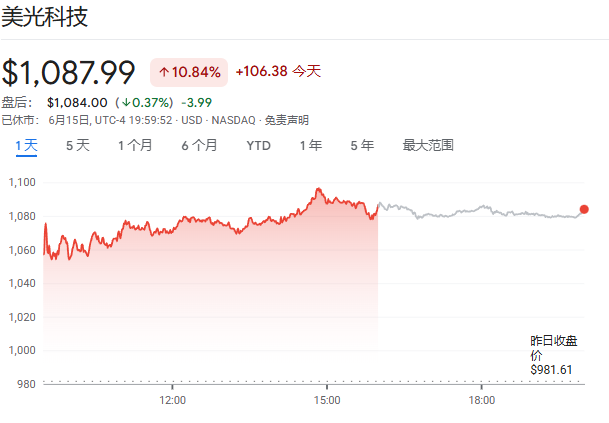
The core rationale behind this forecast lies in the sustained surge in prices for HBM and server DRAM, as well as the structural leap in the share of memory components within the AI hardware bill of materials (BOM). If realized, this scenario would position Micron as one of the biggest beneficiaries of the current AI hardware cycle.
Price target jumps directly to $1,600, with a complete overhaul of the valuation framework
Aletheia has now raised Micron’s price target from its previous level of $650 to $1,600—a gain of over 140%—implying 47% upside from the current share price. More notably, the firm has fundamentally shifted its valuation framework: moving away from a conservative approach based on historical peak price-to-book (P/B) multiples to a profit-driven model anchored on a 10x forward price-to-earnings (P/E) multiple for fiscal year 2027.
The logic underpinning this shift is that, given the structural demand pull from AI for memory, Micron’s profitability can no longer be appropriately assessed using cyclical historical valuation metrics; instead, it should be priced using earnings multiples typical of growth-oriented technology companies.
Upward revisions to HBM and server DRAM price forecasts
On pricing expectations, Aletheia’s upward adjustments also exceed market consensus. The report now forecasts that average selling prices (ASPs) for server DRAM will rise another 30% quarter-over-quarter in Q3 2026—significantly above its prior estimate of 10%–15%—and are expected to climb a further 10%–15% in Q4 2026.
For HBM, Aletheia predicts its ASP will double year-over-year by 2027. This projection is grounded in the continued explosive demand for high-bandwidth memory driven by AI training and inference workloads, while high technical barriers on the supply side further support an elevated price floor.
Memory components’ BOM share to exceed 70%; Vera CPU rack-level price may reach $26 million
The report's most striking insight stems from its analysis of the bill-of-materials (BOM) structure of AI hardware systems. Aletheia notes that the combined value share of memory components in AI hardware systems is expected to surge from the mid-40% range in 2025 to over 70% by 2027, making memory the most critical core component in AI hardware systems.
Taking NVIDIA’s Vera CPU as an example, the report states that SoC AAM alone accounted for more than 70% of the BOM cost in the second half of 2026; meanwhile, a fully configured Vera CPU rack could command an average selling price (ASP) as high as $26 million.