
According to reports, AMD is accelerating its procurement of CW lasers to reduce reliance on NVIDIA's ecosystem. Institutions forecast that the CPO/NPO market will surge from approximately USD 100 million in 2025 to over USD 39 billion by 2030. All silicon photonics solutions, including CPO and NPO architectures, require external CW lasers as light sources. Currently, the global CW laser market is highly concentrated, with Lumentum’s production capacity already booked through 2028, resulting in extremely tight supply.
$Advanced Micro Devices (AMD.US)$ is accelerating its strategic positioning within the optical interconnect supply chain, seeking to reduce reliance on $NVIDIA (NVDA.US)$ ecosystems, sparking heightened market interest in CW laser-related stocks.
According to the latest report from TrendForce, AMD has recently significantly accelerated its procurement of external lasers. The company is reportedly negotiating large-scale purchase agreements for high-power continuous-wave (CW) laser chips to secure future production capacity and mitigate supply chain risks associated with dependency on NVIDIA’s ecosystem.
 Meanwhile, the firm forecasts that the market size for co-packaged optics (CPO) and near-packaged optics (NPO) will surge from approximately USD 100 million in 2025 to over USD 39 billion by 2030, positioning optical interconnects as a core battleground in AI infrastructure competition.
This development has swiftly attracted interest from capital markets. Meanwhile, $Lumentum (LITE.US)$and$Coherent (COHR.US)$ Lumentum’s CW laser production capacity is already scheduled through 2028, and existing EML contracts have further tightened its CW laser capacity.
CW Lasers: The Critical Bottleneck in Optical Interconnects for AI Accelerator Cards
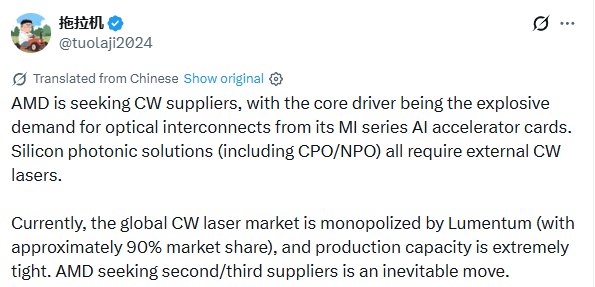
The global CW laser market is highly concentrated, with Lumentum accounting for approximately 90% of market share and facing severe capacity constraints. AMD’s pursuit of second- and third-source suppliers may be an 'inevitable move.'
According to analysis by X user @tuolaji2024, AMD’s primary motivation for seeking alternative CW laser suppliers stems from the explosive demand for optical interconnects driven by its MI-series AI accelerator cards—all silicon photonics solutions, including CPO and NPO architectures, require external CW lasers as light sources.
TrendForce’s report further corroborates this assessment. Since 2024, indium phosphide (InP) substrate supply has remained tight, making lasers and photodetectors strategic components fiercely contested across the industry.
An article by Wall Street News previously noted that both Lumentum and Coherent reported severe shortages in InP capacity, with order visibility extending to 2028 and long-term agreements (LTAs) covering through the end of the decade.
Large-scale commercialization of CPO still faces multiple challenges, including manufacturing yield, serviceability, standardization of fiber connectors, and constraints on InP laser supply. Moreover, scaled CPO switches require integration of numerous optical engines, exerting significant pressure on system-level overall yield.
NPO and CPO advance in parallel, with CSPs accelerating upstream resource securing
TrendForce notes that as data transmission rates evolve from 100 Gbps per lane toward 200 Gbps and even 400 Gbps, the limitations of traditional copper interconnects—particularly in terms of signal loss, equalization cost, and power consumption—are becoming increasingly pronounced. Bringing optical connectivity closer to the switch ASIC and shortening electrical paths has thus emerged as a critical design priority for next-generation AI data centers.
From a deployment perspective, NPO is the preferred near-to-mid-term transitional solution for many cloud service providers (CSPs), offering advantages such as shorter electrical transmission distances, lower power consumption, while maintaining modularity, serviceability, and the flexibility to procure from multiple vendors.$Alibaba (BABA.US)$/ $BABA-W (09988.HK)$ 、 $TENCENT (00700.HK)$ has designated NPO as a core mid-term strategic focus and is promoting related open standards through the Open Data Center Committee (ODCC); $Meta Platforms (META.US)$ and$Microsoft (MSFT.US)$ similarly prioritizes NPO development and is building an open optical interconnect ecosystem via the OCI-MSA;$Amazon (AMZN.US)$adopt a multi-supplier strategy and collaborate with$STMicroelectronics (STM.US)$on NPO-related initiatives.
Co-Packaged Optics (CPO), by contrast, is better suited for long-term applications requiring high power density and high integration. Within the NVIDIA ecosystem, some smaller- to mid-sized CSPs favor NVIDIA’s fully integrated CPO-based AI systems, valuing their system integration efficiency and platform consistency.
At the supply chain strategy level, the analysis indicates that hyperscale cloud providers will extend upstream to secure capacity in advance at the laser, epitaxial wafer, and even indium phosphide (InP) substrate levels to avoid being bottlenecked by NVIDIA.$Corning (GLW.US)$has already received investments, capacity expansion support, and long-term purchase commitments from Meta, NVIDIA, and Amazon, with optical fiber now regarded by major CSPs as a strategic asset for AI infrastructure.
Market Size and Technology Roadmap: A Multi-Architecture Coexistence Landscape Takes Shape
TrendForce forecasts that the CPO/NPO market will surpass USD 39 billion by 2030, with significant acceleration expected between 2028 and 2029 as scale-out architectures begin incorporating optical interconnect technologies. Meanwhile, the pluggable optical transceiver market is projected to remain sizable at approximately USD 26 billion by 2030.
The firm emphasizes that the future of optical interconnects will not be dominated by a single technology; instead, multiple architectures—including Linear Pluggable Optics (LPO), NPO, and CPO—will coexist over the long term. The specific adoption path will depend on a combination of factors, including power efficiency, transmission distance, cost, technological maturity, and supply chain control requirements across different application scenarios.
Editor/Jayden