
SpaceX made a textbook-perfect IPO debut, surging more than 30% in two days with no significant volatility throughout. Gavin Baker, a prominent hedge fund manager, has taken a substantial position, likening the company’s ultimate form to 'the East India Company of the Solar System era'—with orbital computing costs at just half those on Earth, and Cursor already embedded in over half of the Fortune 500 companies. He stated plainly: this may well be the most important enterprise in human history, without equal.
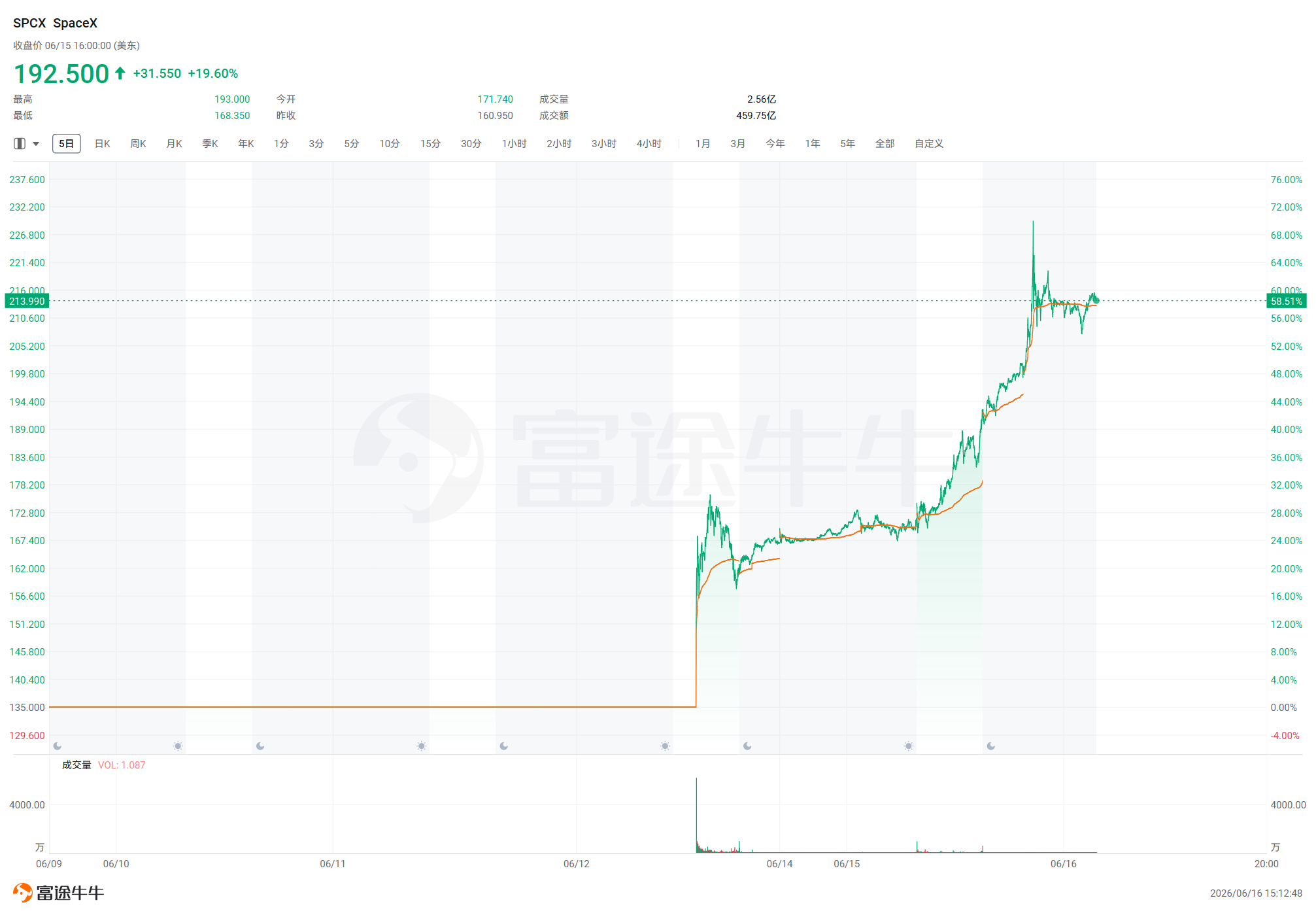
$SpaceX (SPCX.US)$ It made a nearly flawless debut on the public market through its initial public offering, with its share price rising more than 30% over two days without significant volatility.
Renowned hedge fund manager Gavin Baker believes the company not only possesses near-term commercial drivers well within reach but also has the potential to become "the most important enterprise in human history"—a vision he likens to a "British East India Company for the solar system era."
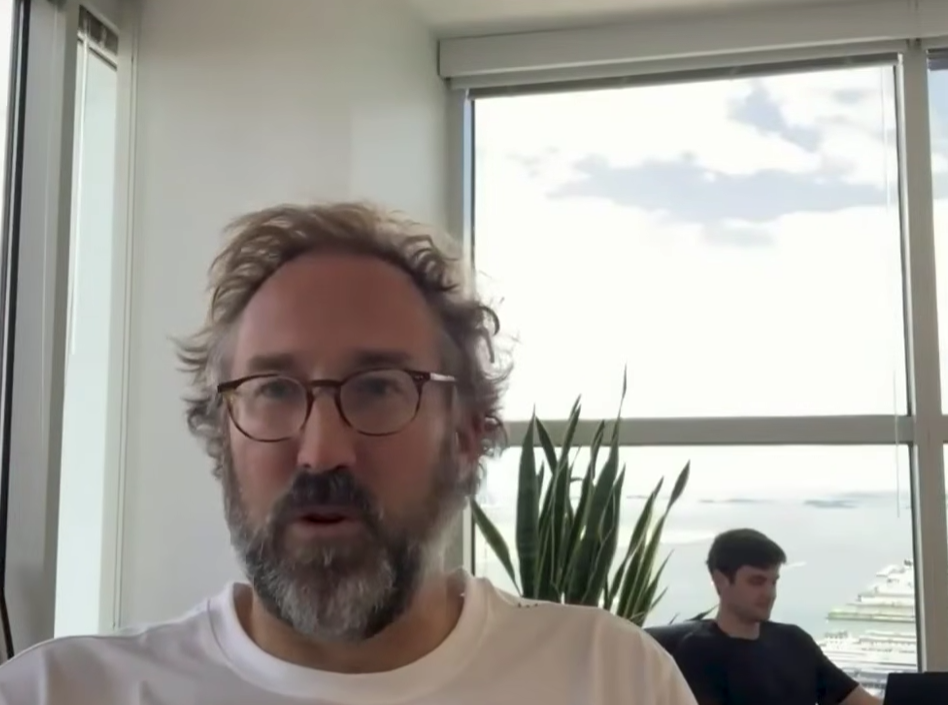
 Baker highly commended the underwriting teams from Goldman Sachs and Morgan Stanley, describing the execution as "textbook perfect"—priced accurately, leaving little value on the table and avoiding the dramatic post-listing surge-and-crash scenario. He also noted that over 10,000 SpaceX employees purchased shares in the IPO, and underlying market data indicates that institutional investors have been the primary buyers since listing, contradicting media narratives of retail investor-driven demand. Overall, the supply-demand dynamics are far more robust than external observers anticipated.
On the near-term commercial front, Baker highlighted two critical variables: first, the high-speed monetization capability of data center compute capacity—according to Altimeter-disclosed figures, SpaceX generates approximately $50 billion in revenue per gigawatt (GW) of compute capacity through its partnership with Google, representing a monetization efficiency roughly two to three times that of typical new cloud providers; second, the AI code editor Cursor has already penetrated more than half of Fortune 500 companies, demonstrating significant commercial traction. Baker stated plainly: "SpaceX’s business story is not as distant or speculative as many outsiders imagine."
From a longer-term perspective, Baker argues that once Starship achieves full reusability, the total deployment cost of orbital compute infrastructure will be only half that of terrestrial data centers, fundamentally rewriting the economic logic of compute infrastructure. Coupled with SpaceX’s multiplanetary civilization vision—including lunar and Martian city development—he admitted that SpaceX represents the "most extraordinary experience" of his career and asserted it is "highly likely to become the most important enterprise in human history."
Textbook Underwriting: Precise Pricing, Nearly 20% First-Day Gain
Baker described SpaceX’s IPO execution as exemplary. The stock rose nearly 20% on its first day without significant volatility—neither priced too conservatively (leaving excessive upside on the table) nor suffering a sharp post-surge correction due to supply-demand imbalances. He emphasized that Goldman Sachs and Morgan Stanley delivered exceptionally high-quality underwriting, and this smooth price discovery process itself stands as the highest testament to professional execution.
Regarding how public markets should evaluate SpaceX’s future, Baker acknowledged that quarterly results cannot be ignored but stressed that public markets typically exhibit greater tolerance for heavy-asset investment cycles than commonly assumed.
He cited $Tesla (TSLA.US)$ and $Amazon (AMZN.US)$ his experience building AWS: during the phase of large-scale infrastructure investment, both companies received considerable patience from public markets, whose time horizons far exceeded those of many participants in the venture capital ecosystem. In his view, this historical pattern also applies to SpaceX.
Near-Term Catalysts: Gigawatt-Scale Compute Monetization and Scalable Penetration of Cursor
Baker has focused the most notable near-term business drivers to track over the next 12 months on two primary themes.
The first theme is the rapid deployment and monetization of data center computing capacity.
NVIDIA CEO Jensen Huang has explicitly stated that SpaceX is building data centers faster than any other player in the industry.
According to Altimeter, SpaceX has already reserved approximately 20% of NVIDIA’s next-generation Rubin architecture chips. Compared to the previous-generation Blackwell platform, Rubin offers enhanced plug-and-play capabilities, significantly shortening data center deployment timelines. Baker also expects Groq’s LPU (Language Processing Unit) to be integrated into certain compute deployments within the next six to nine months, further optimizing inference latency. He noted that rapidly bringing 2 to 4 gigawatts of computing capacity online within the next year would directly generate revenue at an order-of-magnitude scale.
The second theme is the enterprise-scale adoption of Cursor.
This AI-native code editor has already been adopted by more than half of the Fortune 500 companies. Baker pointed out that Composer 2.5, trained on the Colossus 2 cluster and refined through reinforcement learning (RL) and supervised fine-tuning (SFT), has demonstrated Pareto-dominant advantages across multiple evaluation metrics. He believes that migrating it onto a more powerful foundation model will unlock further commercial value.
Regarding the tension between internal and external allocation of computing capacity, Baker remains optimistic. He argues that SpaceX’s ability to simultaneously supply compute resources to external clients such as Anthropic and Google stems from its strong confidence in rapidly scaling new capacity. He also notes that some external contracts include exit clauses, preserving SpaceX’s flexibility to reclaim capacity for its own model training in the future.
Orbital Compute: Disrupting the Cost Logic of Terrestrial Data Centers
Baker has articulated a clear mathematical framework for the economics of Orbital Compute, which constitutes one of his most compelling arguments for SpaceX’s long-term value proposition.
He noted that the total cost of deploying 1 gigawatt of computing capacity on the ground is approximately $60 billion, comprising $25 billion for power and cooling infrastructure and $35 billion for core IT equipment such as GPUs, CPUs, switches, and high-bandwidth memory.
In space orbit, there are no costly terrestrial expenses for power connectivity and cooling—only the costs of IT equipment and launch expenditures apply. Beck estimates that once Starship achieves full reusability, the launch cost for deploying a large volume of equivalent computing power to orbit would be approximately $5 billion, bringing the total deployment cost down to around $30 billion—roughly half the cost of ground-based alternatives.
He further noted that power and cooling costs for terrestrial data centers continue to rise with inflation, whereas orbital deployment is not subject to this constraint, and the cost gap between the two will widen over time. Beck believes that ordinary land does not lie along the core value chain of computing power, with the sole exception being specialized real estate directly connected to nuclear power plants—an asset class that is extremely scarce.
Robust supply-demand structure: Over 10,000 employees hold shares; institutions lead position-building
Beck believes that market concerns about post-IPO lock-up expiration selling pressure for SpaceX have been somewhat overstated, as the underlying supply-demand structure is significantly stronger than it appears on the surface.
He pointed out that more than 10,000 SpaceX employees subscribed to company stock in this IPO, demonstrating strong commitment to ownership. More importantly, SpaceX has historically offered employees and early investors an official share repurchase opportunity in the primary market every six months to provide liquidity. Any shareholder wishing to exit could have already done so through multiple prior tender offers. The remaining shareholder base consists primarily of long-term holders rather than short-term speculators waiting to cash out after lock-up expiration.
Beck also stated that his underlying data shows institutional investors were the primary buyers following the IPO, contradicting certain market rumors suggesting purely retail-driven demand. He generally holds a positive view of retail investors, noting that over the past three and a half years, retail investors as a group have outperformed the vast majority of professional fund managers. He emphasized that the term 'retail investor' should not carry a pejorative connotation.
The ultimate bet: 'The East India Company of the Solar System Era'
Beck makes no secret of his substantial SpaceX holdings and deep alignment with the company, positioning it as one of the most significant investments of his career.
He previously held a 15% stake in NVIDIA on behalf of his fund when its market capitalization was below $2 billion, and a 10% stake in Tesla when its valuation was similarly under $2 billion. However, he stated that SpaceX represents 'the most special experience' for him—'I believe it has the potential to become the most important and iconic company in human history, without peer—and perhaps even without the need for that qualifier.'
His ultimate thesis rests on several yet-to-be-realized but increasingly clear milestones: Starlink is connecting schools and hospitals in low-income countries to the internet at extremely low cost; once Starship achieves full reusability, orbital computing will become economically superior to terrestrial deployment; and if SpaceX ultimately establishes human cities on the Moon and Mars, enabling multiplanetary habitation, it will evolve into a solar-system-scale 'British East India Company.'
Beck acknowledged that there remain "a vast number of difficult engineering and physics challenges" to overcome before reaching this ultimate goal, but in his view, the probability of witnessing a significant portion of it realized within his lifetime is quite high. He specifically recommended that investors take their children to witness heavy-lift rocket launches in person near the Boca Chica site in Texas or Vandenberg Space Force Base in California—"The sound and the rolling waves of heat are far more visceral and awe-inspiring than anything seen on a screen, offering a tangible sense that humanity, as a species, is capable of achieving such miracles."
Editor/KOKO