
The U.S.-Iran conflict appears to be just one step away from resolution but continues to elude a final conclusion. A recent JPMorgan report warns that negotiations remain stuck in a state of 'perpetually approaching but never signing,' with only a 10% probability of an actual agreement being reached.
According to Xinhua News Agency, the U.S. and Iran have already completed electronic signing of their memorandum of understanding, with the formal signing ceremony scheduled for June 19, when the full text of the agreement will be released. On June 15, JPMorgan’s strategy team issued a report stating that analysts assign a 70% probability to the scenario of 'continuously nearing an agreement yet never finalizing it' in the near term; the probability of a formal signing stands at merely 10%; and there is a 20% chance of renewed conflict. The report explicitly cautions that if the situation remains stagnant for several more weeks, global equity markets may lose interest in the process altogether.
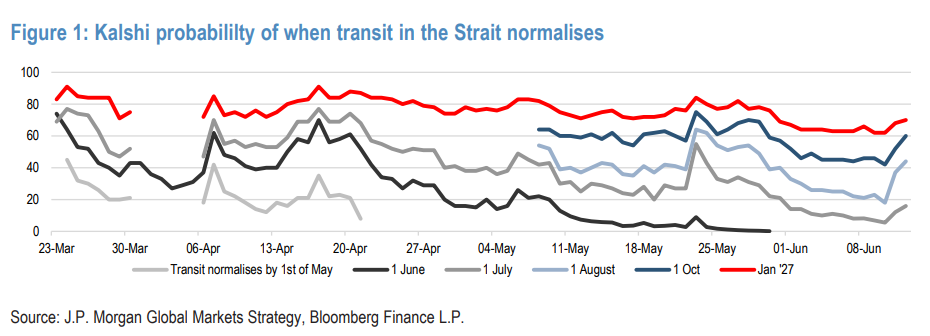
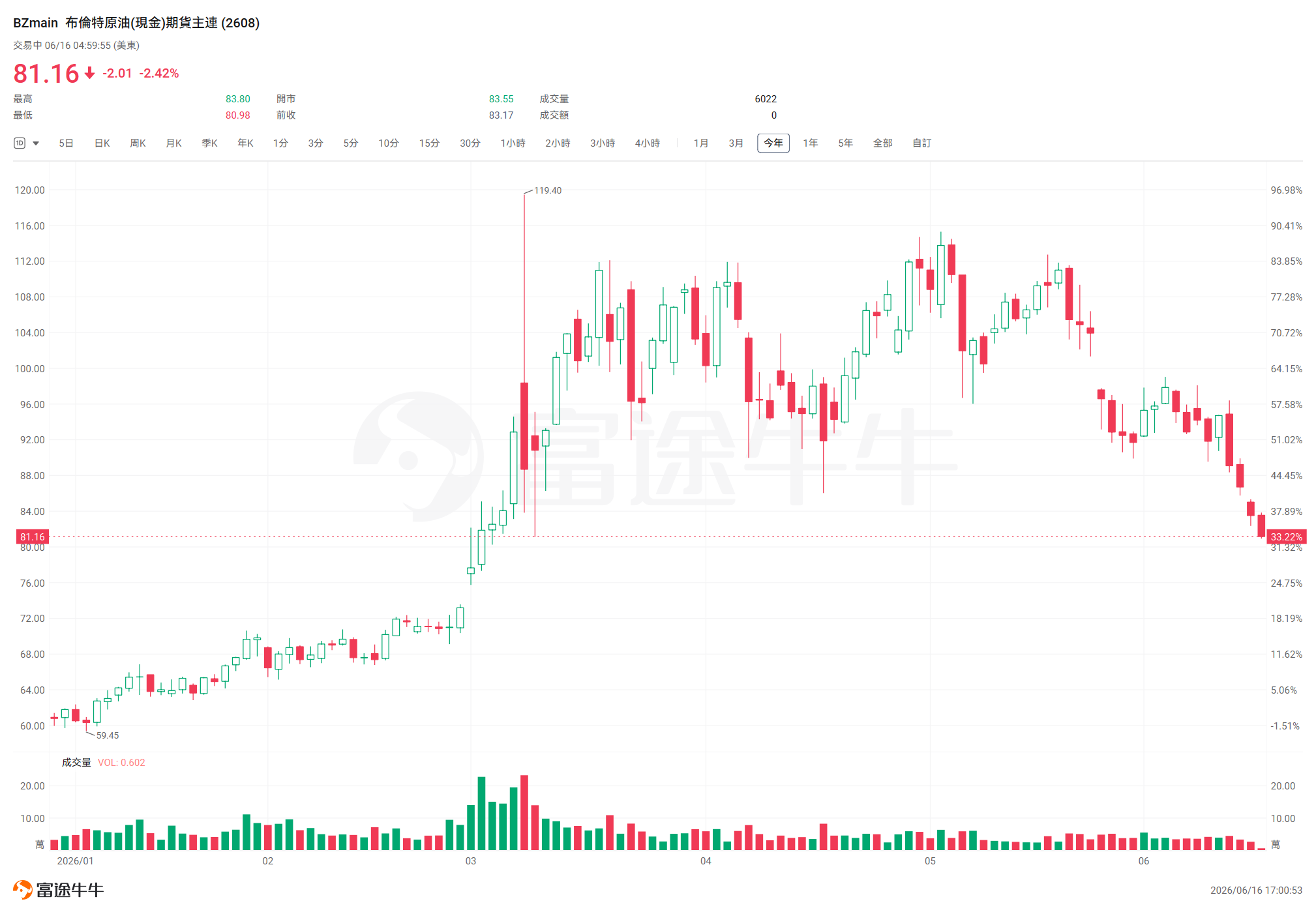
The partial reopening of the Strait of Hormuz and the continued decline in oil prices have somewhat diminished the marginal significance of the agreement for global markets.$Brent Last Day Financial Futures (AUG6) (BZmain.US)$ It closed at $87 per barrel last Friday, marking the lowest closing price since the outbreak of the conflict, down more than 26% from the conflict-driven peak of $118 per barrel. As of this writing, Brent crude is trading at $81.16 per barrel. JPMorgan notes that a strong stock market and low bond yields are viewed as key policy objectives of the Trump administration, and the voluntary decline in oil prices has objectively reduced Washington’s urgency to push for the swift implementation of the agreement.
 However, the costs continue to accumulate for Middle Eastern and North African assets. JPMorgan bluntly states that even if non-Middle Eastern markets can 'move forward,' sectors such as real estate and tourism in the UAE are unlikely to achieve a genuine, full recovery without a durable peace framework.
Three Scenarios: Negotiations Remain Deadlocked
Since Trump announced a ceasefire in early April, the resolution process for the U.S.-Iran conflict has continued to advance incrementally but has persistently failed to cross the threshold of formal signing.
JPMorgan outlines three possible trajectories for the current situation: first, both sides reach an agreement and the Strait of Hormuz fully reopens; second, conflict significantly reignites, pushing back expectations for any agreement; third, the status quo persists—continual approach toward a deal without ever signing it.
The firm assigns a 70% probability to the third scenario and candidly admits in its report that analysts 'lack the creativity and foresight' to envision how the United States, Iran, Israel, and Hezbollah could bridge their core differences.
The report details the core obstacles preventing finalization of the agreement.
First, Israel’s ongoing airstrikes on Beirut underscore the extreme difficulty of incorporating Israel and Hezbollah into any U.S.-Iran peace framework.
Second, as the conflict has progressed, the stated objectives of the United States and Israel have increasingly diverged.
Third, Iran inevitably questions whether any agreement signed with the United States could effectively constrain Israel’s actions.
Furthermore, the Trump administration’s eagerness to secure a deal it claims is 'better' than the Joint Comprehensive Plan of Action (JCPOA)—which it unilaterally abandoned during its first term—has introduced additional uncertainty into negotiations. Meanwhile, Iran’s decision-making process has noticeably slowed following leadership losses prior to the conflict, further heightening negotiation uncertainty.
Unusually sharp oil price decline leaves markets perplexed
Despite the prolonged partial closure of the Strait of Hormuz, oil prices have not surged significantly—a development that has left JPMorgan and many investors equally baffled. Brent crude has fallen from its conflict-driven peak of USD 118 per barrel to the current level of USD 87, still roughly 20% above the pre-conflict price of USD 72 per barrel but marking the lowest closing price since the outbreak of hostilities.
JPMorgan notes that the sustained decline in oil prices has actually weakened market expectations for an imminent deal. With the S&P 500 Index now reaching a record high and U.S. primary bond issuance volumes at historic levels, the report characterizes current market conditions as 'not a pullback' and adopts a cautious stance toward chasing rallies.
The market pricing reflected in falling oil prices and a rebounding global equity market already implies a more optimistic outlook than JPMorgan’s assessed 20% probability of conflict resumption—suggesting that markets may be underestimating tail risks.
JPMorgan believes that even if external conditions improve, relevant assets will struggle to achieve full recovery without a durable peace agreement. Regarding non-Middle Eastern CEEMEA markets—particularly South Africa—the report identifies the sustained depreciation of the U.S. dollar following its wartime appreciation as a key catalyst that could drive these markets to significantly outperform the broader emerging market (EM) universe.
Editor/melody