
Deutsche Bank has more than doubled its forecast for global humanoid robot shipments in 2026 to nearly 50,000 units, with projections of 700,000 units by 2030 and 7 million units by 2050. China is the core driver of this shipment growth, with an estimated 40,000 units to be shipped this year, led globally by manufacturers such as Unitree.
Deutsche Bank has significantly revised upward its global shipment forecast for humanoid robots, raising its 2026 projection from the previous baseline of 17,500 units (based on 2025 estimates) to nearly 50,000 units—an increase of more than twofold—and expects global shipments to reach 7 million units by 2050.
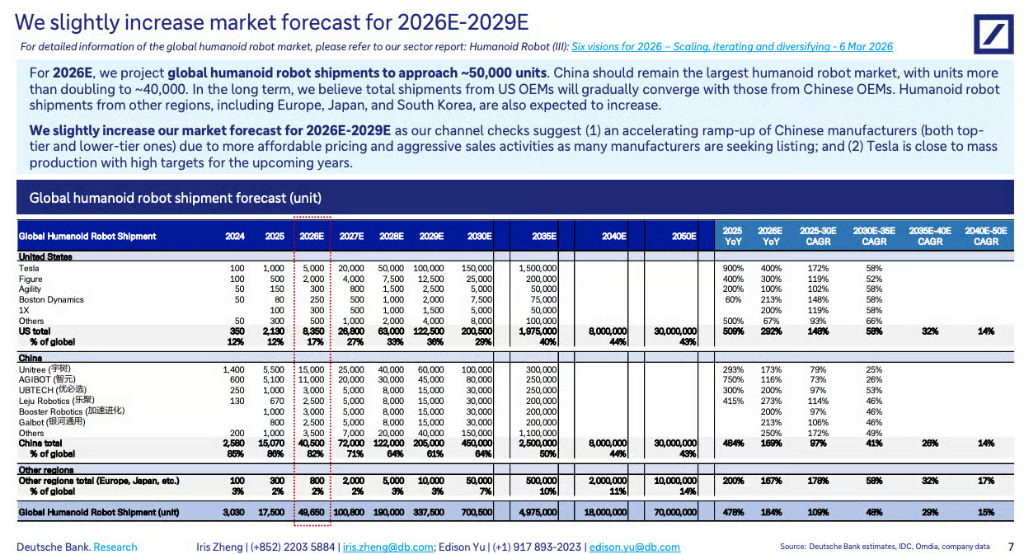
In a research report released Monday, Iris Zheng, Head of Automation and Industrial Research for Asia Pacific at Deutsche Bank, noted that the humanoid robot market is showing clear signs of scaling, driven by dual catalysts: accelerated mass production by Chinese manufacturers and Tesla’s push toward large-scale manufacturing. Her team has accordingly raised its global market forecasts for 2026 through 2029: global shipments are expected to approach 50,000 units in 2026, rise further to approximately 700,500 units by 2030, and reach a long-term target of 7 million units by 2050.
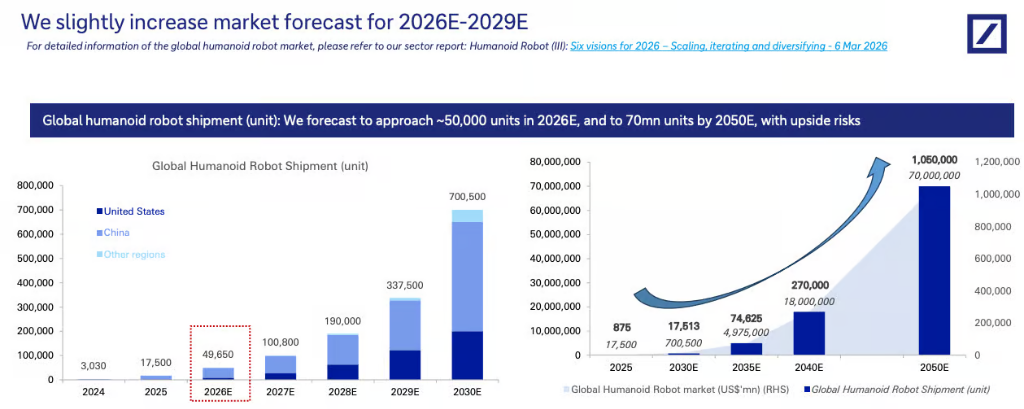
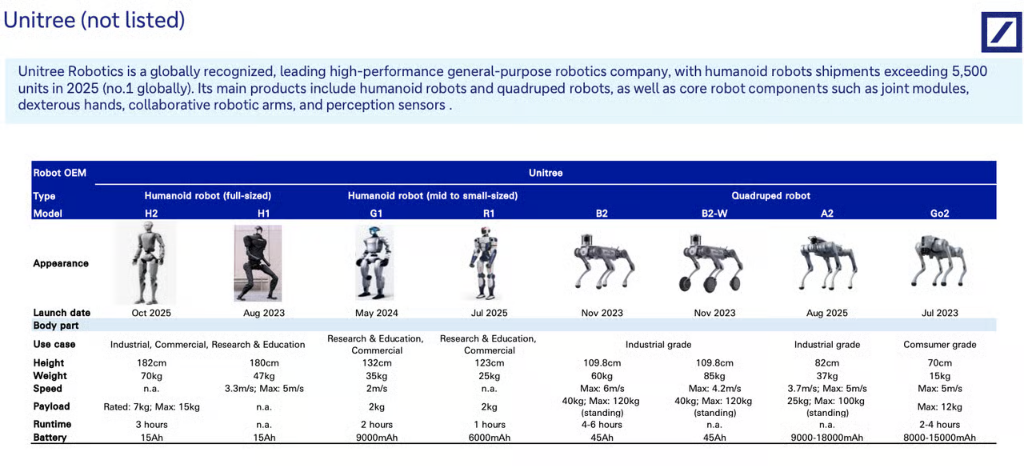
 China is expected to remain the world’s largest market for the foreseeable future, with shipments projected to double to approximately 40,000 units in 2026. Iris Zheng noted that Chinese manufacturers are accelerating volume ramp-up due to three key drivers: improved price accessibility, aggressive sales strategies, and IPO-fueled capacity expansion plans. Unitree has emerged as a market leader in this landscape; by contrast, U.S. shipments are expected to grow more gradually over a longer timeframe.
This assessment aligns with Goldman Sachs’ recent stance. Last month, Goldman Sachs’ Asia trading desk noted that the next phase of artificial intelligence development is shifting from chips to real-world deployment, with humanoid robots representing the clearest near-term monetization frontier. Structural tailwinds from labor shortages and rising automation demand are accelerating industry adoption and prompting investors to rotate capital into robotics-related companies in South Korea, Japan, and China.
Forecast Significantly Revised Upward: Scaling Signals Strengthen
In the report, Iris Zheng stated that the humanoid robot market is transitioning from a hype phase to an early stage of scaled commercialization—a shift that directly motivated the latest forecast revision. Deutsche Bank’s updated projection raises the 2026 global shipment target to nearly 50,000 units, more than doubling the prior estimate of 17,500 units (based on 2025 projections); the 2030 target jumps further to approximately 700,500 units; and the long-term market size target for 2050 reaches 7 million units.
Underpinning this scaling trend is the ongoing penetration of humanoid robots across diverse applications—from household cleaning and factory goods sorting to road and airspace navigation, and even military use. Iris Zheng believes that the capabilities of large models are extending beyond desktops and mobile devices to physical machines capable of autonomous operation in the real world, marking a critical inflection point as physical AI enters its scaling window.
From a regional perspective, China is the core engine driving this shipment growth. Deutsche Bank expects China’s 2026 shipments to double to approximately 40,000 units, accounting for the vast majority of the global forecast total.
Iris Zheng attributes this growth to three factors: continued price declines significantly enhancing affordability; leading manufacturers adopting aggressive sales strategies to capture market share; and numerous companies leveraging IPOs to accelerate capacity expansion. In this context, Unitree has emerged as a leading player in the industry. By contrast, shipment growth in the U.S. market is expected to be relatively modest, progressing incrementally over time.
Goldman Sachs echoes this logic in its long-term investment themes, arguing that as structural demand accelerates, robotics-related equities in Asia—benefiting from stronger growth momentum—still offer attractive valuation discounts. "This represents an early-cycle opportunity to position ahead of multi-year capital rotation into the robotics ecosystem," the firm noted. Currently, Goldman Sachs’ Asia Humanoid Robotics Basket (GSXACHUM) still has significant room to catch up relative to its Asia Power Basket (GSXAPOWG).
Editor/melody