
① Recent reports indicate that Microsoft is considering shifting Copilot Cowork to a usage-based pricing model and integrating open-source models such as DeepSeek to reduce agent operating costs; ② As the frequency of AI agent model calls surges, tech giants are transitioning from deploying the 'most powerful models' to selecting 'cost-effective models tailored to specific scenarios,' enabling Chinese open-source large models to accelerate their entry into global enterprise markets by leveraging cost advantages.
Shi Zhengchen, Editor at Caixin Media, reported on June 17: According to the latest news released early Wednesday Beijing time, Microsoft, the global cloud computing giant, is shifting its AI agent product Copilot Cowork to a 'pay-as-you-go' pricing model and exploring the adoption of open-source models like DeepSeek V4 to address the issue of 'AI being too expensive.'
For context, intelligent agent tools such as Microsoft’s Copilot Cowork, Anthropic’s Claude Code, and OpenAI’s Codex continuously invoke AI models while executing tasks. While these tools significantly enhance productivity, they also incur substantial computational expenses—particularly as an increasing number of AI providers adopt usage-based billing.
 Charles Lamanna, Executive Vice President of Copilot, Agents, and Platforms at Microsoft, told the media that internal testing has shown Copilot Cowork cannot be offered with unlimited usage.
Lamanna stated, 'We have users executing hundreds of tasks per week, which is great—their efficiency improves dramatically—but the cost can become extremely high.'
According to reports, Microsoft revealed it is exploring fine-tuned versions based on DeepSeek V4 or other open-source models as more cost-effective alternatives to power Copilot Cowork. Currently, the service routinely invokes models from Anthropic or OpenAI.
By comparison, Anthropic’s recently released Fable 5 model costs 50 times more per token than DeepSeek-V4 Pro. For most routine tasks that do not require cutting-edge AI capabilities, open-source models can deliver comparable performance at over 90% lower cost.
In a report last week, Citadel Securities noted that the shift toward cheaper models appears to be one factor behind the recent decline in the widely watched AI spending index. The report stated, 'Even the most powerful technologies must ultimately adhere to the mundane realities of cost curves, capacity constraints, and diminishing marginal returns.'
Data from startup Vercel shows that in the U.S. enterprise market, DeepSeek’s usage share surged from 1% in April to 17% in May.
Microsoft stated it expects to launch more affordable model options within the next few weeks and will confirm the final outcome at that time. The company emphasized that the models powering Microsoft’s AI agents will be fully hosted on Azure Cloud to ensure customer data remains within Microsoft’s cloud environment.
Incidentally, Chinese large AI model companies are collectively taking the lead in the open-source AI field.
In the early hours of Wednesday Beijing time, the 'Large Model Arena' updated its leaderboard, confirming that Zhipu AI's GLM-5.2 (Max) has risen to 10th place—up from GLM-5.1 at 13th and DeepSeek-V4 Pro at 14th.
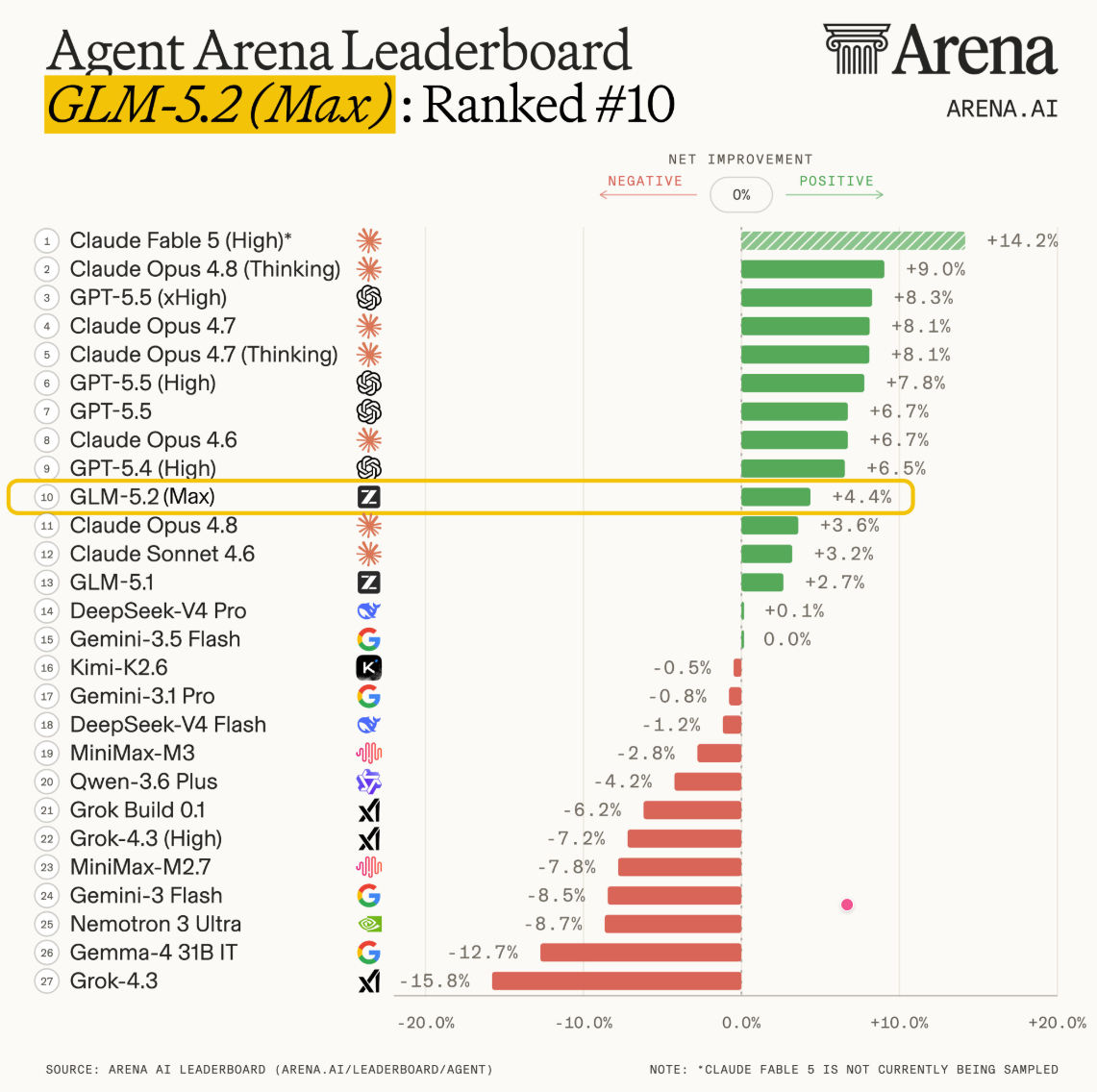
(Source: Arena)
Among the open-source large models on the leaderboard, apart from Zhipu, DeepSeek, Kimi, MiniMax, and Qwen, only NVIDIA’s Nemotron 3 Ultra and Google’s Gemma 4 remain—both positioned at the bottom of the list.
Editor/Liam