When 576 GPUs across eight racks operate in concert, copper cabling has reached its physical limits—optical interconnects have become an unavoidable hardware imperative for AI scaling. On June 16, Jensen Huang personally attended the groundbreaking ceremony in Texas for Coherent’s expanded facility, marking the first tangible milestone of NVIDIA’s $2 billion investment. The world’s first 6-inch indium phosphide mass production line is poised to accelerate, and the outcome of the compute power race may well be decided along this 'corridor of light.'
$NVIDIA (NVDA.US)$ and $Coherent (COHR.US)$ Its optical interconnect strategy is moving from paper to foundation.
On June 16, NVIDIA Founder and CEO Jensen Huang joined Coherent CEO Jim Anderson at the groundbreaking ceremony for Coherent’s expanded facility in Sherman, Texas.
 This expansion will increase capacity at the world’s first 6-inch indium phosphide (InP) wafer high-volume manufacturing line, supplying critical optical interconnect components for NVIDIA’s AI infrastructure. Coherent simultaneously announced it has received a $50 million subsidy under the CHIPS Act to support construction of the facility.
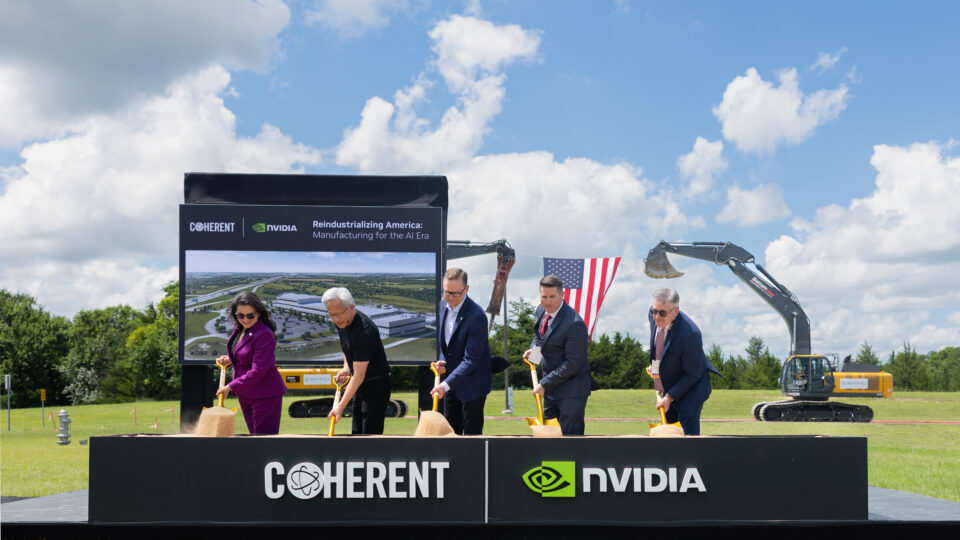
This groundbreaking marks the first tangible milestone following NVIDIA’s announcement in March of a $2 billion investment in Coherent and a multi-billion-dollar procurement commitment. It signifies a deepening of the two companies’ nearly two-decade-long partnership, reinforces the central role of optical interconnects in AI infrastructure development, and provides greater clarity on Coherent’s capacity expansion timeline.
Optical Interconnects: The Physical Bottleneck of AI Scaling
As AI systems continue to scale, the physical limitations of copper cabling are becoming a real constraint in data centers.
At the groundbreaking ceremony, Huang explained that when 576 GPUs operate across eight racks as a single system—as designed for NVIDIA’s upcoming Vera Rubin Ultra NVL576—copper cables can no longer handle inter-rack signal transmission. As signal speeds increase, the effective transmission distance of metal traces continues to shrink. Attempting to connect eight racks with copper would force data centers to expend significant power on signal conditioning and retiming—power that could otherwise be used for computation.
Although optical solutions incur a one-time penalty from electrical-to-optical conversion, once converted, distance imposes virtually no additional cost. At the scale of the NVL576, optical interconnects offer the greatest energy efficiency advantage.
Jim Anderson distilled this logic into a single statement: "AI runs on compute, but scales on connectivity—Sherman is where that connective tissue is being manufactured."
6-inch InP Wafers: The Technological Pivot for Capacity Leap
Coherent operates what it describes as the world’s first 6-inch indium phosphide (InP) high-volume manufacturing line in Sherman. This wafer size holds significant importance in the compound semiconductor industry.
Most InP production lines globally currently remain at the 3-inch or 4-inch wafer stage. Since wafer area scales with the square of the diameter, upgrading from 3 inches to 6 inches increases usable area by approximately fourfold, directly boosting the number of devices produced per batch and substantially reducing unit costs. This improvement in yield and cost structure forms the essential supply foundation required for large-scale AI deployment.
At the ceremony, Jensen Huang remarked that it took 50 years to build the first production line, yet capacity has quadrupled within just the past year—a clear metric of accelerating demand for accelerated computing.
The expanded facility will produce InP wafers and ultimately package them into pluggable optical modules—roughly the size of a USB flash drive—that insert directly into the front panel of NVIDIA network switches to transmit data between server racks in data centers where copper cabling falls short. These modules also serve as external laser sources for NVIDIA’s Spectrum-X Photonics and Quantum-X Photonics co-packaged optical switches.
Dual Drivers: Public Funding and Private Capital
This expansion has received financial support from both public and private sources.
On the public funding side, Coherent announced it has secured a $50 million subsidy under the CHIPS Act, in addition to approximately $17 million in earlier support from Texas’ CHIPS program and the Sherman Economic Development Corporation. The CHIPS Act, with a total appropriation of roughly $50 billion, aims to incentivize semiconductor manufacturing reshoring to the United States.
On the private capital side, NVIDIA announced in March a $2 billion investment in Coherent to support R&D, future capacity expansion, and U.S.-based manufacturing, accompanied by multi-billion-dollar purchase commitments for advanced lasers and optical networking products. NVIDIA has also previously announced new facilities in Arizona and Texas through industry partnerships, with plans to manufacture up to $500 billion worth of AI infrastructure in the United States.
At the ceremony, Jensen Huang stated, "Coherent is a world-class company, and the work you are doing is critical—not only for our future and the future of artificial intelligence, but also for America’s reindustrialization."
Editor /rice