
Recently, Duan Yongping has been actively engaging on a public platform (ID: Da Dao Wu Xing Wo You Xing), frequently interacting with users and addressing a range of investment-related questions on popular topics such as long-term investment returns, his 'farming-style' investment philosophy, Kweichow Moutai,Stock splitcontroversies, Pop Mart’s growth trajectory and store valuation, NVIDIA’s massive bond issuance, and the perceived valuation bubble surrounding SpaceX. His responses are straightforward and insightful, clearly reflecting a mature, long-term value investing mindset.
Accordingly, this article compiles his latest interactive content for readers’ reference.
I. Views on Investment Returns
User: Is it reasonable to invest in Pop Mart at HK$179 and Tencent at HK$466 at these prices?
 Da Dao: If you have to ask, you shouldn’t invest. Everyone’s opportunity cost differs significantly, and so does their understanding. You must be clear about it yourself before proceeding.
User: My math skills are only at an elementary school level [facepalm]. I’d be very satisfied if my average annualized return over 10 years exceeds 8%.
Da Dao: It sounds as if people with higher math skills could easily achieve more than 8%. In reality, most people likely won’t exceed 8% annualized returns over the long term. (June 4, 2026)
II. Foundational Investment Principles
User: I’m just an ordinary farmer with low emotional intelligence. I’d like to humbly ask you a question: How should I get started with learning about investing? Could you recommend some books to read?
Da Dao: Investing doesn’t require culture or emotional intelligence. Investing is actually very much like farming—you’re an insider in this field. (June 2, 2026)
A netizen quoted Buffett: 'If you buy a farm, do you go check every few days how tall the corn has grown? Would you be overly worried if someone said that due to export impacts, agricultural commodity prices are expected to decline this year?'
When you buy the farm, you intend to hold it indefinitely. I bought a farm in the 1980s, and my son runs it—I’ve only visited once. Even if I stood right next to the crops watching them, they wouldn’t grow any faster. Shouting encouragement like ‘Come on, come on!’ wouldn’t help at all.
I know agricultural commodity prices fluctuate, and I know some years yield better harvests than others. But since I’ve already bought the farm, I don’t care about economic forecasts or similar nonsense. What matters to me is that the farm receives consistent, attentive care. I hope the harvest keeps improving—and overall, that’s exactly what has happened.
III. On Moutai’s Stock Split: Speculators Are Irrelevant; Genuine Buyers Are Key
Netizen 1: Ordinary working-class individuals often don’t have enough cash to buy Moutai shares outright, so they start by buying Wuliangye instead. Once they’ve saved enough, they plan to switch to Moutai—but over time, it seems they’ll need more and more Wuliangye shares to exchange for one Moutai share. If Moutai shares were available in single-share lots, they wouldn’t even consider Wuliangye.
Da Dao: Ha! The senior management at Moutai really needs to see this.
Perhaps Moutai really should consider a stock split to make its shares more affordable for small investors? Honestly, I don’t know why Moutai refuses to split its stock—maybe because it has always been regarded as the ‘king of stocks’? With one lot costing over 100,000 RMB, many small investors simply can’t participate in Moutai’s growth. (June 10, 2026)
Netizen 2: It’s also meant to keep out most speculators.
Da Dao: Speculators have no impact on the company. There is only one true buyer—and once you understand that, everything else becomes irrelevant.
User 3: Dadao, why doesn’t Buffett’s Berkshire Hathaway ever split its stock? Buffett has explained that there’s a reason for this.
Dadao: What is BRK.B? It can be split when needed—don’t be dogmatic. (June 10, 2026)
IV. Regarding Pop Mart
1. On long-term profit margins
User: What do you think is the probability that Pop Mart’s profits will exceed Disney’s in 20 years?
Dadao: I genuinely believe the probability exceeds 50%. (June 2, 2026)
2. On the experiential value of physical stores
User: I’d like to ask you a question (or perhaps share an observation?): Since there’s no Pop Mart store in my area, I’ve never visited a physical store to purchase their products. I’m curious about the 'Celebrate' atmosphere Wang Ning mentioned in an interview—do you experience that feeling when visiting a Pop Mart store?
On a side note, every Children’s Day and birthday, I order Labubu online for my daughter. At those moments, I feel something similar to what Wang Ning described. It would be wonderful if physical stores could create such an atmosphere.
Dadao: Just as I’m not a user of Moutai, I’m also not yet a user of Pop Mart—but I can certainly see the joy it brings others.
Their physical stores overseas don’t seem very large; all are designed compactly, possibly due to cost considerations (prime locations are likely hard to secure in large sizes and extremely expensive). Nevertheless, the atmosphere inside the stores appears quite cheerful.
Dadao: Securing prime store locations is also a competitive advantage, but good storefronts still require waiting. Over the next five years, there should be more high-quality store locations available. (June 12, 2026)
V. On NVIDIA’s Bond Issuance: Indeed, It Seems Puzzling
User 1: A source familiar with the matter stated on Monday that NVIDIA plans to raise USD 20 billion through bond issuance in the United States to meet the substantial capital requirements for producing cutting-edge artificial intelligence (AI) chips.
The informed source noted that NVIDIA has not tapped the investment-grade bond market for five years, having previously raised USD 5 billion in June 2021.
Liu Chenggang: Given the current high interest rate environment, it feels puzzling that NVIDIA—a highly profitable company—would choose to issue bonds. The combination of these three facts just seems odd.
Dadao: Indeed, it seems puzzling.
Google has also raised substantial capital, but through equity issuance. Will SpaceX likely follow suit with an equity offering next? Could this be because there’s simply too much money in the market? Perhaps it’s a bubble?
User 2 quoting AI: This reason?
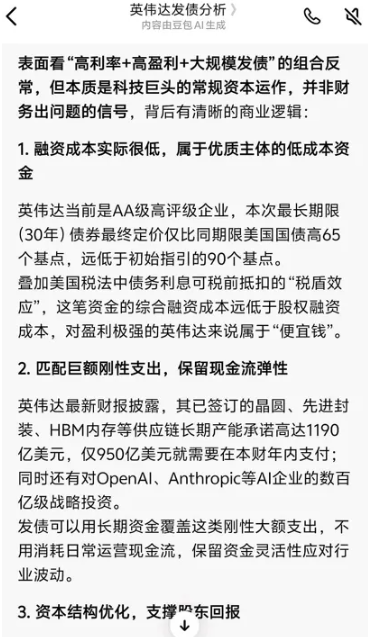
Dadao: That’s one of my guesses as well.
Apple also issues bonds, especially when interest rates are very low; it has issued a significant amount of debt. (June 17, 2026)
6. On SpaceX: It Might Not Be a Bubble
Shortly thereafter, Dadao revised his view again, this time regarding SpaceX, which had just gone public.
Dadao: Is it crazy? Overvalued? A bubble?
Today I took a rough look at the history of this company, which was actually founded as early as 2002, and began to understand why so many people have invested in it.
If SpaceX can generate annual earnings exceeding RMB 150 billion, then a market capitalization of RMB 3 trillion wouldn’t be unreasonable. Can it achieve annual earnings of over RMB 150 billion? It seems genuinely possible within five to ten years.
Therefore, this is likely not a bubble. After reviewing the company’s history, it’s hard not to admire Musk! (June 17, 2026)
Dadao: There are some things Musk does that I truly don’t understand, but he is undeniably extraordinary! SpaceX is a quintessential example.
Editor/joryn