
"New Bond King" Gundlach stated that newly appointed Federal Reserve Chair Volcker emphasized fulfilling the commitment to price stability, significantly reducing the likelihood of substantial rate cuts and thereby markedly enhancing the investment appeal of long-term U.S. Treasury bonds. Overnight, the yield on the rate-sensitive 2-year U.S. Treasury note surged by 13 basis points in a single day, while the 30-year yield briefly edged lower, narrowing the spread between the two maturities to its lowest level in over a year.
Jeffrey Gundlach, CEO of DoubleLine Capital and dubbed the 'New Bond King,' stated that the hawkish signals conveyed by Waller in his debut suggest that bets on accommodative monetary policy may prove misplaced, reinforcing the rationale for holding long-term U.S. Treasuries.
In an interview with CNBC on Wednesday local time, Gundlach said Waller’s remarks clearly signaled a firm commitment to delivering on price stability.
His comments today were nothing like those of the Fed chair many had expected earlier this year—one who would push for rate cuts.
He believes Waller has effectively staked his personal credibility on controlling inflation, significantly reducing the likelihood of substantial rate cuts. Gundlach added:
"The new sheriff is in town, and I believe the case for holding long-term Treasuries is now stronger."
The Fed’s hawkish signal overnight directly pressured short-end U.S. Treasury markets, while long-term Treasury yields attracted strong demand.
The yield on the 2-year U.S. Treasury note jumped approximately 13 basis points in a single day, reaching around 4.21%, while the 30-year Treasury yield briefly declined by about 2 basis points, causing the spread between 2-year and 30-year yields to narrow sharply to its lowest level in over a year.
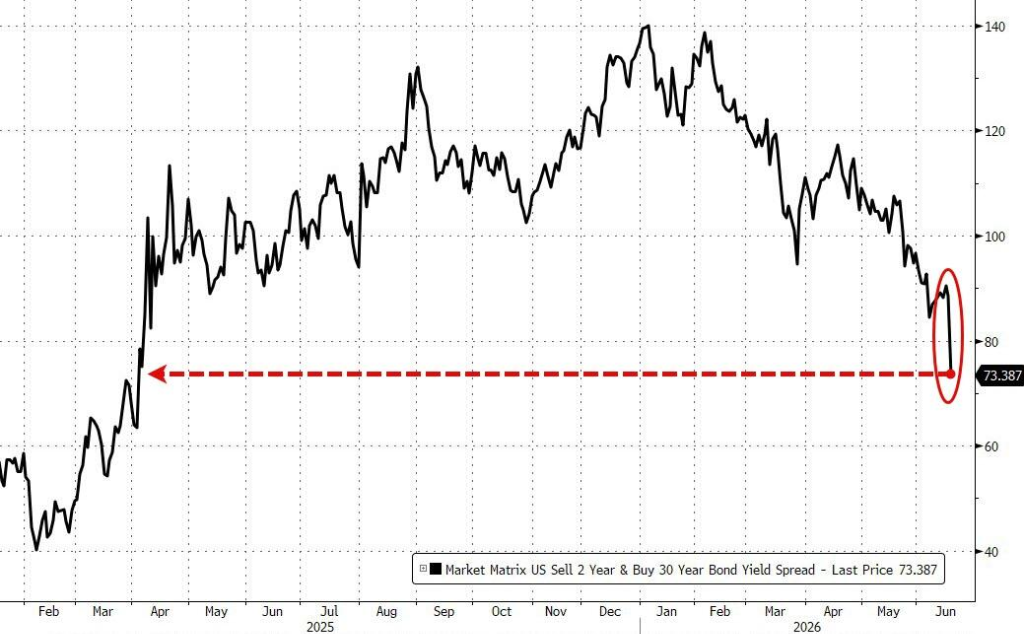
(The spread between 2-year and 30-year U.S. Treasury yields narrowed to its lowest level in over a year.)
Waller’s debut struck a tighter tone, weighing on market expectations for rate cuts.
During his first press conference, Waller repeatedly emphasized the price stability mandate, using clear and forceful language.
The Federal Reserve's policy statement included the phrase, 'The Committee will deliver on price stability,' language that was repeatedly echoed by Wallach during the press conference.
Wall Street Journal noted that Wallach stated during the press conference:
"The commitment to deliver is firm, consistent, and unequivocal—I believe this is a critical message that has been missing over the past five years, and we will correct it."
He also pointed out that inflation has failed to return to the 2% target for five years, expressing clear regret in his remarks.
This tone was more hawkish than expected by some market investors and economists. Previously, due to President Trump’s repeated criticisms of former Chair Powell for maintaining high interest rates, markets had anticipated that Wallach—nominated personally by Trump—would lean toward a more dovish monetary policy stance.
At this meeting, Wallach also made a notable decision to refrain from submitting his personal interest rate projection in the Fed’s dot plot.
Wallach also hinted that he would undertake a broader review of the Federal Reserve’s communication framework.
This signal suggests that he may intend to systematically adjust how the Federal Reserve communicates its policy signals externally, though the specific direction remains unclear.
Gundlach: Betting Credibility on Inflation Strengthens the Case for Buying Long-Duration Bonds
Gundlach believes that Wallach’s strong statement effectively created a self-imposed constraint. Gundlach said:
If he fails to deliver outcomes that can be described as 'price stability,' he has effectively declared today that he will be viewed as a failure.
This reputational bet makes aggressive rate cuts or excessively accommodative policies politically harder to justify. It is precisely based on this assessment that Gundlach believes long-term U.S. Treasury bonds currently offer stronger allocation value.
His reasoning is that if the Federal Reserve remains committed to price stability, the reflationary pressure on long-end bonds from excessively accommodative policy would be significantly reduced. He stated:
We do not need to worry that excessive accommodation or overly loose interest rates will exert further downward pressure on long-duration bonds.
Editor/Lee