
Bullish and bearish positions in China's AI large-model sector are intensifying. Zhipu AI's share price surged due to strong earnings expectations, robust pricing power, and the recent launch of its latest model, while MiniMax faced a rating downgrade following price cuts and significant share lock-up expirations in July. This sharp divergence has fueled a pairs trade strategy of going long on Zhipu AI and shorting MiniMax.
China's large AI model sector is witnessing a pronounced long-short divergence: $KNOWLEDGE ATLAS (02513.HK)$ its share price has surged 170% cumulatively since the end of March, $MINIMAX-W (00100.HK)$ while another has declined by approximately 50% over the same period. This sharp divergence in their price trajectories has created a highly attractive pairs trade—going long on Zhipu and short on MiniMax.
The core driver behind this divergence lies in a fundamental divergence in earnings expectations. Zhipu has raised pricing for its GLM series of models this year while maintaining sales volume, leading consensus market sales forecasts to surge nearly 250% from the start of the year—now surpassing those for MiniMax. In contrast, MiniMax slashed prices by 50% just one week after launching its flagship M3 model, prompting major investment banks including Goldman Sachs and JPMorgan to downgrade their ratings or target prices.
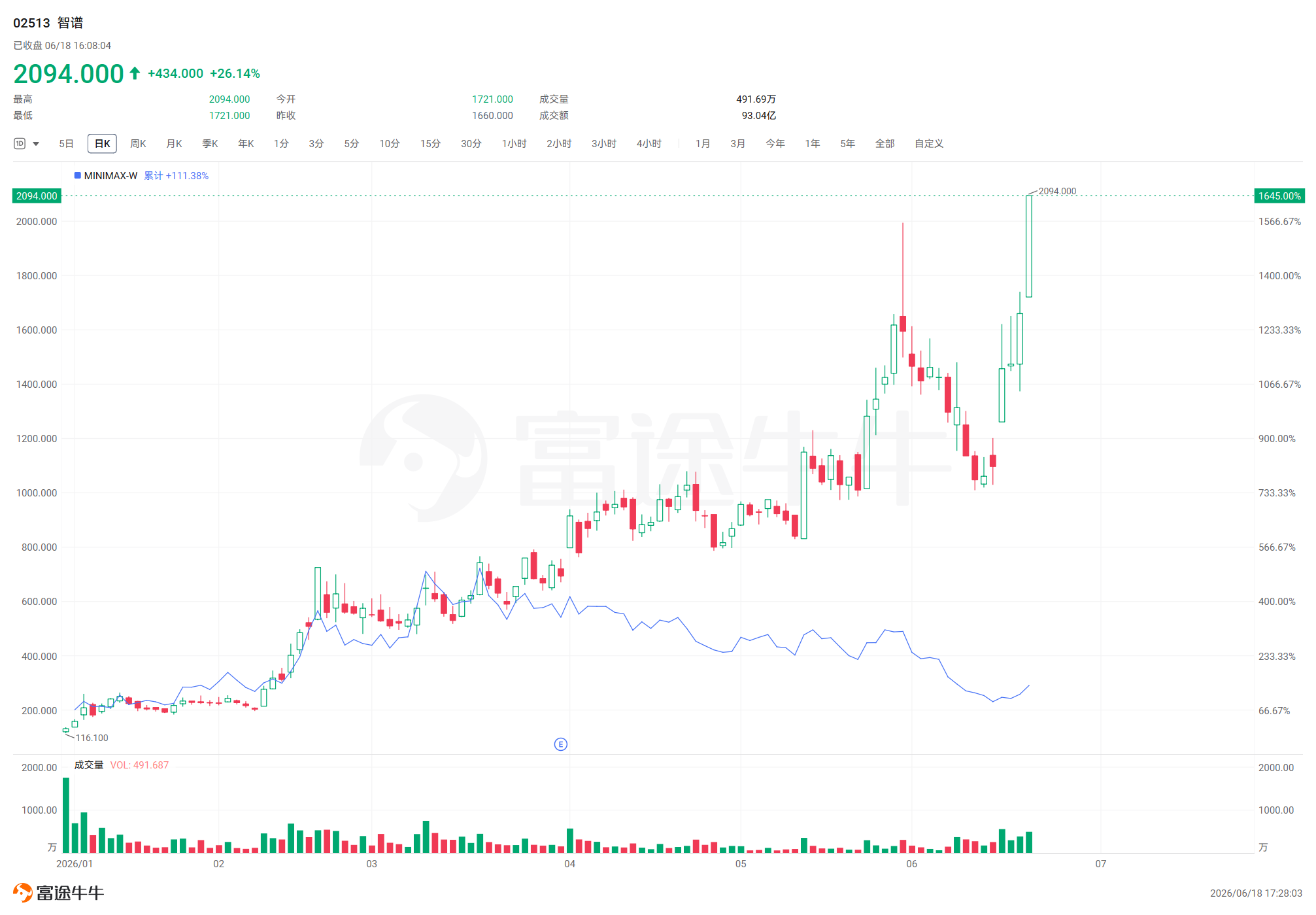
 An upcoming wave of IPO lock-up expirations in early July could further amplify momentum for this pairs trade. According to HSBC Holdings, approximately 65% of MiniMax’s total shares will become freely tradable on July 8, compared with only about 6% for Zhipu, which unlocks a day earlier. Analysts note that the larger unlock proportion for MiniMax will make its shares easier to borrow, thereby lowering short-selling costs and strengthening the position of short sellers.
A recent U.S. government executive order restricting foreign access to Anthropic’s top-tier products has drawn increased investor attention to China’s AI sector. Zhipu capitalized on this trend by releasing its strongest open-source model to date, GLM-5.2 (Max), propelling its share price up more than 70% this week alone and widening the performance gap with MiniMax.
Sharp Divergence in Share Prices and Earnings Expectations
Both Zhipu and MiniMax listed on the Hong Kong Stock Exchange in January this year. Initially, their share prices moved in tandem upward, placing them among the top three best-performing constituents of the Hang Seng Tech Index year-to-date. However, subsequent model updates and pricing adjustments have led to a marked divergence in their trajectories.
So far this year, Zhipu’s cumulative gain has exceeded 1,500%, making it the best-performing stock in the Hang Seng Tech Index; MiniMax, meanwhile, has fallen roughly 50% since the end of March. Leonid Mironov, portfolio manager at Gavekal Capital Ltd., told Bloomberg that going long on Zhipu and short on MiniMax is “a highly profitable trade.” He added that Zhipu’s outperformance is “not surprising,” as it “has superior models and structurally stronger profit potential.”
The gap between the two companies is equally stark when viewed through the lens of sales expectations. According to Bloomberg data, consensus market forecasts for Zhipu’s revenue have surged nearly 250% this year, now exceeding those for MiniMax—a clear sign that market assessments of their commercial prospects have fundamentally diverged.
Divergent Pricing Strategies Trigger Investment Bank Rating Revisions
The two companies have adopted starkly contrasting pricing strategies. Zhipu raised prices for its GLM series of models this year while sustaining sales volume, demonstrating strong pricing power. By contrast, MiniMax announced a 50% price cut for its latest flagship M3 model just one week after launch, aiming to attract a broader user base.
This pricing move triggered a swift response from Wall Street firms. Goldman Sachs downgraded MiniMax's target price by 14% in a research note released this week, citing negative impacts on margins from the price reduction. Meanwhile, JPMorgan analyst Olivia Xu upgraded Zhipu’s target price while downgrading MiniMax, characterizing its lower pricing as a 'signal that model capabilities are below expectations.' A spokesperson for MiniMax did not respond to Bloomberg’s request for comment on these market views.
Meanwhile, model performance data further supports Zhipu’s confidence in its pricing strategy. According to benchmarking platform Arena.AI, Zhipu’s GLM-5.2 (Max) ranks second globally in front-end coding capability, trailing only Claude Fable 5. Leonid Mironov noted that Zhipu is 'better at convincing the market that its customers exhibit stronger stickiness.'
Lock-up expiration pressure serves as a key catalyst for bullish and bearish sentiment.
Analysts view the expiration of IPO cornerstone investor lock-ups in early July as a pivotal moment for further divergence in this paired trade. HSBC Holdings estimates that approximately 65% of MiniMax’s total shares will be unlocked on July 8, compared with only about 6% for Zhipu on July 7.
The stark disparity in unlock volumes will directly affect liquidity dynamics and short-selling costs for both stocks. The influx of a large volume of newly tradable shares will make MiniMax stock easier to borrow, lowering securities lending fees and thereby offering short sellers a cheaper window for execution. As previously reported by Bloomberg, Hong Kong markets face up to $33 billion in lock-up expirations, with AI-related listings exhibiting particularly concentrated unlocking effects.
Although shorting MiniMax has become a popular market trade, some institutions have cautioned against excessive one-sided positioning. Bank of America Securities this week initiated coverage of both Zhipu and MiniMax with Buy ratings, arguing that MiniMax could stage a catch-up rally once lock-up overhang is absorbed.
Felix Wang, head of the technology sector at Hedgeye Risk Management, acknowledged that 'shorting MiniMax is currently quite fashionable,' but emphasized that both companies face similar long-term challenges. He is the only analyst tracked by Bloomberg to assign Zhipu an effective Sell-equivalent rating. His primary arguments include competitive threats from DeepSeek, whose lower pricing has already sparked a price war in China’s AI sector following the launch of its V4 model—putting Zhipu’s pricing power to the test. Additionally, he highlighted ongoing IPO supply pressures: domestic competitors such as Moonshot AI’s Kimi chatbot, along with major U.S. AI firms, all have potential listing prospects that could dilute investor interest in existing names.
Editor/KOKO