
$NVIDIA (NVDA.US)$Topping the data center Ethernet switch market demonstrates that the 'AI compute chain demand surge' has expanded comprehensively from AI GPU and AI ASIC/TPU compute clusters to the entire AI compute ecosystem—including HBM, advanced packaging systems, high-performance Ethernet networking infrastructure, optical interconnect systems, DPUs, data center cabling, ABF/glass substrates, switching chips, and even gas turbines and power management systems.
According to Zhitong Finance APP, a newly released research report from the globally renowned research firm IDC indicates that the world’s highest-market-cap company—the dominant leader in AI chips,$NVIDIA (NVDA.US)$has become the top global supplier in the data center Ethernet switch market by revenue for the first time. According to IDC’s 'Quarterly Ethernet Switch Tracker,' the global Ethernet switch market surged 39.8% year-over-year in the first quarter of 2026, reaching $15.4 billion. IDC’s latest findings align with views from Wall Street giants such as Morgan Stanley, Goldman Sachs, and Bank of America, which hold that AI compute supply chain leaders like NVIDIA are expanding their control beyond 'GPU/AI chip-centric dominance' toward a system-level closed-loop 'AI factory' encompassing GPU clusters, networking, DPUs, optical interconnects, and software ecosystems.
The research firm noted in its report that as global AI computing infrastructure deployment accelerates rapidly, the entire suite of AI computing requirements linked to AI data center delivery has surged collectively. In particular, high-speed switching infrastructure within hyperscale cloud and enterprise data centers—a key segment—soared 61% year-over-year to $10 billion, accounting for the vast majority of the total $15.4 billion market, driven by massive-scale AI inference and training workloads fueling infrastructure investment.
 Morgan Stanley stated that the AI computing arms race has entered a system-level expansion phase. The firm has significantly revised upward its capital expenditure forecast for major U.S. tech giants in 2026—from $433 billion a year ago to $805 billion—and further raised its 2027 projection to $1.1 trillion, up from the previous estimate of $950 billion. This latest outlook underscores that supply chain bottlenecks in AI computing infrastructure have expanded beyond bulk GPU/ASIC procurement to encompass the entire delivery pipeline for AI data centers, including power equipment, liquid cooling systems, CPUs, DRAM/NAND/HBM memory, optical communications/interconnects, high-performance Ethernet networking infrastructure, transformers, and gas turbines.
According to IDC’s granular data, total revenue from enterprise-class campus and branch Ethernet switches worldwide grew 12.3% year-over-year in the first quarter of 2026, reaching $5.4 billion.
In a landmark shift, NVIDIA has become the top vendor in the data center Ethernet switch market by total revenue for the first time. IDC added that campus and branch switching business grew 12.3% year-over-year, supported by hardware refresh cycles and rising component prices.
IDC data shows that NVIDIA’s Spectrum-X platform, with 192.7% year-over-year growth and $2.1 billion in quarterly revenue, captured strong demand from hyperscale cloud providers and large enterprises for AI-factory-style network infrastructure through its co-designed integration of AI GPU clusters and networking infrastructure. The research firm noted that this structural shift is redrawing vendor rankings in the data center networking industry.
According to IDC, NVIDIA becoming the leading supplier in the data center Ethernet switch market in the first quarter of 2026 marks a transformation in data center networking, reflecting the growing influence of next-generation AI computing infrastructure clusters on procurement decisions. Buyers focusing on AI-factory-type campuses have already begun factoring sustained increases in average selling price (ASP) into their budget planning.
“NVIDIA’s rise to the top of the data center Ethernet switch market within just one year represents one of the most significant shifts in vendor dynamics that IDC has tracked in enterprise networking. The Spectrum-X-led integrated design of AI GPUs and networking infrastructure is winning numerous AI factory deals—something incumbent networking vendors cannot match with standalone hardware alone. The campus side tells a different but equally important story: the wave of Ethernet infrastructure upgrades is real, but once memory supply constraints ease, IT teams should prepare for ASP normalization. Budget for this shift now—not after prices change,” said Paul Nicholson, Vice President of Cloud and Datacenter Networking Research at IDC.
It is understood that although the core function of a switch relies on a 'switch chip' to rapidly forward data packets, without memory chips performing critical backend tasks—including software boot-up, configuration storage, address lookups, and data buffering—the switch would be completely non-functional. Buffer memory, typically ultra-high-speed SRAM or DRAM, is often the most critical determinant of switch performance.
IDC notes that massive-scale AI inference deployments are accelerating among hyperscale cloud providers and large organizations, primarily aimed at enhancing customer experience, reducing operational risk, and empowering key business functions such as IT infrastructure and operations, software development, and sales. According to IDC’s report, the widespread adoption of AI workloads—from large-scale training clusters to edge inference—is driving sustained demand for high-speed, low-latency data center network infrastructure.
Spectrum-X is fundamentally reshaping the landscape of data center networking infrastructure, extending the 'AI compute arms race narrative' from GPUs to switches and numerous other domains within the AI compute ecosystem.
IDC forecasts that the Ethernet switch market will maintain strong growth momentum through 2026, driven by continued massive investments in AI compute infrastructure by hyperscale cloud providers and enterprises. The research firm noted that robust demand for high-speed data center switching—particularly for 800G and higher speeds—is expected to remain strong as inference deployments scale alongside training workloads.
IDC added that NVIDIA’s position will face mounting competitive responses from$Cisco (CSCO.US)$, Arista Networks, and$Broadcom (AVGO.US)$—long-established suppliers within the Ethernet ecosystem—making the data center segment one of the most intensely contested submarkets in networking.
IDC stated that refresh cycles in campus and branch environments are expected to remain robust; however, overall revenue growth could moderate if supply constraints on memory/storage chips ease significantly and weaken the average selling price (ASP) tailwinds. IDC also highlighted that significant macroeconomic uncertainties—particularly tariff risks and regional economic volatility—remain key factors warranting close monitoring, as they may dampen investment decisions in certain regions.
Below is IDC’s latest compilation of the competitive landscape in the global data center Ethernet switch market:
IDC noted that NVIDIA’s Ethernet switch revenue is entirely derived from the data center segment, skyrocketing 192.7% year-over-year in the first quarter of 2026 to reach $2.1 billion, giving it a commanding 21.5% share of this segment. The company’s proprietary Spectrum-X high-performance Ethernet platform is an end-to-end networking solution for AI data centers, integrating Spectrum Ethernet switches with BlueField DPUs and NVIDIA$LiNKX,Inc. (584A.JP)$cable systems, purpose-built for NVIDIA’s large-scale AI GPU compute clusters. It has become the preferred network interconnect solution for large-scale AI training and inference clusters and has gained significant adoption among hyperscale cloud providers and AI-native cloud service companies leading the construction of AI factories.
92% of Arista’s Ethernet switch revenue comes from the data center segment. In the first quarter of 2026, its high-performance Ethernet-related revenue grew 37.3% year-over-year to $2.2 billion—meaning NVIDIA’s standalone Ethernet switch revenue alone nearly matched Arista’s total Ethernet revenue. Although Arista’s total Ethernet switch revenue of approximately $2.2 billion slightly exceeds NVIDIA’s, about 92% of that—roughly $2.02 billion—is attributable to data center Ethernet. According to IDC, Arista holds a 14.6% share of the overall Ethernet switch market and a 20.7% share in the data center subsegment, maintaining a strong growth position in 400G and 800G deployments targeting hyperscale cloud customers.
IDC reported that Cisco’s total Ethernet switch-related revenue grew 24% year-over-year in the first quarter of 2026, securing a 29.3% market share. Non-data center revenue accounted for 60.5% of Cisco’s total switch revenue and rose 14.1% year-over-year, reflecting favorable network infrastructure refresh trends in campus and branch environments. Meanwhile, data center-related revenue surged 43% year-over-year, driven by strong demand for AI compute infrastructure. Additionally, IDC stated that Cisco’s total router-related revenue increased 24.4% year-over-year in the first quarter of 2026, enabling the company to capture a commanding 35.1% market share.
$Hewlett Packard Enterprise (HPE.US)$
According to IDC, 70.5% of Hewlett Packard Enterprise's total Ethernet switch revenue comes from non-data-center segments. The company reported a 15.4% year-over-year increase in total Ethernet switch-related revenue for the first quarter of 2026, capturing a market share of 6.4%. Following the completion of all acquisition activities in July 2025, Hewlett Packard Enterprise’s revenue figures now include Juniper Networks. IDC notes that the company’s expanded portfolio for campus and branch networking is effectively converting the current upgrade cycle into strong revenue growth.
Huawei
According to the latest IDC data, Chinese technology giant Huawei reported a substantial 27.2% year-over-year increase in total Ethernet switch-related revenue in the first quarter of 2026, reaching USD 895 million and securing a market share of 5.8%. IDC also noted that Huawei’s router-related revenue grew by 0.8% year-over-year in the same period, with a market share of approximately 25.4%, underscoring its sustained strength in the service provider networking segment—particularly in China and certain emerging markets.
From GPUs to Ethernet Switching, AI Factory Construction Is in Full Swing: Under Goldman Sachs’ Capital-Intensive AI Infrastructure Thesis, the Bull Market in the Compute Chain Is Far From Over
As highlighted in IDC’s research report, NVIDIA and other leaders in the AI compute ecosystem are expanding their scope beyond single-point control via 'GPUs/AI chips' toward an end-to-end, system-level closed loop encompassing 'GPUs + networking + DPUs + optical interconnects + software.' The bottleneck for AI training and inference clusters is no longer merely about 'how many GPUs to buy,' but whether GPUs can achieve synchronization, parameter transfer, inference scheduling, and multi-tenant isolation through low-latency, high-bandwidth, low-loss, and highly utilized networks.
In other words, NVIDIA’s rise to the top of the data center Ethernet switching market demonstrates that the surging demand along the AI compute chain has fully extended beyond AI GPU and AI ASIC/TPU compute clusters to encompass the entire AI infrastructure stack—including HBM, advanced packaging systems, high-performance Ethernet networking infrastructure, optical interconnects, DPUs, data center cabling, ABF/glass substrates, switching chips, and even gas turbines and power management systems.
A recent Goldman Sachs research report indicates that AI CapEx—the capital spending associated with artificial intelligence—is no longer limited to large-scale purchases of NVIDIA Blackwell/Rubin AI GPU compute clusters. Instead, it now encompasses a comprehensive, system-wide investment across the entire AI factory value chain, including data center power equipment, liquid cooling systems, data center CPUs, DRAM/NAND/HBM memory, optical communications and interconnects, high-performance Ethernet networking infrastructure, data center interconnect (DCI) high-speed links, transformers, and gas turbines. On Wednesday, NVIDIA CEO Jensen Huang stated that artificial intelligence could usher in a new era of manufacturing and industrial growth in the United States.
According to Goldman Sachs’ base-case framework, hyperscale cloud providers are projected to invest approximately $770 billion in 2026—nearly equivalent to their total operating cash flow. The firm forecasts cumulative AI infrastructure capital expenditures of around $7.6 trillion between 2026 and 2031, with annual AI CapEx reaching at least $765 billion in 2026 and rising to approximately $1.6 trillion by 2031. In the view of Goldman Sachs analysts, the market’s pricing logic for the AI wave is shifting from 'who develops the most powerful AI foundation models or AI application software' to 'who can rapidly build AI compute clusters, deliver massive-scale power and cooling, accelerate intra-data-center optical interconnects and inter-data-center DCI links, and continuously iterate the next generation of AI factories.'
In the view of Wall Street financial giant Goldman Sachs, the global bull market centered on the AI compute chain is far from over. The market’s core narrative has evolved from the long-standing 'software-driven, light-asset valuation expansion based on programming/code'—dominant since 2008—to a 're-pricing of physical AI compute infrastructure assets.' Goldman Sachs’ latest assessment implies that the next wave of excess alpha returns will no longer be confined solely to top-tier leaders in the AI GPU/AI ASIC space, but will systematically spread across the full-stack AI infrastructure layer of the 'AI factory,' including high-performance data center CPUs, DRAM/NAND/HBM memory, AI PCBs, liquid cooling systems, data center optical interconnects, ABF substrates/glass substrates, MLCCs, electronic fabrics, and broad-based wafer foundry services.
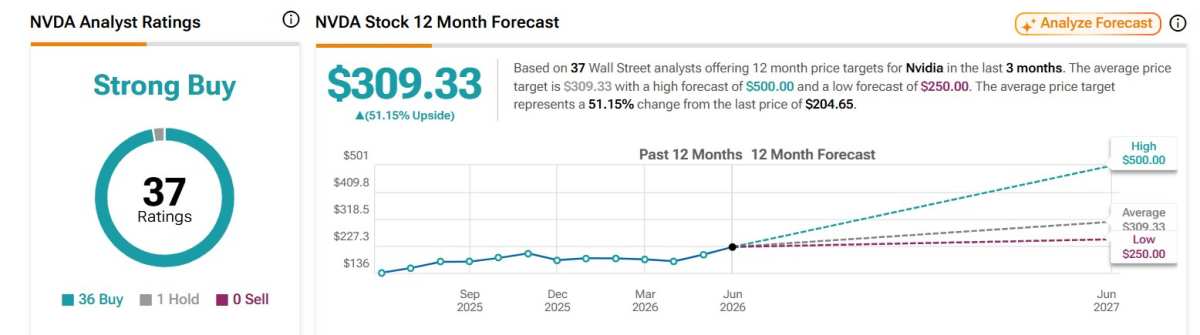
Among Wall Street analysts, MarketBeat shows that 54 senior analysts have assigned NVIDIA a 12-month average price target of USD 305.67, with a high of USD 500; TipRanks reports an average target of USD 311.41 from 37 senior analysts, also with a high of USD 500; and Investing.com indicates an average target of USD 298.93 from 59 analysts, again with a high of USD 500. The average target of USD 305.67 implies a market capitalization of approximately USD 7.43 trillion; at the high target of USD 500, the implied market cap would reach roughly USD 12.15 trillion. By comparison, NVIDIA was trading around USD 207 in pre-market activity on Thursday, with a market capitalization hovering near USD 4.95 trillion.
Editor/Deng