
① Amazon is in talks with enterprises to sell its self-developed AI chips, challenging NVIDIA's market dominance; its stock price rose on the news. ② Amazon’s AI accelerator chip, Trainium, has already attracted major clients including OpenAI, Anthropic, and Uber Technologies. In April this year, the company stated that Trainium had generated over $225 billion in committed revenue.
According to Caixin News on June 19 (edited by Zhao Hao), Amazon is negotiating with potential customers to sell its self-developed artificial intelligence chips to other companies’ data centers, further challenging NVIDIA’s dominant position in the AI chip market.
Amazon executive Peter DeSantis, speaking in Paris, said the company has already begun engaging with some enterprises but declined to disclose the list of potential clients. “We believe AI infrastructure is evolving rapidly, and we are continuously exploring ways to expand our customer base.”
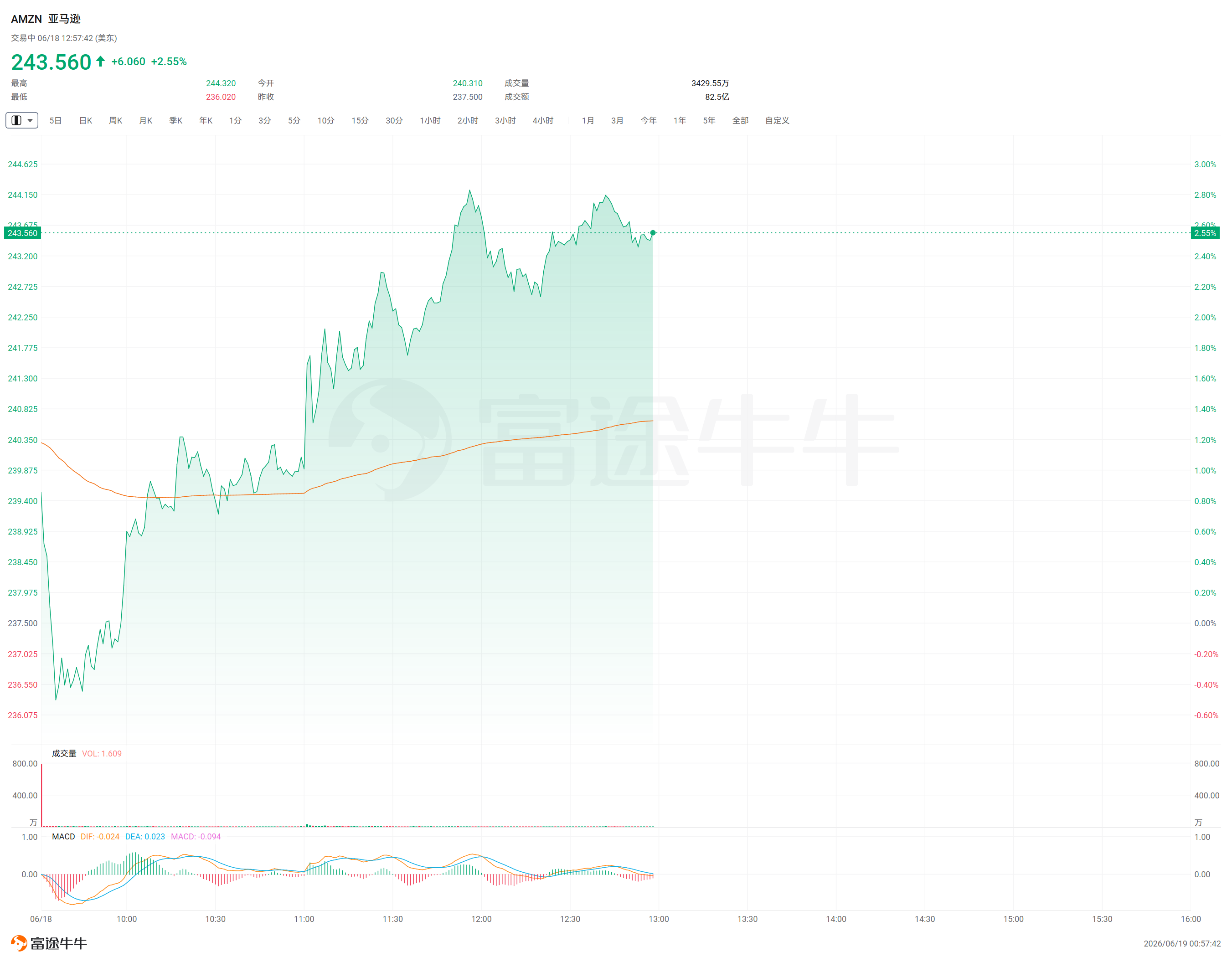
 Boosted by this news, Amazon’s share price rose nearly 2.9% intraday on Thursday, reaching an intraday high of $244.32.
Amazon launched its AI accelerator chip, Trainium, in 2020. It has since attracted heavyweight clients such as OpenAI, Anthropic, and Uber Technologies, which can access the hardware through Amazon Web Services (AWS).
In April this year, Amazon stated that Trainium had already secured over $225 billion in committed revenue. In the same month, CEO Andy Jassy wrote in his annual letter to shareholders that the company was “fully capable” of selling chips directly to third parties.
This move is also part of Amazon’s broader strategic repositioning around its AI business. Previously, the company was widely perceived as lagging behind competitors in the field of artificial intelligence.
Since the launch of ChatGPT, Amazon and other cloud computing giants have accelerated the development of their own chips to replace NVIDIA’s popular GPU products.
While the AI boom has driven rapid growth in cloud computing services, it has also spurred the emergence of new cloud providers specializing in AI computing capacity and increased demand in regions like Europe for 'sovereign cloud' services. Such services typically require data and computing resources to remain within national borders to comply with local laws and regulations.
In April this year, Google CEO Sundar Pichai stated that Google would offer its self-developed Tensor Processing Unit (TPU) chips to select customers for deployment in their own data centers, competing directly with NVIDIA GPUs.
Desantis of Amazon stated that the company will also adopt this model, partly due to the continued growth in demand for locally controlled computing resources outside the United States.
In recent years, particularly in Europe, there have been calls to reduce reliance on U.S. technology companies—and in some cases, to completely decouple from American technology. In response, Desantis said at the VivaTech conference in France that this trend has not yet impacted AWS’s business in any way.
He revealed that the third-generation Trainium chips, which began shipping earlier this year, are 'essentially sold out,' and strong demand has already been secured for the fourth-generation chips expected to launch next year.
When asked whether selling Trainium chips outside of AWS could cannibalize its cloud business, Desantis dismissed the concern, saying, 'There remains a massive supply gap in AI compute capacity—I’m not worried about this issue.'
He also noted that Amazon’s general-purpose Graviton processor business is expanding rapidly, with the chip recently beginning to be supplied to Meta. Over the past three years, Amazon has deployed more Graviton chips than any other type of chip.
Editor/Liam