
On the 18th local time, citing sources familiar with the matter, reports stated that Iran’s negotiating delegation has suspended its trip to Geneva, Switzerland, for talks with the United States, due to the ongoing Israeli strikes in southern Lebanon;
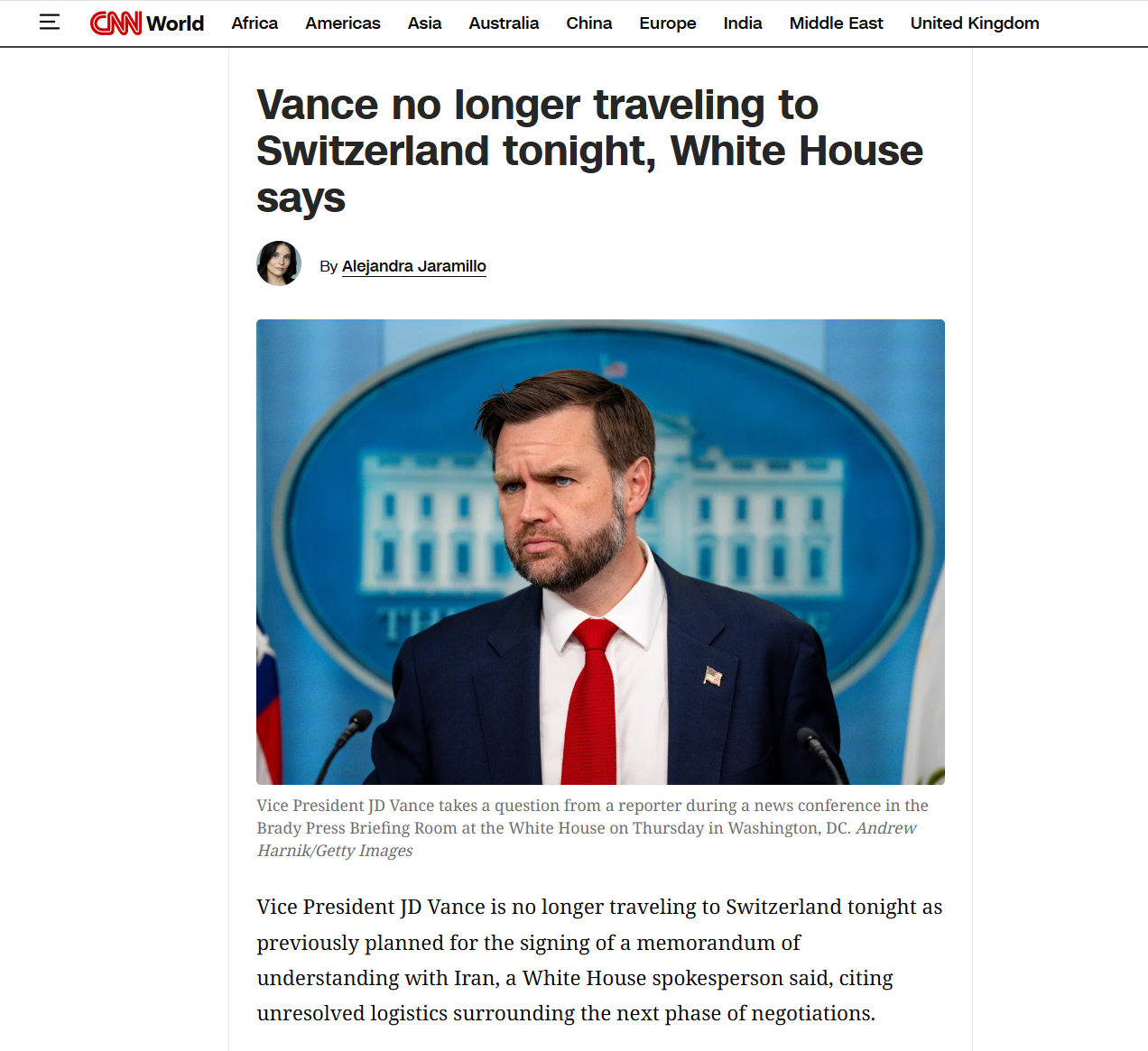
According to CNN, a White House spokesperson said that Vice President Vance will not depart for Switzerland today, and his subsequent travel plans remain pending;
Under the original plan, the U.S. and Iranian sides were scheduled to hold talks in Geneva on Friday, launching a 60-day negotiation process facilitated by Pakistan, aiming to reach a final agreement.
White House: Vance cancels Switzerland trip today; subsequent itinerary pending
 According to CNN, a White House spokesperson stated: 'As the Vice President mentioned at the press briefing, plans for the upcoming technical talks have not yet been finalized. The U.S. delegation is ready to depart at a moment’s notice. However, logistical arrangements for these negotiations have never been simple or predictable. At this time, the Vice President will not be departing tonight. We will provide timely updates once we have specific information regarding next steps.'
Previous report
According to sources, Iran has postponed its delegation's trip to Switzerland due to the ongoing Israeli strikes in southern Lebanon.
On the 18th local time, it was reported that Iran’s negotiating delegation has suspended its trip to Geneva, Switzerland, for talks with the United States, amid the ongoing Israeli attacks in southern Lebanon.
Under the original plan, the U.S. and Iranian sides were scheduled to hold talks in Geneva on Friday, launching a 60-day negotiation process facilitated by Pakistan, aiming to reach a final agreement. According to a memorandum of understanding signed by both sides earlier this week, ensuring the continued implementation of its relevant provisions is a prerequisite for commencing negotiations on a final agreement.
Sources indicated that prior to making the final decision to postpone the trip, Iran’s delegation had already completed all preparations for departure.
Iran had previously informed the United States and the mediating parties that the Lebanon issue remains a core component of the U.S.-Iran negotiations and will directly determine whether the talks continue. According to informed sources, Iran currently considers Israel’s ongoing military operations and strikes within a 10-kilometer depth inside Lebanese territory as a clear violation of Article I of the U.S.-Iran memorandum of understanding.
Notably, Pakistan’s state television also reported earlier on Thursday that Pakistani Prime Minister Shehbaz Sharif, who serves as mediator in the negotiations, has postponed his originally scheduled trip to Switzerland to attend the signing ceremony, as the memorandum of understanding has already been signed and is currently being implemented.
On June 18, U.S. President Trump signed a copy of the Memorandum of Understanding (MoU) reached between the United States and Iran at the Palace of Versailles in France. Iranian President Pezeshkian also signed the U.S.-Iran MoU.
Pursuant to Article I of the MoU, the United States, Iran, and their respective allies involved in the current conflict hereby declare an immediate and permanent cessation of military operations on all fronts, including Lebanon. The parties commit, effective immediately, not to initiate any acts of war or military action against one another, to refrain from threats or use of force against each other, and to uphold Lebanon’s territorial integrity and sovereignty.
According to Lebanon’s National News Agency on the 18th, Israeli Defense Forces (IDF) drones carried out multiple strikes that day on the southern Lebanese region of Nabatieh, resulting in three fatalities.
On the same day, Iranian Foreign Ministry spokesperson Baghaei stated that any continued Israeli attacks on Lebanon would be regarded as a violation of the United States’ commitments under the MoU.
Vance criticizes Israel
Notably, U.S. Vice President Vance, in an interview on Thursday, sharply criticized Israel’s 'hysterical' reaction to the U.S.-Iran Memorandum of Understanding.
In recent days, far-right members of the Israeli government have consistently criticized the agreement between the United States and Iran to halt hostilities and reopen the Strait of Hormuz. In response to these criticisms, Vance rejected what he described as personal attacks on Trump and pointed out that the majority of weapons used to defend against Iran and protect Israel are manufactured in the United States.
‘Israel’s problem isn’t Trump. Any Israeli who believes the U.S. President is their biggest problem needs to wake up and face the reality of their country’s situation,’ Vance said.
During a White House press briefing that day, Vance also stated, ‘Trump is the only head of state in the world today who genuinely sympathizes with Israel. If I were a member of the Israeli cabinet, I probably wouldn’t attack my one remaining powerful ally in the entire world.’
In a prior interview, Vance had also remarked that Israel ‘cannot solve every national security issue through killing alone.’
Clearly, Vance’s remarks underscore the growing rift between Israeli Prime Minister Netanyahu and Trump: the former has urged Trump to maintain pressure on Iran, while the latter seeks a way out of this unpopular and costly war. Successive U.S. administrations have long differed with the Israeli government on Middle East policy, but such disagreements have typically remained behind closed doors—at least in public statements.
Israel insists on its right to self-defense across multiple fronts in the Middle East. Although Trump has criticized Israel’s ongoing operations in Lebanon, Israeli officials state that they must eliminate the threat posed by Hezbollah.
Currently, Israeli Prime Minister Netanyahu continues to avoid directly criticizing Trump’s agreement with Iran in public. However, Israeli officials have privately expressed concern that the U.S.-Iran deal could provide Tehran with both funds and time to rebuild its missile and drone arsenals, replenish its proxy forces in Lebanon, Yemen, and Iraq, and ultimately shift the regional balance of power against the interests of both the United States and Israel.
In an interview, Vance accused Israel of lacking even basic trust in the United States. He stated, 'I believe the claim that we’ve reached a bad deal—a memorandum of understanding—is factually inaccurate and makes no strategic sense when viewed in the context of our long-standing bilateral relationship. Israel assumes that every scenario favorable to Iran will materialize—even without any change in Iranian behavior—but that is not what the memorandum of understanding says.'
Vance also said on the same day that the 60-day deadline stipulated in the U.S.-Iran memorandum of understanding for reaching a final agreement would begin counting from the 18th, and that he would lead the U.S. negotiating team in the upcoming talks. Vance noted that he still plans to travel to Switzerland, though the exact timing remains to be determined.
Editor/melody