
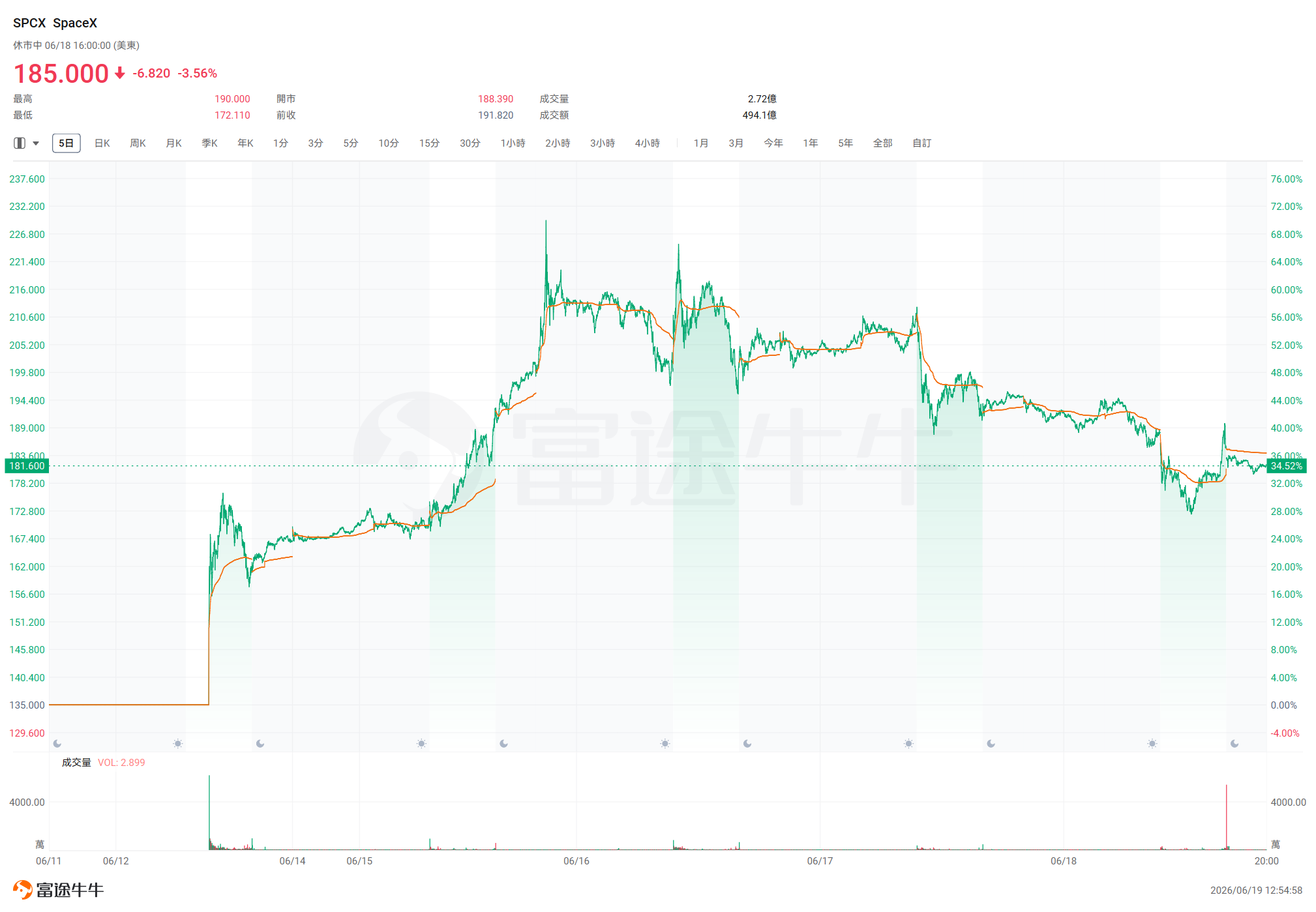
SpaceX closed its first week of trading at $185 per share, up 37% from its IPO price of $135, giving it a total market capitalization of $2.4 trillion. Based on an expected price-to-sales ratio of 39.2x for 2027, its valuation exceeds that of all constituents in the S&P 500.
Analysts’ target prices range widely from $250 to $401.
$SpaceX (SPCX.US)$Having completed its debut week of trading at an unprecedented valuation, debates over whether its stock is in a bubble have ensued.
 SpaceX closed its first week of trading at $185 per share, up 37% from its IPO price of $135. Despite a cumulative pullback of approximately 8.3% over two days, the company’s market capitalization remains at $2.4 trillion, making it the world’s sixth-largest publicly listed company.
Based on its projected price-to-sales (P/S) ratio for 2027, SpaceX trades at 39.2 times sales—surpassing all constituents of the S&P 500 and ranking among the world’s most expensive large-cap technology stocks.
Behind this surge in valuation is investor anxiety—both retail and institutional—about missing out. Billions of dollars flowed into SpaceX-linked ETFs within days of the listing, and at one point, net retail buying of the stock exceeded that of NVIDIA.
Its valuation dwarfs that of the S&P 500, leaving even Tesla in the shadows.
$SpaceX (SPCX.US)$As the company is not yet profitable, price-to-earnings comparisons are meaningless, making the price-to-sales ratio the primary valuation metric at present.
According to Dow Jones Market Data and the consensus forecast of four analysts, SpaceX’s stock trades at a 2027 forward price-to-sales ratio of 39.2x, exceeding that of every constituent in the S&P 500.
Palantir Technologies ranks second with a P/S ratio of 28x, while Tesla stands at 12.6x—a level already widely regarded by the market as richly valued.
In a client report dated June 14, Julian Emanuel of Evercore ISI likened SpaceX’s IPO to the starting point of a new wave of 'dream-driven FOMO,' suggesting it could catalyze 'the next leg of the bull market.'
Fueling this frenzy is investors’ collective fear of missing a historic opportunity and their heavy bet on CEO Elon Musk’s vision—motivations that lie beyond the scope of traditional valuation frameworks.
Netscape's ghost returns as bubble debate intensifies
$SpaceX (SPCX.US)$Its IPO has sparked market discussions drawing parallels with Netscape’s 1995 IPO.
Netscape’s IPO ignited an internet investment frenzy but also marked the beginning of the dot-com bubble burst.
In a blog post published on the eve of SpaceX’s IPO, Maury Blackman, Managing Director at Pierpoint Ventures, wrote that Netscape’s IPO “validated people’s imagination,” while SpaceX’s IPO will signal to every CEO, every board, and every institutional investor that “the direction has been set.”
Jim Thorne, Chief Strategist at Wellington-Altus, was more blunt:
Bubbles are a normal phenomenon during technological revolutions. We over-allocate, invest too much capital, and overbuild.
He stated that the real question is not whether the market is in a bubble, but how the situation will evolve after the bubble bursts.
However, several analysts also pointed out fundamental differences between SpaceX and Netscape.
SpaceX has already established a vast and real commercial footprint, faces virtually no competition in rocket launches, and holds growing competitive advantages in satellite communications and AI infrastructure, providing irreplaceable access to space for both government and numerous commercial clients.
Analysts’ target prices vary widely
Despite ongoing valuation disputes, several institutions have already taken bullish positions.
In a client report on Thursday, Oppenheimer analyst Timothy Horan raised his price target from $190 to $250, implying approximately 39% upside from the current price, and stated:
We believe SpaceX will leverage its expertise in engineering, manufacturing, and aerospace technology to become the world’s largest communications and cloud computing/AI company.
Andrew Beale of Arete Research initiated coverage with a price target of $401, implying more than double the current share price.
He forecasts that SpaceX’s revenue will exceed $200 billion by 2030, but also cautioned:
Space is hard—risks such as launch anomalies, technical challenges, and environmental factors could all delay timelines, and all projections should allow for significant uncertainty.
Michael Monaghan, partner and portfolio manager at Founder Funds, said his fund’s confidence in holding SpaceX stock is based on the expectation of achieving $200 billion in revenue by 2030, adding:
But literally and figuratively, you need a rocket to earn that revenue.
Index inclusion approaching; passive funds may provide support
Near-term share price pressure could be alleviated by the upcoming index inclusion.
Under Nasdaq’s rule easing fast-track inclusion for large-cap IPOs,$SpaceX (SPCX.US)$it will be eligible for inclusion in the Nasdaq-100 Index after 15 trading days post-listing and will also be added to relevant FTSE Russell and MSCI indices in due course.
According to calculations by Intropic, a firm that forecasts index rebalancing, approximately 30% of SpaceX’s free-float shares will be held by passive investors just two weeks after listing.
Combined with the fact that company insiders are restricted from selling shares during the lock-up period and the relatively small float, multiple factors could provide additional support to the stock price.
Ann Miletti, Global Head of Equities at Allspring, noted that benchmark-focused investors have already begun considering, 'If this stock enters any index, how should I adjust my holdings?'—a key driver behind current trading volumes.
Dec Mullarkey, Managing Director at SLC Management, advised investors to remain patient:
There is still considerable noise at the trading level. Tactical buying interest will persist and typically takes several weeks to absorb. We are still in the early stages of the price discovery process within a reasonable valuation range.
Historical data show that large IPO stocks have experienced an average maximum drawdown of 55% within their first year of listing—a notable historical reference for$SpaceX (SPCX.US)$a company currently trading at such elevated valuations.
Editor/melody