① Over the weekend, the United States and Iran again offered conflicting accounts regarding passage through the Strait of Hormuz;
② U.S. President Trump issued a new warning that if a final agreement with Iran is not reached within 60 days, the United States will impose tolls on passage through the Strait of Hormuz;
③ Representatives from both sides are scheduled to hold their first round of technical-level talks in Switzerland on Sunday, and the Iranian negotiation delegation has already arrived in Zurich, Switzerland.
 Caixin Global, June 21 (Editor: Bian Chun) — Following the signing of a memorandum of understanding (MoU) between the United States and Iran aimed at ending hostilities and reopening the Strait of Hormuz, traffic through this globally strategic oil corridor has rebounded in recent days. However, tensions surrounding this vital oil chokepoint flared up again over the weekend.
The United States and Iran once again presented divergent statements regarding passage through the Strait of Hormuz. Although the latest developments pose a risk of undermining the U.S.-Iran MoU, negotiations between the two sides will continue to move forward.
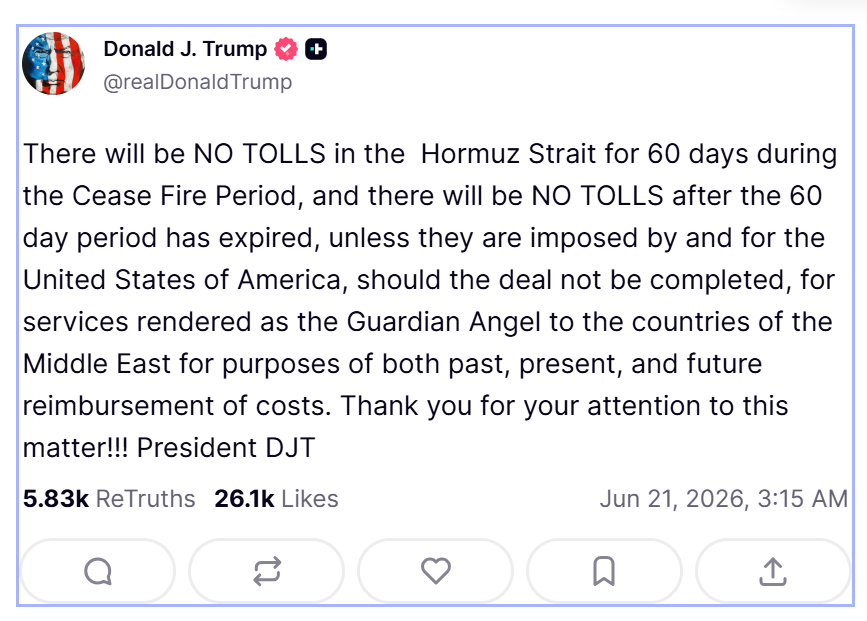
Additionally, concerning the Strait of Hormuz, U.S. President Trump issued a fresh warning on Saturday afternoon local time, stating that if a final agreement with Iran is not reached within 60 days, the United States will impose tolls on passage through the strait.
According to reports from media outlets including China Central Television (CCTV), on June 20 local time, U.S. President Trump posted on the social media platform Truth Social that no tolls would be charged for passage through the Strait of Hormuz during the 60-day ceasefire period. He added that no tolls would be imposed after the 60-day period either.
However, Trump stated that unless a relevant agreement is reached, the United States might impose tolls on the Strait of Hormuz to compensate for the costs incurred in “securing” the Middle East region.
According to the U.S.-Iran memorandum of understanding previously released by Iranian state media and U.S. officials, the provisions concerning passage through the Strait of Hormuz explicitly state that Iran will make its utmost efforts to ensure commercial vessels can freely and safely transit between the Persian Gulf and the Gulf of Oman during the 60-day period. Beyond this period, the management regime for the Strait of Hormuz will be established through dialogue between Iran and Oman, in consultation with other littoral states of the Persian Gulf.
Trump was likely referring to a U.S. military operation that had assisted in guiding commercial vessels safely through the Strait of Hormuz. He previously stated that during an operation in early June, U.S. forces secretly escorted more than 100 million barrels of oil and 200 vessels through the strait.
During peacetime, the Strait of Hormuz handles approximately 20% of global oil shipments, and this strategic waterway has been Iran’s primary leverage in the current conflict. The closure of the strait has disrupted the global economy and caused crude oil prices to surge near a historic high of USD 126 per barrel in late April.
As Trump made the above remarks, officials from both the United States and Iran were locked in disagreement over passage through the Strait of Hormuz.
On Saturday evening Beijing time, Iranian military authorities abruptly announced the closure of the Strait of Hormuz.
That day, the Khatam al-Anbia Central Headquarters of Iran’s Armed Forces issued a statement declaring: 'Given the United States’ overt breach of its commitments by failing to implement Clause One of the Memorandum of Understanding aimed at ending the war; given Israel’s continued violations of the ceasefire agreement through repeated attacks on southern Lebanon, resulting in numerous Lebanese civilian casualties and displacing hundreds of thousands; and given that Israeli forces have still not withdrawn from southern Lebanon, the Strait of Hormuz is hereby closed to all vessel navigation.'
The Islamic Revolutionary Guard Corps Navy subsequently stated that all vessels should refrain from approaching the Strait of Hormuz, as their safety could no longer be guaranteed.
However, U.S. officials denied this claim. Vice President Vance stated there was currently no evidence indicating that Iran was closing the Strait of Hormuz.
Shortly thereafter, U.S. Central Command issued a statement noting that the number of commercial vessels transiting the Strait of Hormuz had increased as U.S. forces continued operations in surrounding waters to support freedom of navigation.
U.S. Central Command stated that safe passage through the Strait of Hormuz remains fully intact, with 55 merchant ships having transited the strait on Saturday. It added that its forces will continue maintaining a presence in the region and remain on high alert to ensure full compliance with, implementation of, and sustained effectiveness of the agreement reached with Iran.
In addition, senior U.S. officials said on the 20th local time that U.S. forces have not yet observed any military movements by Iran indicating the closure of the Strait of Hormuz.
Technical-level negotiations are being held today.
Currently, representatives from the United States and Iran are scheduled to hold their first round of technical-level talks in Switzerland on Sunday (the 21st). The U.S. delegation includes Vice President Vance, Special Envoy Steve Witkoff, and Trump’s son-in-law Jared Kushner.
The United States and Iran had originally planned to meet in Geneva last Friday (the 19th), launching a 60-day negotiation process mediated by Pakistan with the aim of reaching a final agreement.
However, the Lebanon issue affected the negotiation process, causing the talks originally scheduled for the 19th to be postponed. On the 18th, reports indicated that due to Israel’s continued attacks on southern Lebanon, the Iranian delegation had suspended its travel to Switzerland for negotiations with the United States.
On the 20th, Pakistan’s Ministry of Foreign Affairs issued a statement confirming that U.S.-Iran technical-level talks will take place in Switzerland on the 21st. Pakistan and Qatar will participate in the meeting as mediators.
According to the latest reports, the Iranian negotiating delegation has arrived in Zurich, Switzerland. The Swiss Federal Department of Foreign Affairs also confirmed the arrival of the Iranian delegation. In a social media post, the Swiss Foreign Ministry stated that it welcomes the Iranian delegation’s arrival in Switzerland and noted that the delegation is en route to Bürgenstock, as part of implementing the Memorandum of Understanding signed between the United States and Iran.
On June 20 local time, a spokesperson for the U.S. Vice President stated that Vice President Vance had departed from Washington and was en route to Switzerland to attend the U.S.-Iran negotiations.
On the 21st, Pakistani sources reported that Prime Minister Shehbaz Sharif had led a high-level delegation departing for Switzerland.
On the 20th local time, Iranian Foreign Ministry spokesperson Baghaei stated that the Iranian delegation would travel to Switzerland to present its demands regarding the U.S. side’s fulfillment of its commitments and clarify how Iran itself would fulfill its own commitments. Baghaei emphasized that the U.S. must swiftly take necessary measures, or else the entire Memorandum of Understanding would risk collapse.
Editor/Jeffy