
Wall Street remains highly bullish on SpaceX, with analysts viewing the company as a powerful amplifier of the AI-driven super bull market rather than a bubble-bursting force.
Although the U.S. mega-tech giant founded by Elon Musk, focused on 'AI + space exploration,' $SpaceX (SPCX.US)$ plunged more than 16% on Monday and declined for three consecutive trading sessions—with its market capitalization evaporating by USD 400 billion on Monday alone due to liquidity stress triggered by a bond issuance plan of at least USD 20 billion, marking the second-largest single-day loss in corporate market value in global history—Wall Street remains strongly bullish on SpaceX. Analysts believe SpaceX could act as a powerful amplifier of the AI-driven super bull market rather than a bubble-burster. This suggests that SpaceX’s record-breaking trillion-dollar IPO could signal that the global bull run centered on the AI computing power supply chain, which has swept equity markets worldwide, is far from over.
Tim Horan, an analyst covering AI infrastructure, satellites, and communications at the prominent Wall Street investment firm Oppenheimer, remains optimistic about SpaceX’s fundamentals and stock outlook despite its recent share price decline. He maintained his most bullish 'Buy' rating and assigned a target price as high as USD 250. As of Monday’s U.S. market close, SpaceX shares fell 16.43% to USD 154.60, with its market cap hovering near USD 2.03 trillion.
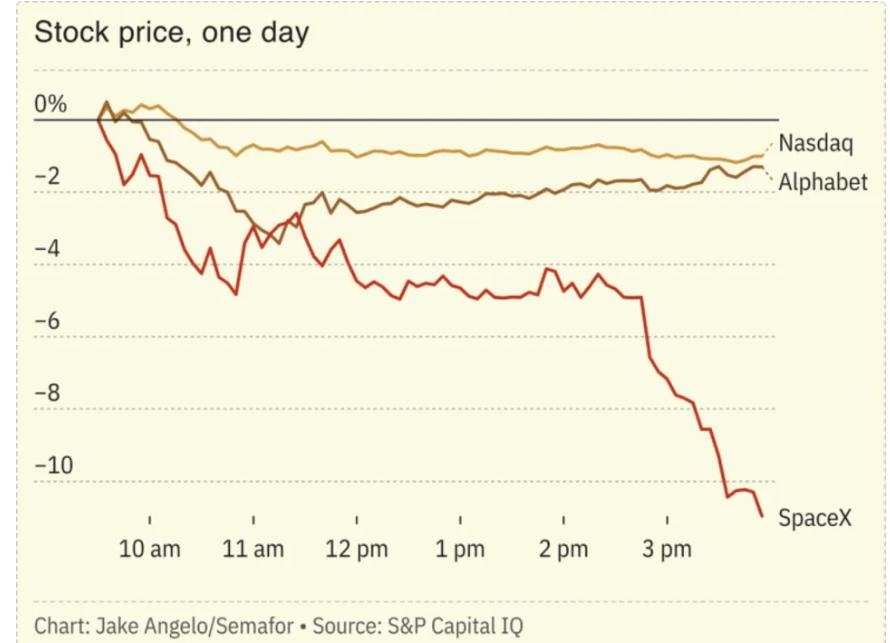
 This recent dip appears more like a 'financing discipline check' within the broader AI infrastructure super bull market: Over the long term, if SpaceX delivers on accelerating Starlink mobile communications market share expansion, achieves scalable reuse of Starship, rapidly penetrates enterprise AI applications, successfully launches its TeraFab chip manufacturing project, and fully closes the loop on its space-based AI computing infrastructure platform, it could remain the most compelling vertically integrated asset within the AI applications + AI computing infrastructure ecosystem. In the short term, however, debt expansion, low share float, post-IPO retail investor crowding, and excessive forward valuation could make it more prone to sharp volatility compared to traditional tech giants.
As the world’s wealthiest individual to date, Musk has previously accomplished feats many deemed impossible: building a commercially viable high-frequency rocket launch business through SpaceX, mainstreaming electric vehicles via Tesla—the global EV leader—and deploying internet connectivity infrastructure from space through Starlink. However, some investors remain skeptical about whether Musk can truly realize his latest ambition unveiled in Austin: an 'epic-scale' semiconductor initiative and his visionary blueprint integrating artificial intelligence, autonomous driving, humanoid robotics, and space-based AI data centers.
SpaceX’s vertical integration ambitions aim squarely at building a 'space-based AI super empire.'
In a media interview, Oppenheimer senior analyst Horan explained that SpaceX’s entry into AI computing infrastructure leasing and AI application markets has doubled its valuation over the past six months. He noted that the cutting-edge AI-related industrial chain represents a total addressable market of USD 25 trillion, aligning closely with the USD 28.5 trillion 'super space AI' vision outlined in SpaceX’s prospectus. Horan emphasized that SpaceX is the world’s only 'fully vertically integrated tech giant' capable of disrupting the entire AI industry landscape.
“They are the only company capable of attacking every segment of this sector and truly disrupting numerous traditional industries through vertical integration,” Horan stated in the interview. He pointed out that the company manufactures its own solar panels and large-scale energy storage infrastructure and aims to produce its own chips through a massive TeraFab wafer fabrication facility capable of outputting five times the current global chip production capacity.
The analyst noted that Elon Musk’s ambitious goal of achieving USD 1 trillion in annual revenue within five years represents a highly significant investment opportunity for SpaceX.
“If he comes close to that target, companies of this nature typically trade at around 10 times their annualized revenue run rate. Therefore, what we’re looking at is a potential USD 10 trillion space-based AI super empire within five years,” Horan explained, though he added that his current valuation framework does not extend that far.
Starlink remains the primary driver of SpaceX’s revenue and free cash flow, with Horan’s forecasts suggesting the satellite internet business could ultimately be worth approximately USD 1 trillion.
The company currently serves approximately 12 million broadband subscribers globally, but Horan believes its network capacity could increase by as much as 100-fold over the next five to ten years, potentially supporting hundreds of millions of customers.
‘They will also enter the mobile market, which will ultimately be larger than the broadband market,’ he added, describing Starlink as the ‘cash cow’ funding SpaceX’s ambitious plans for space-based AI data centers and large-scale AI application deployment—and potentially even its Mars colonization ambitions.
When asked about risks, Horan highlighted two primary concerns: fully integrating the Starship rocket into a high-frequency launch and low-cost operations framework, and successfully launching TeraFab—SpaceX’s ambitious chip manufacturing initiative.
‘These are all extremely, extremely ambitious projects,’ Horan acknowledged. ‘But this company and Elon Musk have proven exceptionally capable of executing highly ambitious, large-scale initiatives.’
From Starlink as a cash cow to the dream of a TeraFab chip fabrication giant, SpaceX’s recent stock plunge does not signify a collapse in AI-related investor confidence.
The recent sharp decline in SpaceX’s share price does not mean Wall Street has entirely rejected its grand AI narrative. Rather, the market is now re-pricing the company’s ‘super AI growth story’—comprising high-frequency Starship launches, Starlink as a cash cow, space-based AI data centers, TeraFab chip fabrication facilities, and large AI models/applications—within a framework that accounts for financing costs, debt duration, free cash flow, and valuation multiples.
Tim Horan of Oppenheimer maintains a Buy rating and a $250 price target, viewing SpaceX as the only company capable of disrupting the AI landscape through full vertical integration. His rationale lies in SpaceX’s end-to-end control across satellite networks, solar power, commercial spaceflight systems, and potential chip manufacturing. He even estimates the total addressable AI market at $25 trillion, with Starlink alone potentially worth around $1 trillion; its current base of approximately 12 million broadband users could see capacity increase 100-fold over the next 5–10 years. The core of this bullish thesis is not traditional aerospace valuation but rather treating SpaceX as a new kind of AI infrastructure company—combining space-based communications networks, non-terrestrial AI computing infrastructure, vertically integrated hardware platforms, and dominant AI applications.
However, the three-day stock plunge reflects another reality: the AI compute arms race is shifting SpaceX from a high-growth narrative toward a capital-intensive balance sheet. The company’s inaugural investment-grade bond offering aims to raise at least $20 billion, primarily to repay the $20 billion bridge loan incurred from its acquisition of xAI and to fund data center construction, AI-related hardware procurement, and power infrastructure development for AI expansion. The bonds received ratings of Baa1 from Moody’s and BBB from S&P, though AI-related operations are seen as carrying high upfront costs and significant revenue uncertainty.
Thus, SpaceX’s share price fell approximately 16.4% on Monday to close at $154.60, erasing roughly $400.8 billion in market value and bringing its total valuation down to about $2.04 trillion—not due to a simple ‘collapse in AI faith,’ but because investors are beginning to question whether SpaceX can sustain multi-front capital expenditures for xAI, TeraFab, Starship, and future orbital AI data centers using Starlink cash flows, debt financing, and continued capital market confidence.
From a long-term investment perspective, if SpaceX delivers on accelerated Starlink mobile market share expansion, Starship’s scalable reusability, rapid enterprise AI adoption, successful execution of the TeraFab chip manufacturing project, and full closure of its space-based AI computing infrastructure platform, it could remain the most compelling vertically integrated asset in the AI applications and AI compute value chain.
SpaceX’s highly anticipated IPO prospectus, released last month, estimates the company’s total addressable market (TAM) at a staggering $28.5 trillion. If this 'space-AI empire' vision is ever fully realized, it would approach the total annual economic output of the United States. In its IPO filing, the company stated it has 'identified the largest executable total addressable market opportunity in human history,' primarily driven by AI-powered software, with significant contributions also expected from the space sector.
This $28.5 trillion TAM projection is comparable to the U.S. nominal GDP of nearly $32 trillion in Q1 2026. Of this, the enterprise-facing AI super-applications market alone is estimated at $22.7 trillion—roughly equivalent to 70% of total U.S. economic output. Furthermore, if SpaceX, Tesla (TSLA.US), and xAI ultimately pursue deeper integration, the company’s investment narrative and valuation ceiling could rise further. Dan Ives, a senior analyst at Wedbush, believes that SpaceX and Tesla could merge as early as 2027.
Notably, these projections do not represent earnings forecasts, secured orders, or formal valuations for the space technology giant. Instead, they reflect SpaceX’s effort to convince capital markets that it is more than just a commercial aerospace or satellite internet company—rather, it is packaging its Starlink constellation, AI capabilities, potential orbital AI computing infrastructure, enterprise software, and space-based solutions for defense or commercial clients into a ‘super-platform narrative’ spanning terrestrial AI and space-based AI data centers.
The $28.5 trillion outlook does not merely encompass the 'space-based AI data center market size' Elon Musk has repeatedly referenced recently. Rather, it represents SpaceX’s internally calculated total addressable market (TAM) disclosed in its IPO filing, with the vast majority stemming from AI software and enterprise applications—not space or space-based data centers. According to its breakdown, AI-related segments total approximately $26.5 trillion, comprising $22.7 trillion in AI enterprise applications, $2.4 trillion in AI infrastructure, $760 billion in AI consumer subscriptions, and $600 billion in AI-driven digital advertising. The actual 'space-enabled solutions' segment accounts for only $370 billion, while Starlink broadband and mobile services combined represent approximately $1.61 trillion.