
The Thacker Pass lithium mine, the largest in the United States, is expected to begin production by the end of next year, with output ten times the current U.S. lithium production capacity. General Motors has secured the entire 20-year output from the first phase, and the U.S. government has taken a direct equity stake and provided a $2.2 billion low-interest loan. However, the mine employs a clay-based lithium extraction process that has never been commercially proven at scale, and the company’s stock price has fallen more than 56% from its peak last year. The CEO stated that the initial production will be a critical milestone for revaluation.
A clay-hosted lithium deposit that has never been mined at scale is now a pivotal bet for the United States in reshaping its domestic metal supply chain.
According to a recent report by The Information, the Thacker Pass mine in Nevada, developed by Lithium Americas, holds the largest known lithium reserves in the United States. Production from the mine’s first phase is expected to commence by the end of next year, with annual output projected to reach ten times the country’s current lithium production.
 General Motors (GM) has already secured the entire 20-year output from the mine’s first phase, sufficient to meet the battery demand for approximately 850,000 electric vehicles—or an equivalent amount for batteries used in artificial intelligence data centers, drones, robotics, and military equipment. Meanwhile, the U.S. government holds a 5% equity stake in Lithium Americas and a separate 5% interest in the Thacker Pass mine, and has provided a $2.2 billion low-interest loan through the Department of Energy, jointly funding the project alongside GM.
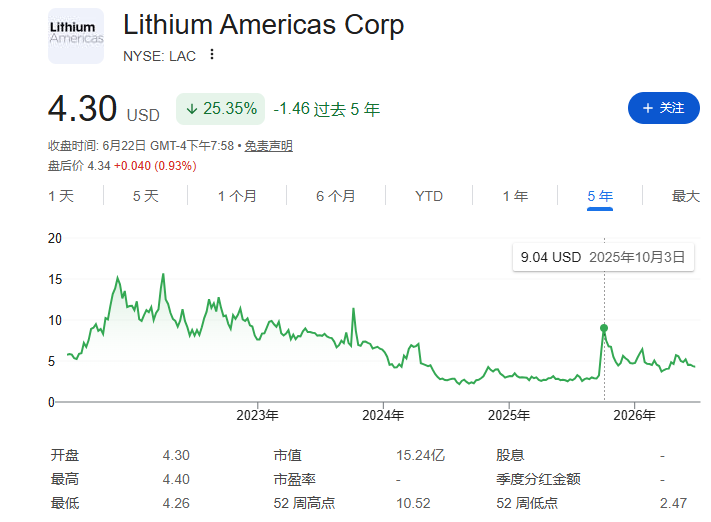
However, Lithium Americas’ share price has fallen 56% cumulatively from its peak of around $10 in October last year, with an 8.3% decline so far this year. Market concerns center on a single issue: the lithium at this mine is embedded in clay deposits, and the extraction process has never been proven at commercial scale.
Government Equity Stake: Integrating Minerals into National Strategy
The Trump administration designated metal demand from defense and AI data centers as a new strategic priority and took a series of unusual steps—directly acquiring equity stakes in metal-producing companies.
Beyond Thacker Pass, the government also holds a 15% equity stake in MP Materials, a rare earth metals developer based in Nevada. Jon Evans, CEO of Lithium Americas, stated that this policy shift has fundamentally altered the market landscape: "From last summer to this summer, the entire situation has changed. It’s now more balanced, because this is no longer just about electric vehicles—we’ve become part of energy security policy."
GM invested $625 million for a 38% equity stake in the mine. These funds are primarily allocated to purchasing equipment that processes ore into lithium carbonate—the key raw material for lithium iron phosphate (LFP) batteries, widely used in data center energy storage and grid backup systems. Evans also equipped the facility with a steam turbine capable of supplying roughly half of the site’s electricity needs.
Clay-Based Lithium Extraction: The Core Technological Uncertainty
Currently, nearly all global lithium production comes from two sources: hard-rock spodumene and brine from salt flats. The lithium at Thacker Pass, however, is hosted in clay deposits—a third pathway that has never been commercially validated at scale.
This is precisely the greatest concern among investors. By comparison, Australian lithium miners Mineral Resources, PLS Group, and Liontown Resources— all traditional spodumene producers—have risen by 25%, 36%, and 22% year-to-date, respectively. Lithium Americas’ share price has moved in the opposite direction.
Evans acknowledged that this uncertainty will continue to weigh on the company’s valuation until actual production begins. He stated plainly, 'As soon as I produce the first ton of lithium, the valuation will be repriced, because the market always has the question: ‘Can you really do it?’'
Chris Berry, President of metals research firm House Mountain Partners, shares the same view: 'The market is waiting to see whether there will be delays or initial ramp-up issues.'
Notably, Evans stated that multiple independent due diligence experts, including those from the Department of Energy, have reviewed the company’s mining plan and deemed the technical approach feasible.
Phase Two: Demand Is Already Queuing Up
Beyond Phase One at Thacker Pass, the second phase aims to extract and process an additional 40,000 tons of lithium over the next decade. General Motors has secured first rights to 38% of the output from this phase and holds an option to acquire the remaining volume.
However, GM is not the only interested party. Evans revealed that several companies have expressed interest in supply from Phase Two, with one even offering a $100 million upfront deposit.
Berry added, 'There are many people in Washington closely watching Lithium Americas, and I believe the list of potential customers will be very long.'
Furthermore, BloombergNEF research indicates that continued declines in battery costs have brought the cost of battery energy storage systems for power grids and AI data centers below that of gas turbines and now roughly on par with low-cost coal-fired power generation. This trend further reinforces the strategic value of lithium resources.