
Deutsche Bank follows Goldman Sachs in lowering its gold price forecast, as another bullish investor scales back optimistic expectations.
Zhitong Finance APP has learned that, as investors grow increasingly cautious about the outlook for U.S. monetary policy and gold investment demand remains persistently weak, major international investment banks have recently launched a fresh wave of downward revisions to their gold price forecasts. Following Goldman Sachs’ significant cut to its gold price target last week, Deutsche Bank, in its latest report, slashed its gold price forecast by as much as 32%. This substantial adjustment not only marks a notable cooling of bullish sentiment toward gold on Wall Street but also reflects a dramatic shift in macroeconomic policy logic under the Federal Reserve’s new leadership.
Deutsche Bank’s 'Aggressive Downgrade': From $5,600 to $4,800—Largest Cut of 32%
The magnitude of Deutsche Bank’s revision is exceptionally rare in recent years. According to a report issued by the bank’s research analyst Michael Hsueh, the Q3 gold price forecast was reduced by more than one-fifth to $4,300 per ounce, while the Q4 target price was lowered by 17% to $4,800.
 Although both revised targets remain above the current level of approximately $4,140—implying the bank still expects gold prices to rise further from here—the degree of bullishness has 'significantly weakened.' Hsueh explicitly identified two key drivers behind the downward pressure on gold prices: the repricing of the Federal Reserve’s policy trajectory and the resilience demonstrated by U.S. macroeconomic data.
More concerning is the quantified assessment of downside risks. Hsueh further warned that if the Federal Reserve implements three to four rate hikes, gold prices could fall to around $3,800 per ounce—representing a potential decline of up to 32% from the all-time high of $5,600 reached in late January.
Goldman Sachs’ 'Bullish Stance' Rarely Wavers: A $500 Cut
Deutsche Bank’s move is not an isolated incident. Just a week earlier, Goldman Sachs—the most steadfast and vocal gold 'bull' on Wall Street—was the first to reverse course. The firm sharply lowered its year-end 2026 gold price target from $5,400 per ounce to $4,900, a reduction of $500. Analysts Lina Thomas and Daan Struyven clearly outlined two primary reasons for the downgrade:
First, expectations for rate cuts have completely evaporated. Goldman Sachs economists have now pushed back the Fed’s final two rate cuts to June and December 2027, meaning no rate cuts will occur in 2026. The market’s previously widespread assumption of 'rate cuts within the year' has been entirely overturned.
Second, Waller’s 'hawkish debut' has reshaped market logic. The first FOMC meeting chaired by new Fed Chair Waller delivered an 'unexpectedly hawkish' signal, substantially alleviating market concerns about the central bank’s independence and making it unlikely that demand for gold as a macro policy hedge will rebound as previously anticipated.
Although Goldman Sachs maintains a constructive view on gold over the medium to long term, it has explicitly characterized its near-term stance as 'tactically cautious' and warned that if the Fed implements two rate hikes this autumn, gold prices could fall further to $4,440 by year-end.
Citi’s Reversals and Wall Street’s Divergence
Notably, not all institutions are uniformly bearish. Citi has exhibited the most dramatic shift in stance—on June 12, it lowered its three-month gold price target to USD 4,000, only to reverse course just four days later by raising it to USD 4,500, arguing that the recent decline represented a 'price reset' rather than the end of the bull market, while maintaining its bullish forecast of USD 5,000 over a six- to twelve-month horizon.
Bank of America, while acknowledging that gold is unlikely to reach its short-term target of USD 6,000, still contends that persistently high U.S. fiscal deficits and the absence of fiscal consolidation will underpin gold’s long-term upside. JPMorgan maintains its forecast of USD 6,000 by the end of 2026 and an average price of USD 6,263 in 2027.
However, there is growing consensus among most institutions regarding the near-term outlook. Morgan Stanley stated plainly that without a substantial rebound in ETF inflows, gold would struggle to achieve its bullish target of USD 5,200 in the second half of 2026. Joni Teves, strategist at UBS Group, remarked, 'The downside risks to our view have increased significantly.'
Wash’s 'Hawkish Debut': The Dot Plot Upends the Rate-Cut Narrative
The core driver behind the recent gold selloff was the Federal Reserve’s unexpectedly hawkish signal from its June policy meeting. In the early hours of June 18 Beijing time, the Federal Open Market Committee (FOMC) unanimously voted 12–0 to keep the federal funds rate target range unchanged at 3.50%–3.75%. However, beneath this 'hold' decision, the dot plot delivered a disruptive message: nine committee members now expect at least one rate hike in 2026, compared to only one member forecasting a cut. The median projection for the federal funds rate at the end of 2026 jumped from 3.4% in March to 3.8%, implying one 25-basis-point rate hike within the year.
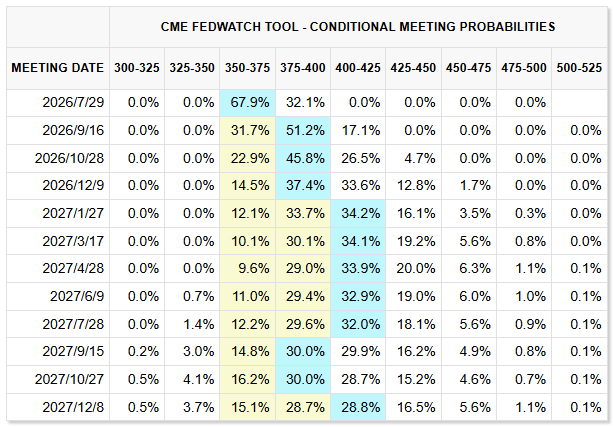
Newly appointed Fed Chair Kevin Wash clearly stated in the post-meeting press conference that the committee is 'united in its commitment to achieving price stability and returning inflation to the 2% target.' The policy statement removed the previous 'easing bias' that had hinted at possible future rate cuts and added language noting that 'productivity growth and capital investment remain robust.' According to the CME FedWatch Tool, markets now price in at least one rate hike by the Fed this year.
Jeffrey Gundlach, founder of DoubleLine Capital and dubbed the 'New Bond King,' bluntly stated that Wash is 'sending a clear signal to the market: restoring price stability is the top priority, not launching a new easing cycle.'
The Fed also sharply revised up its 2026 inflation forecast from 2.7% to 3.6% and slightly lowered its GDP growth projection to 2.2%. In its latest research report, Deutsche Bank further raised its U.S. inflation outlook, forecasting a cumulative 50 basis points of rate hikes by the Fed in 2026, lifting rates to 4.1%, with a potential hike as early as July.
ETF Outflows vs. Central Bank Support: The Fractured Narrative in Gold Markets
In this policy-expectation-driven price adjustment, the gold market is exhibiting a rare divergence in capital flows. On one side, investors are accelerating their exit. Global gold ETFs have recorded net outflows for the fifth consecutive week, with a single-week outflow of USD 4.27 billion—the highest this year—of which USD 1.5 billion came from U.S. investors. In May, global physical gold ETFs turned to net outflows of approximately USD 2 billion, reducing total holdings to 4,121 tonnes. Deutsche Bank explicitly noted that the persistent selling of gold ETFs indicates a 'clear absence' of this traditionally supportive factor for gold prices.
Outflows from the domestic market are equally striking. Since Q2, the scale of gold ETFs in China has declined by over RMB 37 billion. As of June 11, the combined assets under management of the top four gold ETFs had shrunk by nearly RMB 40 billion compared to the end of Q1, with Huaan Gold ETF falling below the RMB 100 billion mark. Moreover, China—one of the world’s major gold-consuming countries—has recently seen its onshore gold prices trade at a discount to COMEX prices, indicating that Asian physical import demand is unlikely to provide meaningful support to international gold prices at current levels.
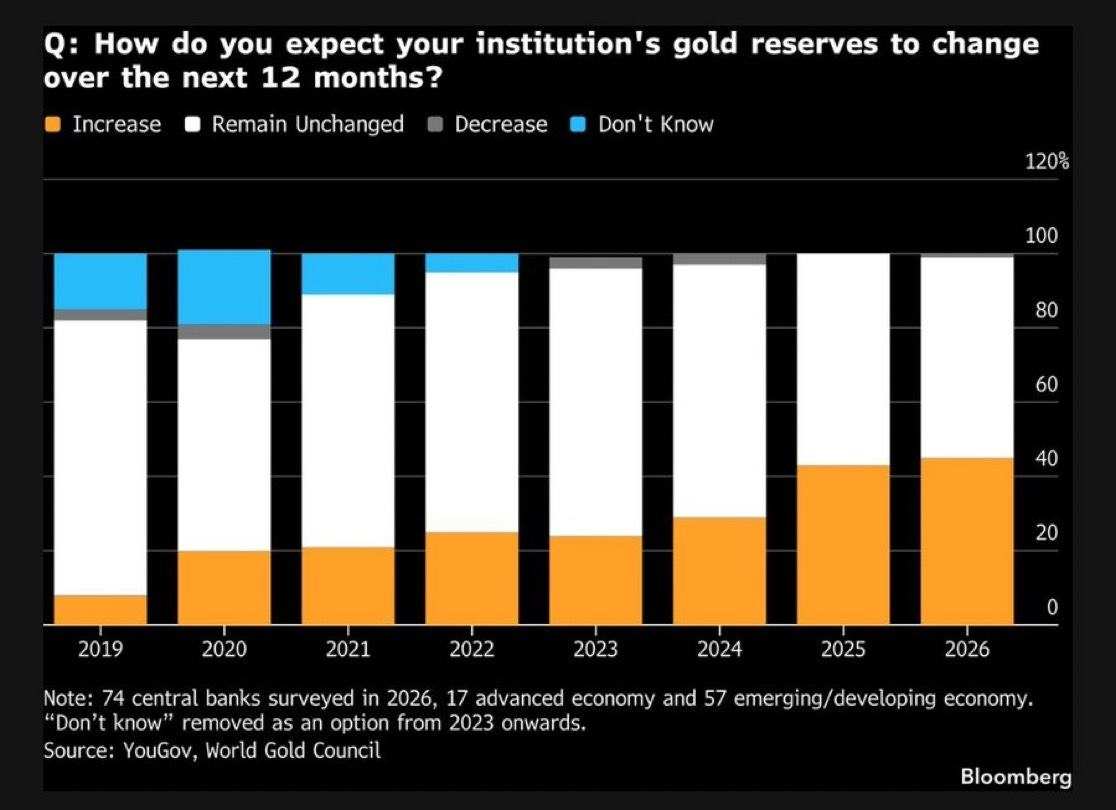
On the other side, central banks are firmly stepping in as a backstop. The World Gold Council’s ‘Central Bank Gold Reserves Survey 2026,’ released on June 16, shows that among 74 surveyed central banks, 45% indicated plans to increase their gold reserves within the next 12 months—the highest proportion since the survey began in 2018. Furthermore, 89% of respondents expect the total global central bank gold reserves to continue rising over the next year. Approximately 53% of central banks in emerging and developing economies anticipate increasing their gold holdings.
The People’s Bank of China has raised its gold reserves for 19 consecutive months, adding 320,000 troy ounces in May—the largest monthly purchase this year. Goldman Sachs forecasts that central banks will continue buying gold at a pace of 50 tonnes per month through 2026. Deutsche Bank also described central bank demand as the 'only remaining pillar of strength' in today’s gold market.
ETF investors are retreating while central banks are entering—the divergence between short-term speculative capital and long-term strategic capital is reshaping the dynamics of the gold market.
Gold Price Outlook Amid Bull-Bear Tug-of-War
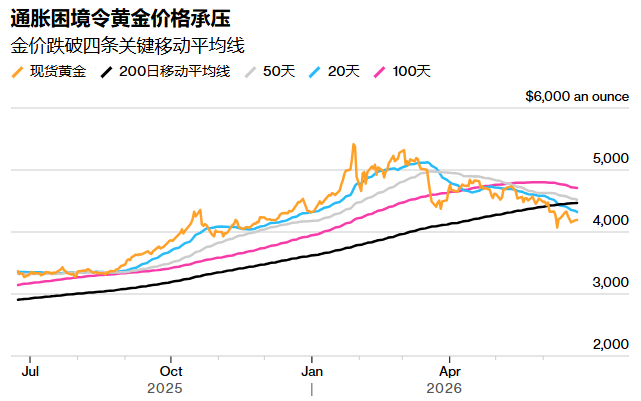
Spot gold is currently hovering within the critical range of USD 4,100 to USD 4,140. Technically, the 2026 trend low of USD 4,023 serves as the next key support level; a break below this would expose the long-term uptrend line near USD 4,000—a zone that has historically anchored gold’s multi-year rally.
In the short term, downward pressure on gold has not been fully alleviated. Geopolitical tensions in the Middle East remain a key variable—although Iran and the U.S. unexpectedly announced an agreement in the early hours of the 22nd, Iran’s Foreign Minister wrote on social media: 'The first real test: the Lebanon conflict resolution working group.' The ebb and flow of geopolitical risk will continue to drive short-term gold price volatility.
Meanwhile, this week will see the release of U.S. PCE inflation and GDP data. Hotter-than-expected readings would further reinforce hawkish Federal Reserve expectations, potentially triggering another wave of gold sell-offs.
From a medium- to long-term perspective, central bank gold purchases remain the most stable source of demand support. As one analyst put it, gold—as a non-sovereign credit asset—derives its value independently of any single nation’s creditworthiness. However, this long-term rationale is unlikely to offset, in the near term, the triple headwinds of a stronger U.S. dollar, rising Treasury yields, and elevated interest rate expectations.
From its historic peak of USD 5,600 to a seesawing level around USD 4,100, the gold market has undergone a full bull-to-bear cycle within just five months. As Wall Street’s staunch bulls collectively revise their expectations downward, as Kevin Warsh’s hawkish remarks completely upend the narrative of rate cuts, and as ETF outflows persist for a fifth consecutive week—has the foundation of the gold bull market begun to crack? The answer may lie not in any investment bank’s forecast model, but in a more fundamental variable: at what level will the Federal Reserve’s interest rate path stabilize, and for how long?