
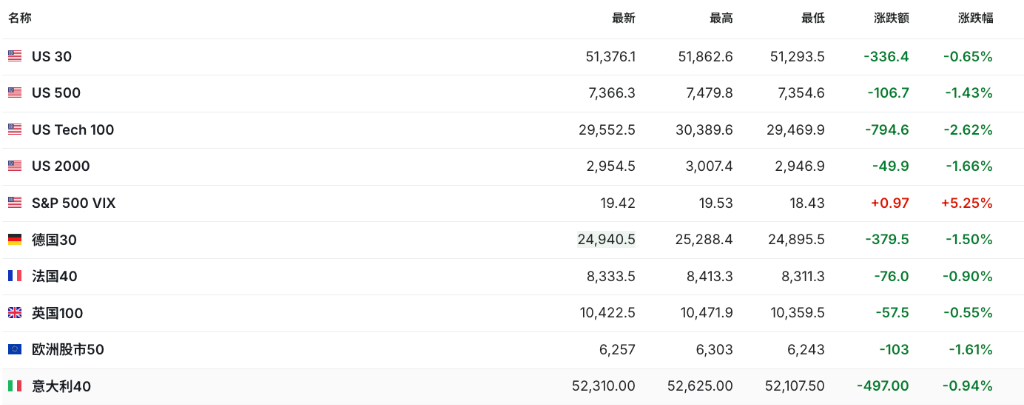
Global risk assets were sold off on Tuesday, with South Korean equities plunging sharply.activating the circuit breaker mechanism, suspending trading for 20 minutes.Nasdaq futures dropped more than 2.5%, while gold and crude oil also declined in tandem; only the U.S. dollar and U.S. Treasuries rose. The immediate trigger was rumors of tax reform in South Korea, but the underlying pressure stemmed from rapidly intensifying expectations of Federal Reserve rate hikes—Bank of America now forecasts three rate increases this year, as markets shift from a 'rate-cut trade' to a 'higher-for-longer' stance. High-valuation tech stocks bore the brunt of the sell-off. The AI-driven bull market currently faces multiple headwinds, including rising interest rates, tightening regulation, and a wave of IPOs by major tech firms. Upcoming key tests include Micron’s earnings report and the U.S. core PCE data due in the coming days.
Global markets witnessed a broad sell-off in risk assets on Tuesday.
The Korean KOSPI index plunged 10%, triggering a trading halt, while Nasdaq 100 futures dropped more than 2.5%. European technology and semiconductor stocks came under widespread pressure, and gold, silver, copper, and crude oil all declined in tandem. In sharp contrast, the U.S. dollar and U.S. Treasuries emerged as among the few assets to post gains.
 On the surface, the market selloff was sparked by a Korean policy discussion paper concerning capital gains taxation; however, deeper underlying factors include rapidly intensifying expectations of Federal Reserve rate hikes. As major Wall Street banks, including Bank of America, collectively revised upward their inflation and interest rate forecasts, the low-rate narrative that has underpinned the AI-driven bull market over the past two years is now being challenged—hitting richly valued tech stocks first and hardest.
Markets are now reassessing a critical question: if the AI investment cycle persists but the cost of capital rises again, can current valuations still be justified?
Korean equities led the plunge
During Tuesday’s Asian trading session, South Korean equities were the first to buckle. A discussion draft proposing to include unrealized gains from stocks and real estate in a comprehensive income tax system circulated in the market, triggering panic selling among investors.
According to a prior article by Wall Street Journal citing Yonhap News Agency, on the morning of June 23, lawmakers from multiple parties—including the Democratic Party of Korea, the Progressive Party, and the Social Democratic Party—jointly participated in a tax reform forum. The forum’s central proposal was to advance a shift toward 'comprehensive income taxation,' under which tax liability would be based on substantive net asset appreciation regardless of whether the assets have been sold, thereby bringing unrealized gains—i.e., paper gains—from investment assets such as stocks and real estate into the taxable base.
Spurred by this news, the KOSPI index closed down 10%, marking its steepest single-day decline since March this year. Semiconductor stocks bore the brunt of the losses, with Samsung Electronics and SK Hynix each falling more than 12%. Nevertheless, market participants widely view the tax reform announcement as merely a trigger.
Prior to the selloff, South Korea’s AI-related and semiconductor sectors had already accumulated substantial gains, with valuations significantly stretched and investor positioning reaching extreme levels of concentration. Lee Jae Mahn, a strategist at Hana Securities in Seoul, noted that SK Hynix’s valuation briefly surpassed that of Samsung Electronics—a clear signal in itself of excessive market exuberance.
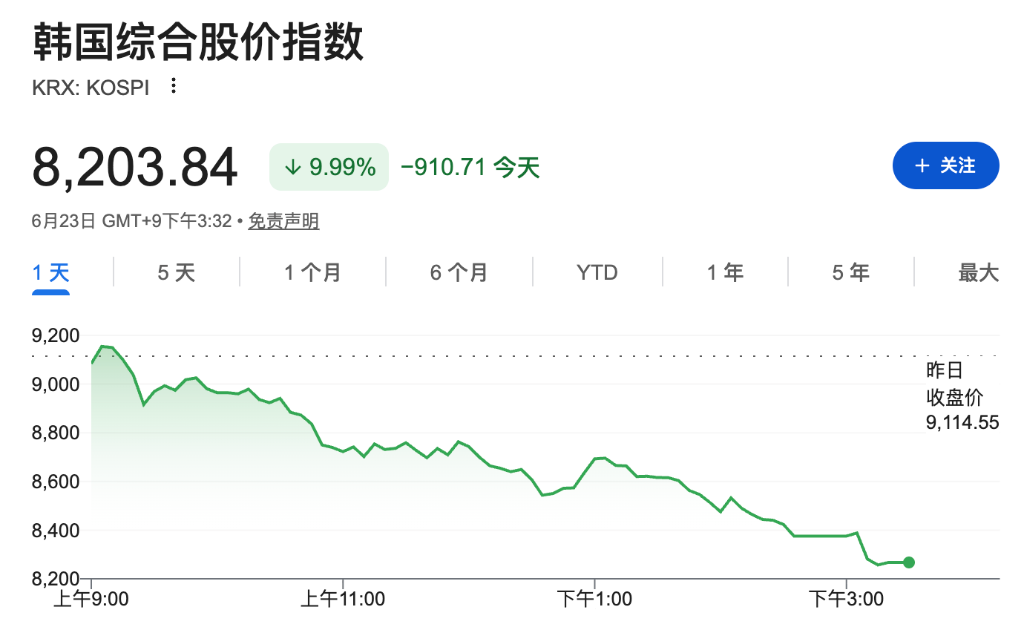
As the Korean market buckled, the selloff quickly spread globally. Nasdaq 100 futures fell 2.5%, S&P 500 futures dropped 1.4%, and the Stoxx Europe 600 index declined by approximately 1%, with technology and resource sectors leading the losses.
Even a U.S.-Iran deal can't rescue the market—the trading narrative has already shifted.
A noteworthy phenomenon is that this round of market declines occurred after geopolitical risks had clearly eased.
Following the interim agreement between the U.S. and Iran, international oil prices dropped sharply. According to conventional logic, falling oil prices signal reduced inflationary pressure and improved risk appetite, which should be bullish for equities. Yet the market did not deliver the anticipated 'relief rally': the S&P 500 remains below its monthly high, and credit spreads have even widened.
The reason is that market focus has already shifted from the Middle East to the Federal Reserve. Last week, the Fed’s dot plot showed that half of officials expect at least one more rate hike this year, while newly appointed Chair Kevin Warsh repeatedly emphasized the importance of restoring price stability.
Meanwhile, the market had previously viewed the Iran conflict as a transitory event, and the crude oil futures curve consistently reflected expectations of lower prices ahead. This means the U.S.-Iran deal largely validated existing market assumptions rather than delivering new positive catalysts.
For global equities—already buoyed by AI-driven gains and trading at elevated valuations—the easing of geopolitical risks is certainly good news. However, against renewed expectations of rate hikes, this positive factor is clearly insufficient to support a new rally. The market is shifting from 'trading geopolitical risk' to 'trading interest rate risk.'
Wall Street is once again discussing 'rate hikes.'
What truly altered the market’s pricing dynamics was the sharp shift in expectations regarding the Fed’s policy path.
According to a prior article by Wall Street Journal, Bank of America Securities’ latest report forecasts that the Fed will raise rates three times consecutively—in September, October, and December—by 25 basis points each time, totaling 75 basis points, thereby completely abandoning earlier expectations of rate cuts. Goldman Sachs, Morgan Stanley, and Deutsche Bank have recently warned that U.S. services inflation, wage growth, and rising energy prices could significantly slow the disinflation process.
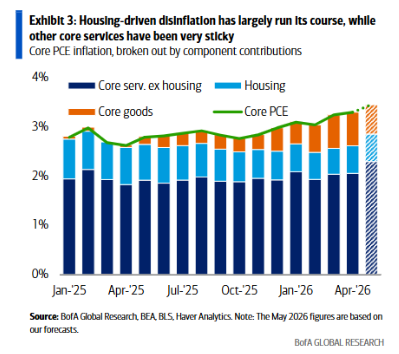
Bank of America expects the year-over-year core PCE inflation rate to rise to 3.5% in May. As the disinflationary tailwind from housing costs fades, non-housing services prices remain notably sticky.
The bond market has already priced in the shift. Last week, trading volume in U.S. Treasury futures hit a record high, and market-implied probabilities of a July rate hike surged from nearly zero to approximately 50%. Analysts at BNP Paribas noted a clear shift in the Federal Reserve’s internal stance, stating, “Every meeting could become a window for action, including the July meeting.”
What AI-driven trades fear most: rising interest rates
For AI-driven trades that have powered global equity markets over the past two years, heightened expectations of rate hikes undoubtedly represent one of the most adverse environments.
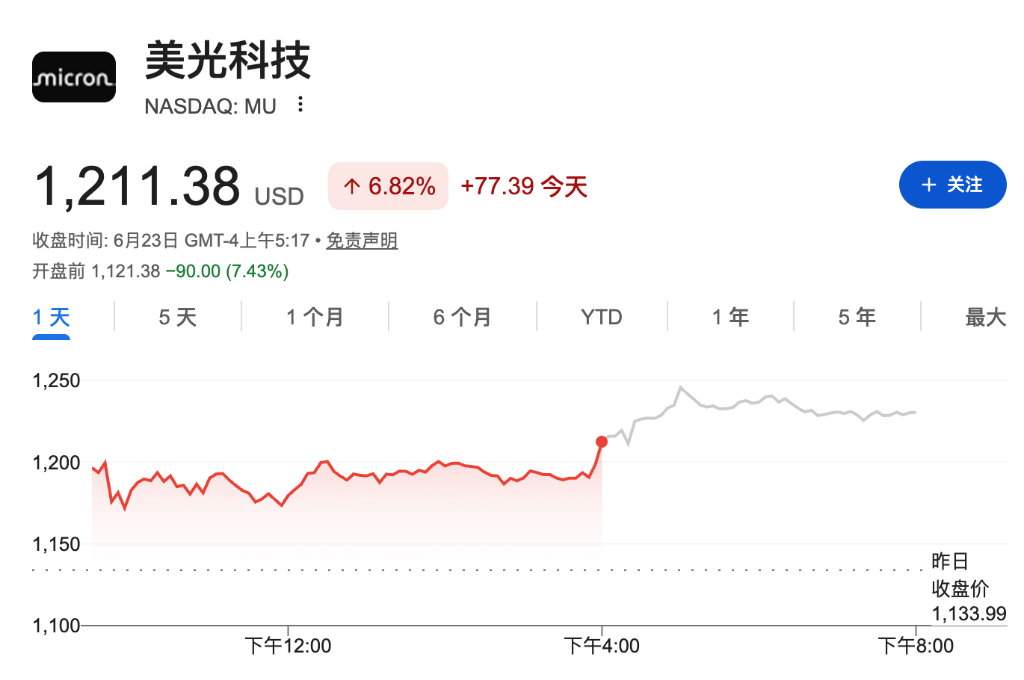
Ultimately, the valuation logic for high-growth technology companies hinges on the discounting of future cash flows. When interest rates rise, the present value of distant earnings naturally declines—assets propped up by forward-looking expectations are often the first to suffer. Markets have reacted swiftly: Micron fell more than 7% in pre-market trading, ASML dropped over 4%, and the global semiconductor sector broadly came under pressure.
More concerning is the substantial accumulation of leveraged capital and crowded positioning within the AI supply chain. For example, a Hong Kong-listed ETF linked to SK Hynix once swelled to $17 billion in assets, becoming one of the largest ETFs in the region. Should sentiment reverse, such concentrated capital structures could significantly amplify market volatility.
Mike Bell, Chief Strategist at RBC BlueBay, observed that when tech stocks rally too quickly and leveraged positions alongside retail participation continue to build, markets require little negative catalyst to trigger a sharp correction. The current environment may well epitomize this fragility.
AI-driven trades face two additional headwinds
Beyond escalating rate hike expectations, AI-driven trades now confront two increasingly significant challenges: regulatory risks and supply pressures.
First is the 'weaponization' of AI regulation. Recently, the U.S. Department of Commerce required AI firm Anthropic to restrict foreign users’ access to its latest model, signaling that Washington’s restrictions are now extending directly to AI models themselves. For investors, this introduces a new layer of uncertainty: competition in AI is shifting from purely commercial and technological domains toward geopolitical and national security considerations. Markets struggle to accurately price such policy-related risks.
Second, a record wave of equity supply looms. With SpaceX completing the largest IPO in history—valued at approximately $1.77 trillion—the market now faces a pressing question: who will absorb the flood of new shares coming to market? AI darlings like Anthropic and OpenAI remain in the IPO pipeline, and SpaceX alone raised more capital than the combined total of all U.S. IPO proceeds over the past two years.
For technology stocks already trading at historical highs, this means the market must absorb not only higher interest rates but also a larger supply of equities. With liquidity tightening at the margin, valuations elevated, and continuous new financing demands emerging, the AI sector now faces not just a growth challenge, but a reallocation-of-capital issue.
Why are only the U.S. dollar and U.S. Treasuries rising?
Against a backdrop of broad-based pressure on risk assets, the U.S. dollar and U.S. Treasuries have strengthened, becoming among the few asset classes to post gains.
The underlying logic is straightforward: as markets begin repricing the Federal Reserve’s policy path, investors are exiting high-valuation tech stocks and cyclical assets while increasing allocations to the U.S. dollar and U.S. Treasuries to hedge against potential tightening risks. Market focus has shifted from 'when will rate cuts come?' to 'will there be more rate hikes?'
This shift is particularly evident in the rates market. SOFR futures—closely tied to Fed policy—show that positions previously betting on rate cuts are being rapidly unwound. For example, open interest in the June 2026 SOFR contract declined by approximately 90,000 contracts in a single day, reflecting a systematic dismantling of what had been the most crowded 'rate-cut trade' over the past year.
Consequently, capital flows have shifted noticeably. Geoffrey Yu, Senior FX Strategist at BNY, noted that the shift in Fed expectations has effectively raised the performance bar for all risk assets. Amid growing uncertainty around growth and liquidity prospects, the U.S. dollar and U.S. Treasuries have regained favor among safe-haven investors.
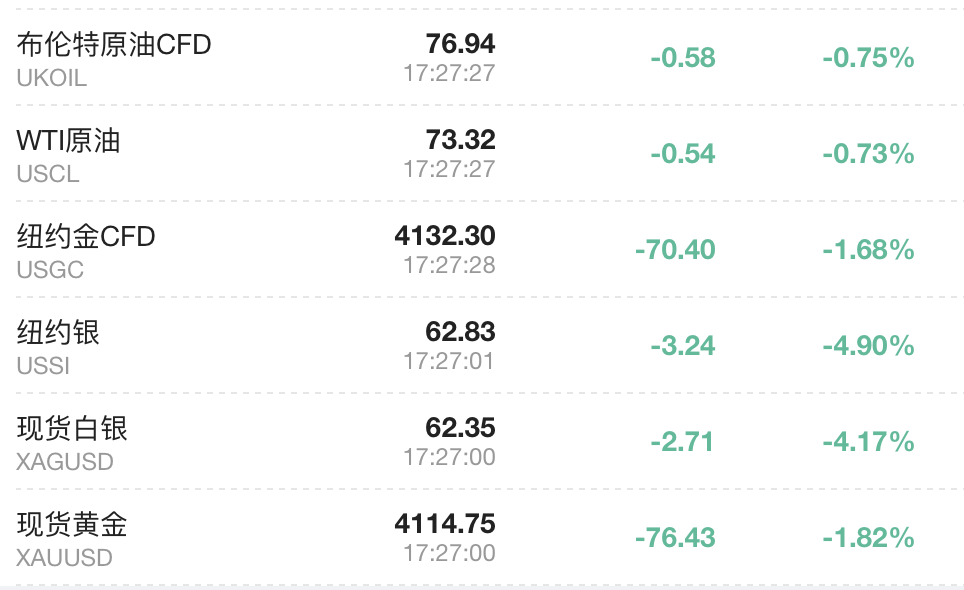
Meanwhile, risk assets broadly faced selling pressure. Spot gold fell more than 2%, Brent crude declined over 1%, and industrial metals such as copper also weakened; the Japanese yen continued to hover near multi-decade lows, reflecting persistent pressure from widening U.S.-Japan yield differentials.
For markets, the signal behind this round of capital flows is clear: investors are transitioning from a 'rate-cut trade' to a 'higher-for-longer rates trade.' Against a backdrop of renewed hawkishness in Fed policy expectations, the U.S. dollar and U.S. Treasuries remain the primary safe havens.
The AI bull market faces a critical stress test
For markets, the coming days will bring two critical tests.
First is Micron Technology's upcoming earnings report (scheduled for release on June 25 Beijing time). This will serve as a critical window into whether demand in the AI supply chain remains robust.
Second is the U.S. core PCE price index (scheduled for release on June 25 Beijing time). If inflation continues to run above expectations, it will further reinforce market bets on the Federal Reserve resuming rate hikes.
Over the past two years, narratives around AI, ample liquidity, and expanding capital expenditures have jointly driven a sustained rally in global technology stocks. Now, however, with inflation re-emerging, interest rate expectations rising, and valuations climbing ever higher, the market is entering a new phase: investors are no longer focused solely on how strong AI demand is, but rather on what that growth is truly worth in a higher-for-longer interest rate environment.
Editor/Deng