
Just two weeks after SpaceX's initial public offering, its share price briefly fell below the $150 IPO opening price. Following the waning of retail investor enthusiasm, the stock declined for four consecutive days, with over $600 billion in market value erased in three days. With 95% of locked-up shares set to be released en masse, coupled with a planned $20 billion bond issuance and projected losses extending through 2029, market confidence in the 'AI + space' narrative is facing a severe test.
Just two weeks after SpaceX’s listing, the initial rally—fueled by retail investor sentiment and high-growth narratives—has clearly cooled. Amid consecutive pullbacks, the market has begun reassessing the valuation expansion centered on the dual narrative of 'AI plus space.'
During U.S. pre-market trading on Tuesday, SpaceX shares experienced a rollercoaster session: after briefly breaking below the $150 opening price and plunging as much as nearly 5%, the stock quickly rebounded to gain nearly 3%. Market participants are watching closely: is this the start of a comeback following three straight days of declines, or merely a brief respite before further steep losses? If the rebound lacks momentum, the stock could record its fourth consecutive daily decline, with its market capitalization continuing to approach the $2 trillion mark.
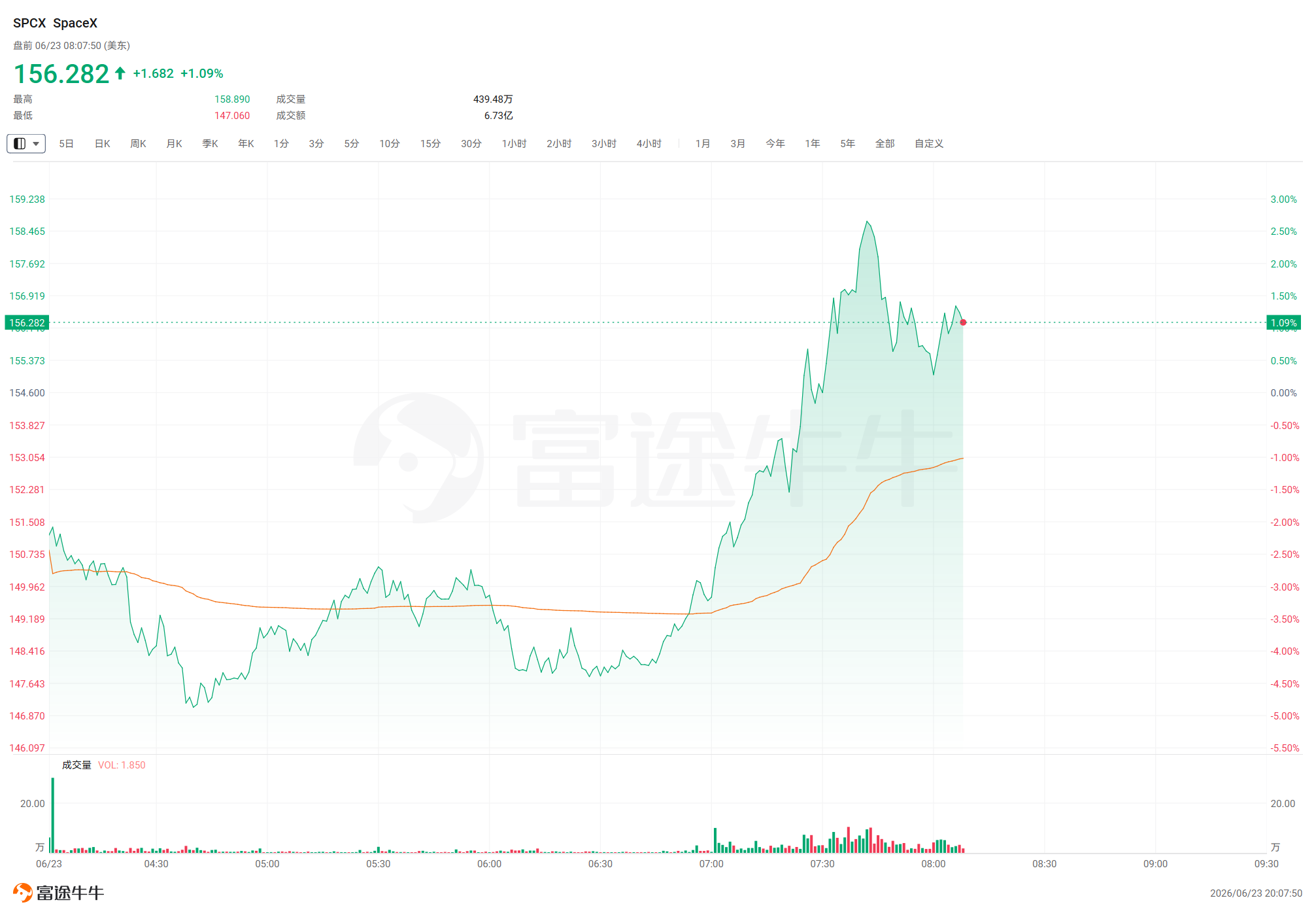
 Over the previous three trading sessions, SpaceX had already shed more than $600 billion in market value. On Monday alone, it plunged 16.4%, wiping out approximately $400 billion in market cap—one of the largest single-day market value contractions in U.S. stock market history, second only to NVIDIA’s roughly $590 billion loss last year.
This wave of selling coincides with a critical window for the company’s inaugural investment-grade bond offering. SpaceX plans to raise at least $20 billion through bond issuance to support AI infrastructure expansion and capital expenditures, while also refinancing existing debt.
Retail enthusiasm cools abruptly
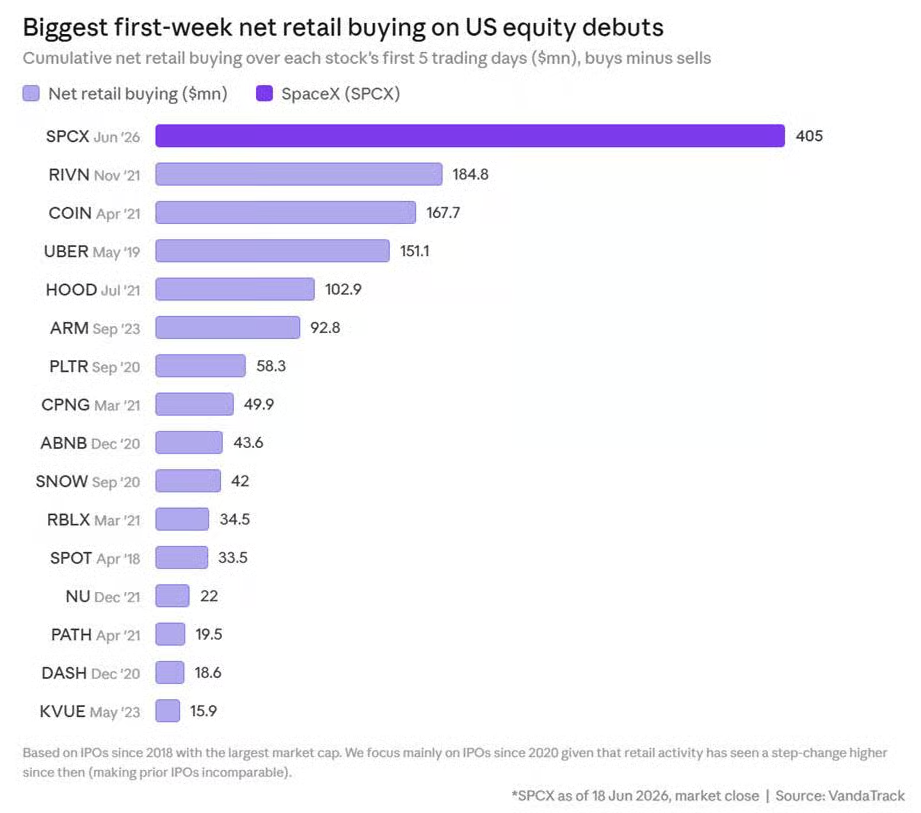
SpaceX opened at $150 on June 12, above its $135 IPO price, triggering unusually strong retail demand on its first trading day. According to VandaTrack data, retail investors net bought $405 million worth of SPCX during the debut week, marking one of the strongest inflows into a recent IPO from retail investors.
This level of inflow stood out sharply in the broader market: retail buying of SpaceX not only exceeded the combined net purchases of approximately $278 million in the so-called 'Magnificent Seven'—NVIDIA, Microsoft, Amazon, Meta, and Google—but also surpassed the combined inflows of about $352 million into SPY and QQQ, highlighting an extreme concentration of capital into a single stock.
In a research note, Canaccord characterized this phenomenon as 'the formation of a new layer of euphoria,' noting that SpaceX entered the top six global companies by market capitalization within its first week of trading, despite having a valuation significantly higher than its sister company Tesla, even though its revenue is only about 20% of Tesla’s. The firm also warned that 'beneath these assets, a more fragile and dangerous layer of air has accumulated,' signaling concerns over liquidity and valuation support.
However, sentiment shifted rapidly after the stock peaked at $225 on June 16. Retail inflows subsequently cooled markedly and nearly dried up entirely by Monday, causing short-term momentum to fade quickly.
Michael O’Rourke, Chief Market Strategist at JonesTrading, stated bluntly, 'The sellers have regained control of the market,' adding that 'everyone globally who wanted to buy this stock has essentially already done so,' implying that marginal buying power has significantly diminished.
Unlocking pressure poses a persistent risk.
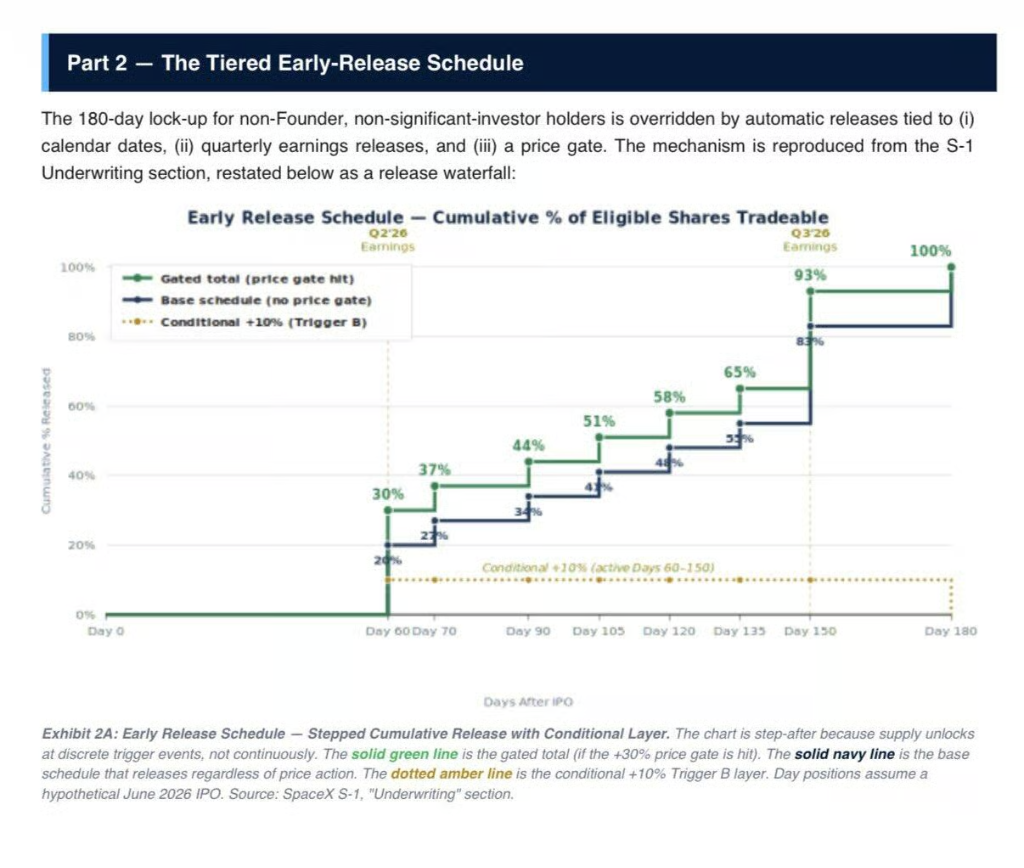
In the current market, only approximately 5% of SpaceX's shares are freely tradable, with the remaining 95% still subject to lock-up restrictions. However, this structure—characterized by low float and high expectations—is now facing a clear supply-side inflection point.
According to Jeff Jacobson, strategist at 22V Research, the company is entering a concentrated share-unlocking window over the coming months: following the release of its earnings report in early to mid-August, approximately 20% of insider-held shares will become eligible for sale; an additional 10% will be unlocked if the stock price rises 30% above its IPO price; and further tranches of around 7% each are scheduled for unlocking around August 21 and September 10, respectively.
Under the combined effect of these multiple mechanisms, Jacobson estimates that by early September, insiders could potentially sell up to 44% of the total outstanding shares, expanding the free float by approximately ninefold (a roughly 900% increase) compared to current levels. This shift implies that the current valuation framework—supported by share scarcity—will be fundamentally reshaped.
Against a backdrop of already significantly weakened demand-side momentum, the concentrated release of potential supply could substantially amplify market volatility and exert sustained downward pressure on the stock’s upside potential.
Bond issuance is at odds with underlying fundamentals.
SpaceX’s planned issuance of approximately USD 20 billion in investment-grade bonds represents an exceptionally rare structural case within the high-grade bond market. In its latest report, S&P Global Ratings noted that the company has yet to achieve profitability and expects its cash burn cycle to persist through 2029, creating a significant divergence from traditional investment-grade issuers—such as automakers or insurers—in terms of credit fundamentals.
From a business mix perspective, SpaceX’s revenue focus has gradually shifted from launch services toward satellite internet and computing services. In 2025, Starlink is expected to generate approximately USD 11.39 billion in revenue—substantially higher than the USD 4.1 billion from launch services—while AI-related computing services are projected to contribute around USD 3.2 billion, forming a critical component of its new growth trajectory. The company also announced on Monday a multi-billion-dollar computing capacity supply agreement with AI startup Reflection AI, further reinforcing its positioning as an ‘infrastructure-focused technology company.’
Despite recent sharp corrections, SpaceX’s share price remains approximately 10% above its IPO price of USD 135, though this cushion is rapidly eroding. With share-unlocking pressures approaching, retail investor buying interest waning at the margin, and global tech stocks under broad-based pressure, market tolerance for its high-growth narrative is diminishing, rendering its valuation support structure increasingly fragile.
Editor/KOKO