
On the same day global semiconductor stocks suffered a 'chip catastrophe,' Bank of America released a report extending the visibility of AI demand through 2028. DRAM/NAND supply availability is expected to remain above 110% through 2028, indicating no material risk of oversupply; semiconductor equipment spending is projected to reach $250 billion in 2028, an upward revision of 23% from previous forecasts. Based on this, the bank raised Micron's price target to $1,500.
Chip stocks have just experienced an "earthquake," yet Bank of America Merrill Lynch has issued a highly bullish report on semiconductors at this very moment.
On June 23, the same day global semiconductor stocks suffered a sharp decline—with the Philadelphia Semiconductor Index plunging 7.9% in a single day, Micron Technology falling 13%, and South Korea’s KOSPI index triggering a circuit breaker—activating the circuit breaker mechanism, suspending trading for 20 minutes.—analysts including Vivek Arya of Bank of America Merrill Lynch released a report titled “State of the U.S. Semiconductor Industry: Raising Forecasts, AI Extends Visibility Through 2028.”
 The report concludes that visibility into AI-driven chip demand now extends through 2028, that memory supply will not face oversupply before then, and that semiconductor equipment spending will peak in 2028.
The semiconductor industry is projected to generate an additional $1 trillion in revenue within five years.
It took the chip industry approximately 50 years to achieve its first $1 trillion in annual sales. However, according to the bank’s framework, AI is expected to help the industry add another $1 trillion in revenue over the next five years.
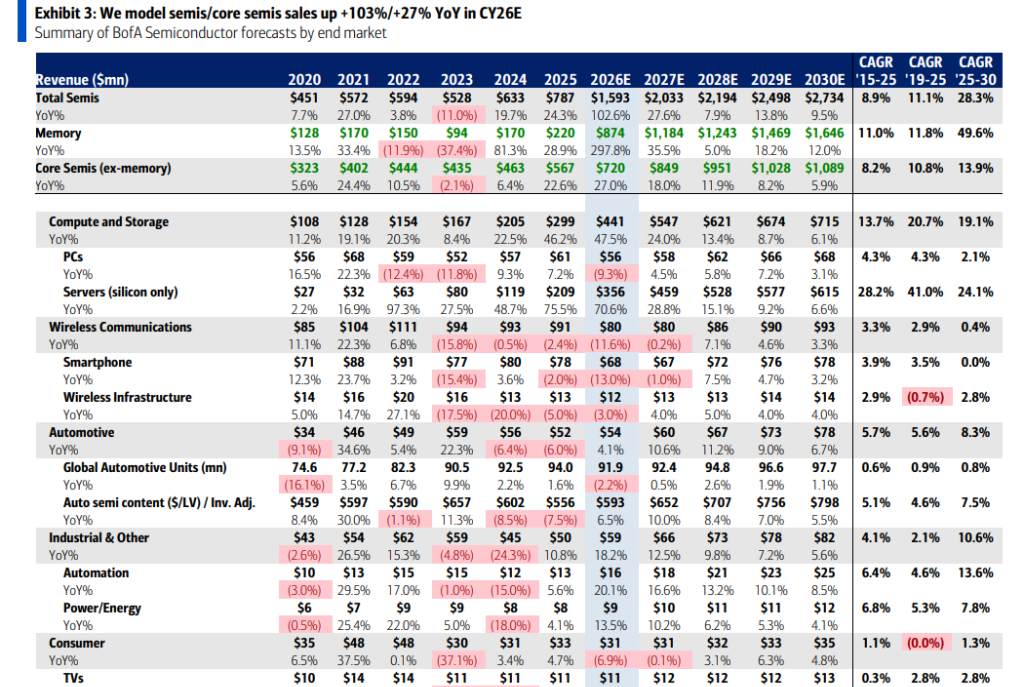
At the numerical level, the forecast for the total size of the global semiconductor market has been revised upward from $2.3 trillion to $2.7 trillion by 2030, implying a compound annual growth rate (CAGR) of 28% from 2025 to 2030.
2026 will be a breakout year: total semiconductor sales are expected to surge 103% year-over-year, with memory chips growing even faster at 298%—DRAM projected to rise 309% and NAND up 295%.
Five key themes driving this growth:
AI data center systems market: expected to reach approximately $1.7 trillion by 2030, starting from around $273 billion in 2025
Strength and durability of memory chips: long-term agreements (LTAs) provide 2–3 years of visibility into supply-demand dynamics and pricing; Micron’s partnership with Anthropic is a recent example.
Semiconductor equipment / advanced packaging / EDA: Benefiting from extended supply agreements and increasing chip complexity
Analog chips: Benefiting from rising power demand driven by AI
Server CPUs: Agentic AI presents a server market opportunity of approximately USD 170 billion
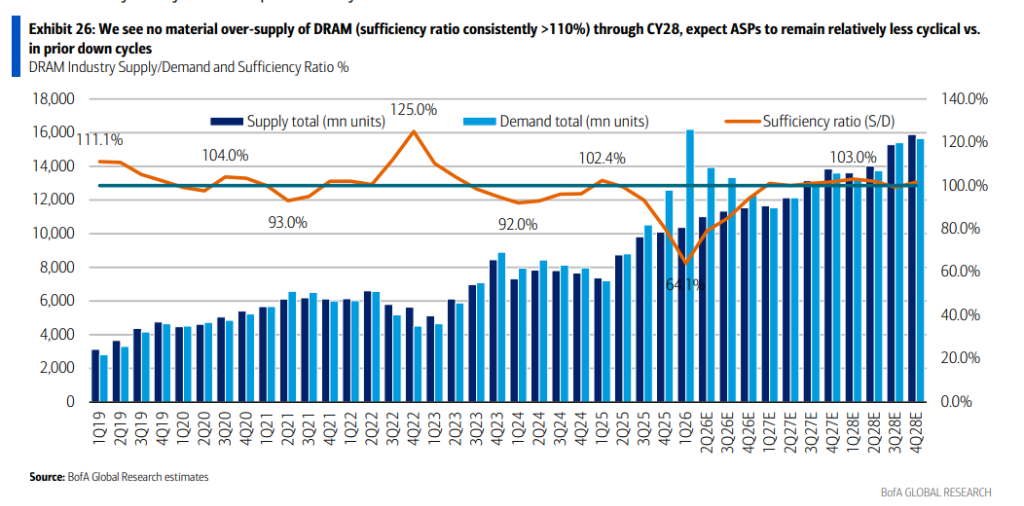
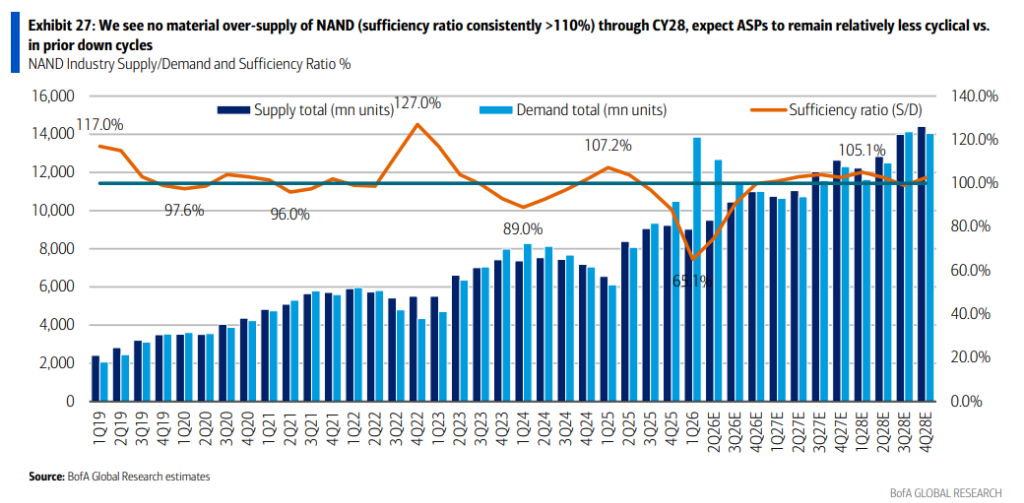
Memory chips: No oversupply expected before 2028
Analysts project that the supply sufficiency ratio for DRAM and NAND will remain above 110% throughout the forecast period, avoiding the severe oversupply conditions seen historically. On pricing, spot and contract prices for both DRAM and NAND are expected to stay robust through all of 2026, with no quarter-over-quarter declines anticipated before 2027.
Why is supply elasticity so low? The reasons are multifaceted:
Capital expenditures are primarily allocated to constructing facilities rather than purchasing equipment. Micron has guided for capital spending exceeding USD 25 billion in fiscal year 2026 (up from USD 13.8 billion in FY2025), but the majority of this incremental investment is directed toward building cleanroom facilities. Equipment investments that directly translate into chip output will not scale significantly until 2028.
Building cleanrooms and expanding capacity are two distinct activities. The former is capital-intensive and time-consuming, while the latter directly affects supply. This implies that the substantial capital outlays in 2026–2027 are effectively laying the groundwork for capacity expansion in 2028.
Micron’s new Idaho facility is expected to begin initial production in mid-2027 and enter volume ramp-up in 2028; its advanced HBM packaging facility in Singapore is projected to start contributing in 2027 and reach full production in 2028.
Geopolitical factors, packaging capacity constraints, and power limitations are also restricting the pace of supply expansion.
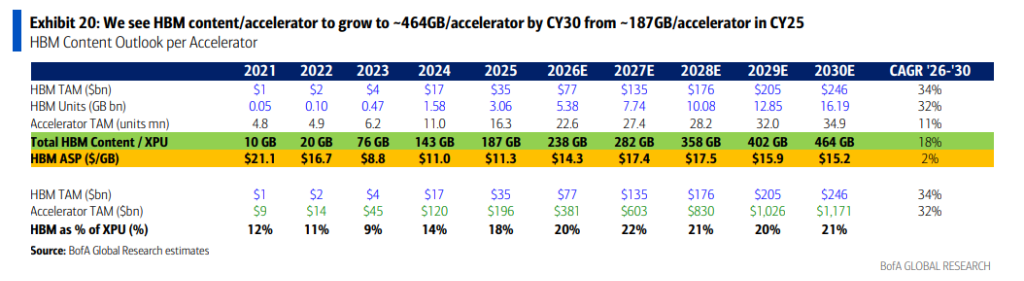
HBM (High Bandwidth Memory) is the most closely watched segment among memory chips. The HBM market is projected to grow from approximately USD 35 billion in 2025 to around USD 246 billion by 2030, representing a compound annual growth rate (CAGR) of 34%. The HBM capacity per AI accelerator is expected to increase from approximately 187 GB in 2025 to about 464 GB in 2030, reflecting an 18% growth rate.
NVIDIA’s latest Vera Rubin system requires 288 GB of HBM4 memory per accelerator.
Semiconductor Equipment: Spending to Exceed USD 250 Billion in 2028
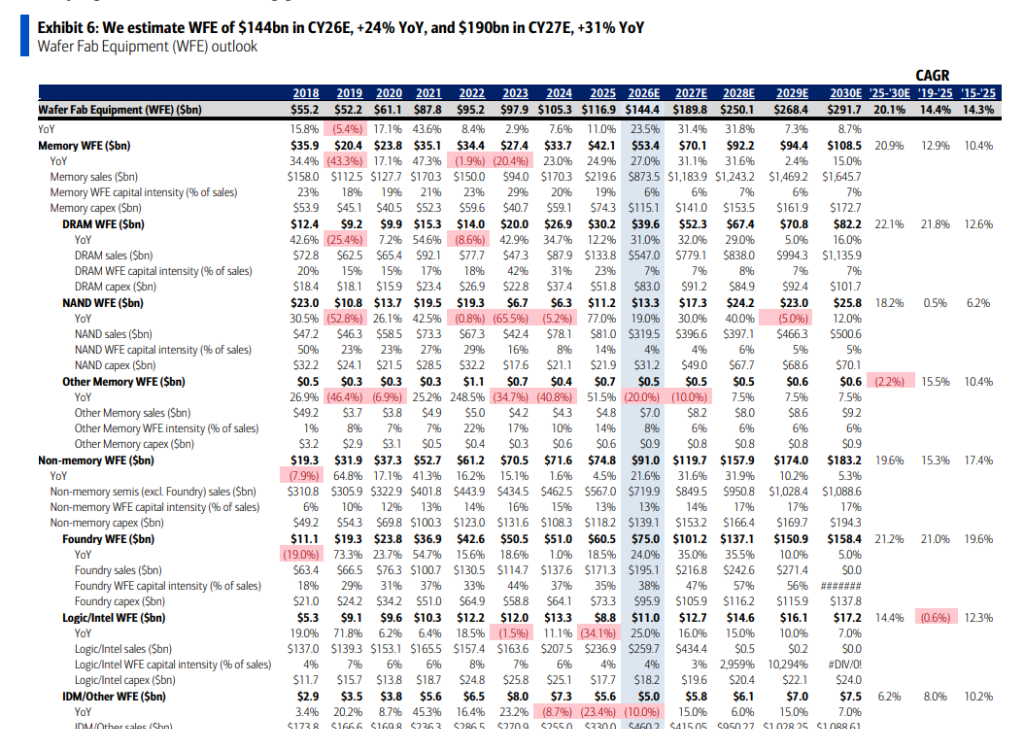
The forecast for wafer fabrication equipment (WFE) spending represents another significant upward revision in this report.
The 2028 semiconductor equipment (WFE) spending forecast has been sharply revised upward by 23%, from the previous estimate of USD 203 billion to USD 250 billion (a year-over-year increase of 32%). The 2027 forecast has also been raised from USD 183 billion to USD 190 billion (a year-over-year increase of 31%).
Overall, WFE spending is projected to grow at a compound annual growth rate (CAGR) of 20% between 2025 and 2030.
Why 2028? Three key drivers:
First, cleanroom capacity will be massively deployed around 2028. Current capital expenditures are heavily directed toward constructing facilities, with equipment procurement concentrated after facility completion.
Second, technology node transitions are increasing equipment intensity. Full-scale production of the 2nm gate-all-around (GAA) process will accelerate between 2026 and 2028. In the early stages of new processes, lower yields and reduced equipment utilization lead to higher equipment investment per wafer. The introduction of High-NA EUV lithography tools is also a major contributing factor.
Third, technological upgrades in memory chips are driving additional equipment investment. The transition of HBM from HBM3 to HBM4/5 involves more layers and more complex packaging, while NAND is moving from 300-layer to 400-layer architectures—both requiring significantly more equipment.
Calculations indicate that if historical trends in equipment spending per wafer are extrapolated, implied WFE (Wafer Fab Equipment) spending would reach approximately $193 billion in 2027 and $245 billion in 2028, closely aligning with the forecast of $190 billion/$250 billion.
Notably, one indicator may lead to misinterpretation: WFE intensity—the ratio of WFE spending to semiconductor sales—is expected to decline from its historical norm in the mid-teens percentage range to around 11%. However, this is primarily due to a sharp surge in memory chip prices, which inflates the denominator (sales), and does not reflect weakening equipment demand. A more meaningful metric is equipment spending per wafer, which continues to rise.
HBM: From $35 Billion to $246 Billion
HBM is the core driver of this memory supercycle.
Forecasts show that the HBM market will grow from approximately $35 billion in 2025 to about $246 billion in 2030, representing a compound annual growth rate (CAGR) of 34%. The HBM capacity per AI accelerator is expected to increase from 187 GB in 2025 to 464 GB in 2030, at a CAGR of 18%.
NVIDIA’s latest Vera Rubin system (launching in the second half of 2026) will feature 288 GB of HBM4 per accelerator—a figure that itself underscores the trend.
HBM price forecasts indicate approximately $17.5 per GB in 2027–2028, up from $14.3 per GB in 2026.
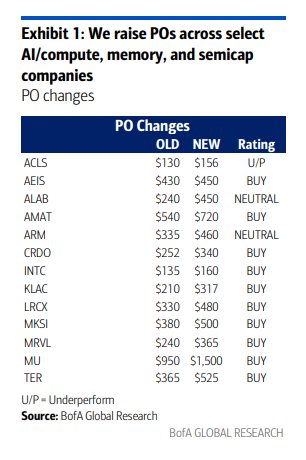
Based on the above industry assessment, the bank’s analysts have significantly raised target prices for multiple semiconductor stocks and shifted their valuation base year from 2027 to 2028:
For memory chips, analysts raised Micron Technology’s target price from $950 to $1,500, maintaining a Buy rating. In semiconductor equipment, Applied Materials’ target price was increased from $540 to $720, and target prices for several other companies, including MKS Instruments, were also raised. In AI infrastructure chips, the analysts are bullish on Marvell, Credo, and Intel.
Consumer Electronics and Smartphones: Outsiders in the AI Boom
Not all market segments are sharing in the AI dividend.
Smartphone chips are projected to decline by 13% year-over-year in 2026, PC chips by 9%, and consumer electronics as a whole by 7%. These markets face structural pressure from declining shipment volumes, in stark contrast to the explosive growth seen in AI data centers.
The automotive and industrial markets are in a phase of moderate recovery: automotive chips are expected to grow by 4% in 2026, and industrial chips by 18%, primarily driven by demand rebound following inventory drawdowns and the continued increase in chip content per vehicle.