In the first half of 2026, global financial markets were marked by volatility and uncertainty, presenting both opportunities and risks—the emergence of major events such as the U.S.-Iran conflict, Kevin Warsh assuming the role of Federal Reserve Chair, and SpaceX completing the largest IPO in history has been relentless. Fellow investors are not only participants in the market but also witnesses to this era.
Looking back, we draw on past experience—may all our efforts in the first half of the year lay the groundwork for pleasant surprises in the second half.
As the first half of this year draws to a close, the performance of Hong Kong’s equity market has exhibited extreme structural divergence. Broad market indices have underperformed: as of the close on June 25, 2026, the Hang Seng Index was down nearly 10% year-to-date, while the Hang Seng Tech Index had declined by over 20%, lagging behind major global benchmarks such as A-shares, U.S. equities, and Korean stocks. Meanwhile, AI-related hard-tech stocks have carved out their own independent rally, with many individual names repeatedly hitting new highs.
 From a fundamental perspective, market expectations underwent repeated revisions in the first half of 2026 due to multiple factors. On one hand, rising expectations of global monetary tightening, oil price volatility, and geopolitical tensions persistently dampened offshore investor sentiment, while southbound capital inflows slowed markedly compared to the same period last year, exacerbating market turbulence. On the other hand, a supercycle in memory storage combined with robust earnings from global tech leaders has driven the sustained outperformance of AI-related structural themes.
Regarding the economic backdrop facing the Hong Kong equity market in the first half of this year, CICC noted that the economy displayed a 'K-shaped divergence.' The AI supply chain, propelled by strong external demand and domestic capital expenditure, has boosted related exports and investments, leading to a recovery in corporate credit impulse. In contrast, traditional domestic demand sectors have weakened, as subdued consumer sentiment weighed on household credit impulse.
The Hong Kong market includes a significant number of large-cap stocks closely tied to domestic consumption and demand, such as internet platforms, e-commerce, electric vehicles, and new-consumption brands. CICC argues that the market's underperformance directly reflects China’s underlying K-shaped economic divergence—where the strong grow stronger and the weak grow weaker.
Top 10 Best-Performing Hong Kong Stocks Revealed! AI Hard-Tech Emerges as the Dominant Theme
Amid broad market volatility and divergence, the first half of 2026 saw the emergence of several standout performers in the Hong Kong market. The top 10 best-performing stocks were primarily concentrated in segments such as large language models, memory semiconductors, optical communications, PCBs, and semiconductor equipment. According to Futubull data, among companies with market capitalizations exceeding HK$50 billion, all ten top gainers posted gains of more than 160%.
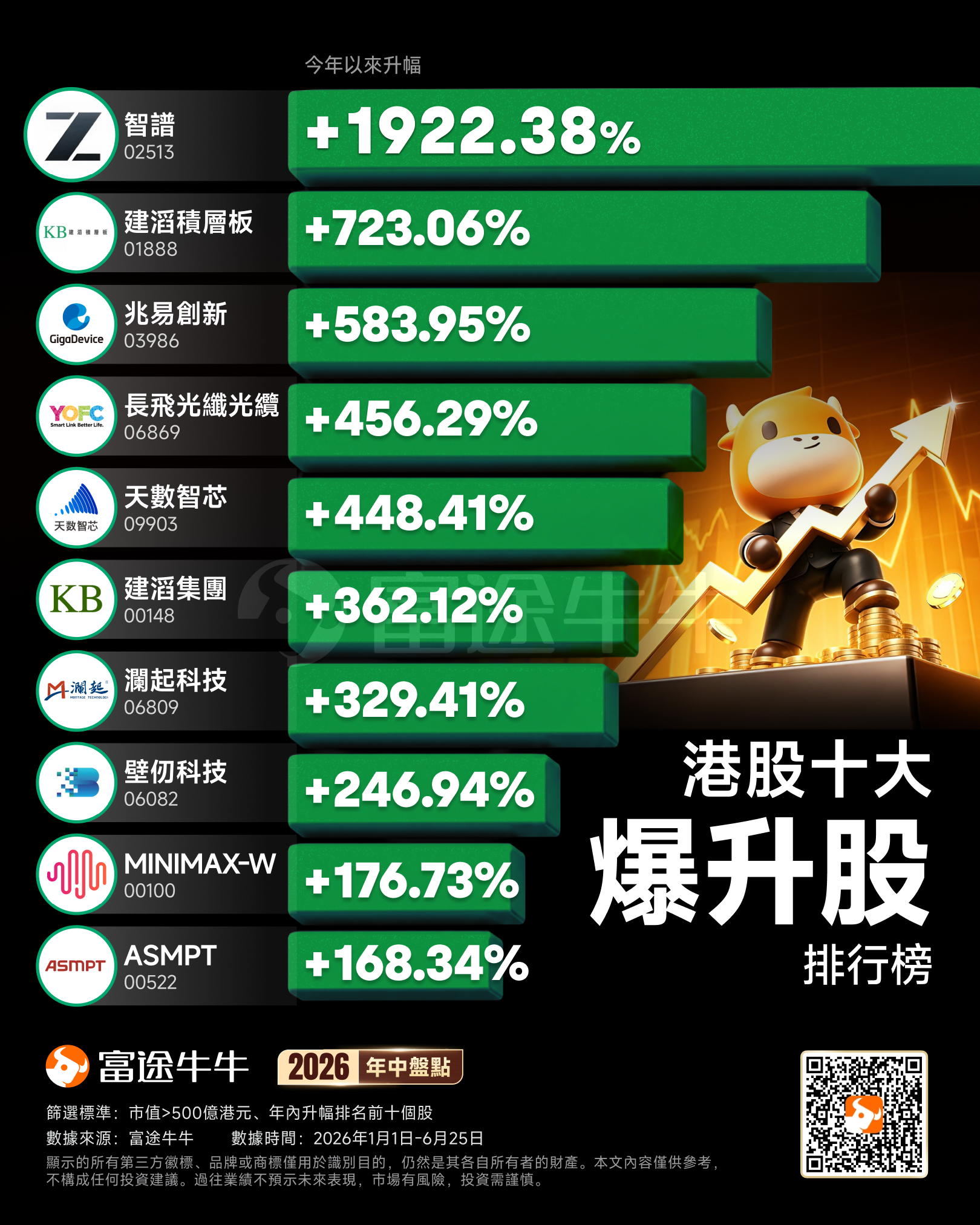
Among them, the 'twin giants of large language models' $KNOWLEDGE ATLAS (02513.HK)$and$MINIMAX-W (00100.HK)$ listed on the Hong Kong Stock Exchange in succession at the beginning of the year. In the first half of 2026, global AI capital expenditure continued to expand, and supportive domestic policies accelerated the push for autonomous and controllable computing infrastructure. Traditional Hang Seng and Hang Seng Tech Index constituents are dominated by internet platforms and lack pure-play large-model companies. This led to intense investor concentration, further amplified by limited free floats and ongoing policy tailwinds for the AI sector, resulting in an independent and powerful rally—the strongest thematic driver across the entire market in H1. Notably, Zhipu AI surged by over 19-fold, topping the year-to-date gainers list in the Hong Kong market.
Two companies from the 'Kingboard Group,' a major player in the PCB sector, have both made the list, $KB LAMINATES (01888.HK)$ surging more than sevenfold, $KINGBOARD HLDG (00148.HK)$ and soaring over 360%. Both belong to Kingboard’s industrial chain and are global leaders in copper-clad laminates (CCL) and copper foil. High-end AI servers and high-speed optical modules require advanced high-frequency, high-speed CCLs, driving substantial growth in demand for premium CCL driven by AI computing hardware. Upstream materials—copper foil and epoxy resin—have seen simultaneous increases in both volume and price, enabling these two firms to fully benefit from the cyclical upswing in upstream materials for computing hardware.
Memory chips are core components of AI hardware. Under the dual drivers of a global memory cycle bottoming out and rebounding in pricing, coupled with China’s push for computing power self-reliance, $GIGADEVICE (03986.HK)$ 、 $ILUVATAR COREX (09903.HK)$ 、 $MONTAGE TECH (06809.HK)$ earnings have continued to materialize, propelling share prices sharply higher. Among them, GigaDevice surged nearly sixfold to rank among the top three on the list, while Tianshu Zixin and Montage Technology rose by approximately 450% and 330%, respectively.
Only one company from the optical communications sector made the list: $YOFC (06869.HK)$ the company, as a global fiber optics leader, achieved a gain of over 4.5x in the first half of the year. Against the backdrop of rising global demand for high-speed fiber, submarine cables, and upstream fiber for optical modules—driven by data centers and overseas AI computing clusters—global capital expenditure on fiber optic cables is trending upward, supporting sustained recovery in YOFC’s performance.
How do institutional investors view the Hong Kong stock market in the second half of the year?
Regarding the outlook for the Hong Kong equity market in the second half of 2026, leading securities firms have issued differentiated yet complementary forecasts. The overall tone is neutral-to-optimistic, with consensus that the risk-reward profile in the second half will be superior to that of the first half. Systemic risks are limited, and structural opportunities will continue to emerge, with industry-leading companies in high-quality sectors and undervalued core assets expected to lead market performance.
CICC forecasts that the Hong Kong market will experience a volatile but gradually recovering trend in the second half. U.S. Treasury yields are expected to decline steadily, alleviating valuation pressures on Hong Kong equities. Ongoing domestic industrial policy support will underpin fundamental improvements. CICC sees the core trading range for the Hang Seng Index between 23,500 and 28,000 points, noting that pessimistic market expectations have largely been priced in, and earnings recovery will become the central theme—favoring high-growth technology segments and high-momentum cyclical sectors.
Everbright Securities International believes that the current Hang Seng Index (HSI) valuation is only slightly above the lower bound of its five-year range, and the first-half headwinds—including weak domestic demand, high U.S. Treasury yields, and Middle East geopolitical tensions—have already been fully priced in. If a decline in U.S. inflation revives expectations of Federal Reserve rate cuts, coupled with renewed southbound capital inflows, the HSI could rebound in the second half of the year to challenge its year-to-date high around the 27,300 level, resulting in a choppy but gradually recovering market trend. However, a sustained bull market remains unlikely, and structural divergence will continue to dominate.
BOCOM International highlights key market risks and portfolio timing considerations, noting that Hong Kong equities in the second half of the year warrant close attention to global oil price volatility, shifts in overseas monetary policy, weaker-than-expected recovery in domestic demand, and short-term pressure from large-scale share lock-up expirations. It also identifies three core investment themes: high-growth AI and semiconductor sectors with visible earnings delivery, export-oriented cyclical industries benefiting from supply chain realignment, and policy-supported core assets in real estate, innovative pharmaceuticals, and consumer staples.
CITIC Securities expects that, amid stabilizing fundamentals and an improving external environment, Hong Kong equities are once again becoming attractive on a risk-reward basis, potentially driving accelerated inflows from both domestic and foreign investors. However, investors should remain cautious about the substantial wave of share lock-up expirations totaling HK$1.57 trillion for the full year, which is heavily concentrated in the second half—particularly during peak periods in June–July, September–October, and December—potentially exerting temporary pressure on market liquidity.
 Looking to select stocks or analyze your holdings? Want to understand the opportunities and risks in your portfolio? For any investment-related questions,just ask Futubull AI!

Editor/Lambor