
Following Federal Reserve Chair Kevin Warsh’s pledge to restore price stability, senior strategists at major Wall Street institutions—including JPMorgan, Bank of America, and Goldman Sachs—have renewed their confidence in the U.S. dollar.
As several major Wall Street investment banks observe a significant reversal in the dollar’s fortunes, the benchmark gauge measuring the dollar’s strength against a basket of currencies is$USD (USDindex.FX)$on track to record one of its best-performing months in a year. Since taking the helm at the Federal Reserve, Warsh has recentered monetary policy on price stability and shifted the Fed’s forward guidance framework toward a ‘minimal communication’ approach. Coupled with Wall Street repricing the interest rate hike trajectory, the strengthening dollar has directly pressured risk assets highly sensitive to real rates and with weak cash flow characteristics, such as$Bitcoin (BTC.CC)$gold, silver, and crude oil futures.
Top foreign exchange strategists from major banks including JPMorgan, Bank of America, and Goldman Sachs have renewed their strong bullish conviction on the U.S. dollar following new Fed Chair Kevin Warsh’s pledge to restore price stability, which has fueled rising market bets on further rate hikes.
 Meera Chandan, Co-Head of Global Foreign Exchange Strategy at JPMorgan, stated in an interview that the Federal Reserve has 'activated' a bullish outlook for the dollar. 'It appears other central banks won’t catch up, and the gap between U.S. interest rates and Treasury yields relative to those elsewhere won’t narrow significantly.'
The early signals from Warsh’s leadership at the Fed are unequivocal: the central bank’s monetary policy and expectations management function are being recalibrated toward ‘inflation control,’ rather than international market stability, exchange rate coordination, or the comfort of risk assets. For$ASIA FINANCIAL (00662.HK)$markets, this serves as a sobering reminder that the U.S. central bank’s primary mandate remains anchored in domestic inflation and financial conditions.
The most significant impact stems from the shift in expectations. Prior to his appointment, Warsh was partly perceived by markets as a candidate closer to Trump’s preference for loose monetary policy. Yet after presiding over his first policy meeting, he adopted a markedly more hawkish stance than anticipated, and a growing number of Fed officials now lean toward raising rates this year. This pivot swiftly strengthened the dollar, reigniting the familiar dynamic of 'Fed hawkish repricing → dollar strength → pressure on Asian currencies.'
Warsh ignites hawkish sentiment, bringing the 'strong dollar trade' theme back to center stage on Wall Street.
In recent weeks, market narratives have undergone a major shift: under Warsh’s leadership, the Fed has proven more hawkish than expected, while the AI-driven computing boom and robust U.S. economic resilience have reignited optimistic speculation that 'American exceptionalism' will support all U.S.-dollar-denominated assets. Statistical data indicate that the U.S. economy will continue to demonstrate greater resilience compared to the rest of the world. Meanwhile, artificial intelligence continues to drive massive corporate spending on AI-related initiatives and global capital inflows into equities, as investors bet that AI-fueled gains in labor productivity will further boost the value of dollar-denominated assets.
This marks a dramatic reversal from just over a year ago, when themes such as 'hedging against American exceptionalism,' global de-dollarization, and dollar depreciation trades dominated market sentiment and weighed heavily on the greenback. Since Warsh formally assumed leadership of the Fed and delivered a strongly hawkish signal at his first FOMC meeting, these themes have cooled considerably.
Even before Warsh took office, the dollar had already shown signs of strengthening, primarily because investors sought safe-haven assets following U.S. and Israeli strikes on Iran in February, during which the dollar was virtually the only appreciating asset globally. The surge in oil prices at the time also significantly bolstered the dollar, given the United States’ status as the world’s largest oil producer—although oil prices have since returned to pre-conflict levels.
Chandan of JPMorgan remarked, 'The real driver of markets has now clearly shifted from energy to the Federal Reserve’s actual monetary policy response.'
According to reports, the Bloomberg Dollar Spot Index has risen 2.1% so far in June, nearly matching the strong gain driven jointly by soaring oil prices and risk-off sentiment in March. The index is currently trading near its highest level since November of last year and is up 1.7% year-to-date.
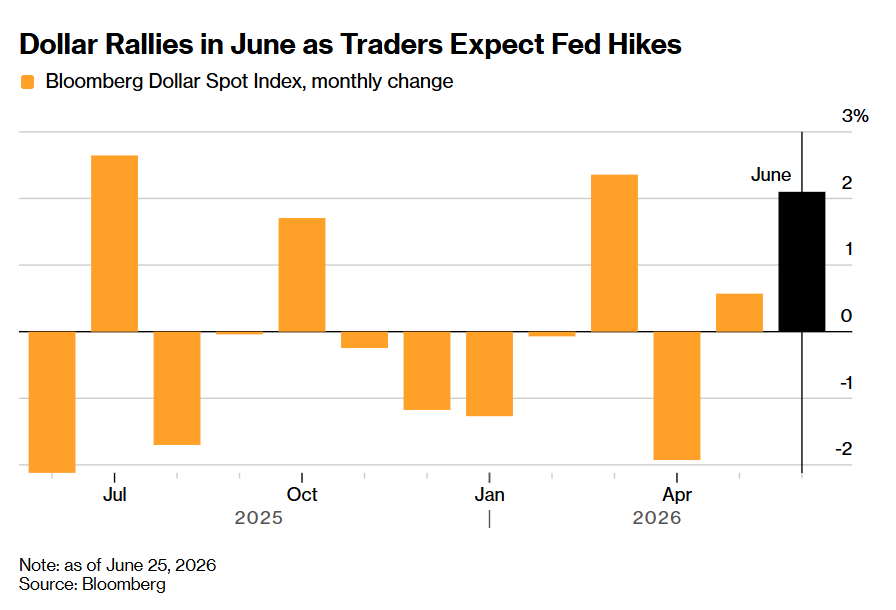
It is not only a hawkish Federal Reserve that is bolstering dollar bulls. Even Treasury Secretary Scott Bessent has recently spoken more frequently about a strong-dollar policy and expressed support for Warsh. However, Bessent stated that it is the certainty of U.S. fiscal and monetary policy—not the exchange rate itself—that sustains the dollar’s dominant role in the global economy.
Rising interest rate expectations, a strong-dollar policy, and speculative capital flows are converging, pushing dollar-long positions into crowded trade territory.
Against this backdrop, prominent hedge fund Man Group Plc expects the dollar to appreciate by 5% by year-end, while TD Securities forecasts a more modest gain of approximately 2% in the third quarter. The dollar appears to have entered a phase of appreciation driven jointly by policy, interest rate differentials, and positioning.
Jayati Bharadwaj, Head of Foreign Exchange Strategy at TD Securities, stated: “Compared with other Western economies, U.S. economic data show robust resilience, economic activity remains strong, and a hawkish new chair is discussing policy, the Fed’s credibility, and mechanisms for price stability.” “The threshold for the Fed to resume rate hikes has now lowered—this represents a shift in market perception.”
Challenges remain ahead. Bharadwaj noted that for the dollar to see more pronounced gains, the Fed would need to adopt a more hawkish stance than currently priced into markets—specifically, implementing one or two additional 25-basis-point rate hikes by early next year.
Some indicators suggest the dollar could remain relatively strong against other currencies in the second half of the year, though the pace of appreciation may moderate. Over the next 12 months, the premium paid to hedge against a rise—rather than a fall—in the dollar relative to a basket of major Western sovereign currencies is near its highest level in over a year and close to its five-year average, though still significantly below the levels seen during the last period when American exceptionalism dominated market narratives.
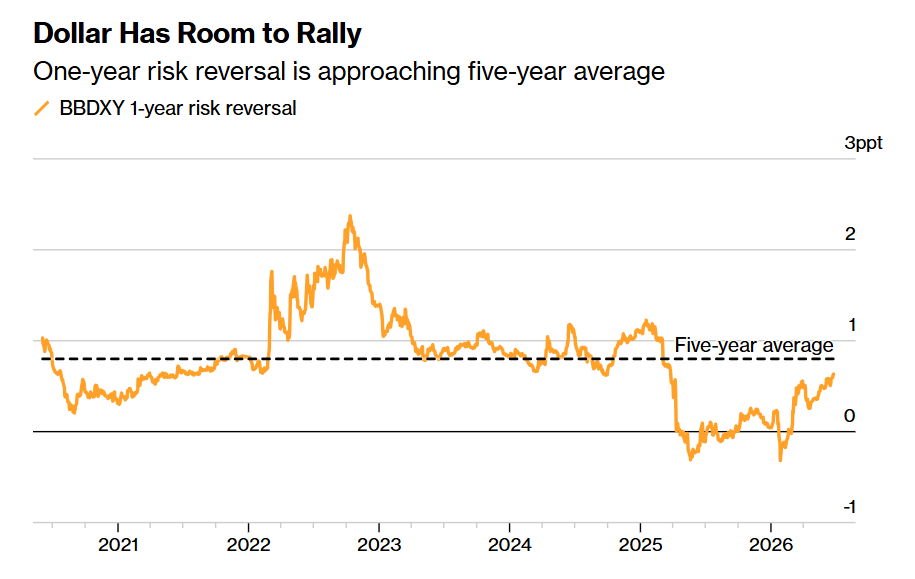
As illustrated in the chart above, the dollar appears to retain upside potential—the one-year risk reversal indicator is approaching its five-year average.
Barclays strategists noted that with Fed rate hikes already priced into asset valuations and market sentiment highly bullish—and given that both oil prices and U.S. economic data may be peaking—“the dollar’s path is unlikely to be linear.”
For Alex Cohen, foreign exchange strategist at Bank of America, the dollar “still has room to rise further.” On Thursday, Bank of America revised its year-end EUR/USD forecast downward from $1.20 to $1.15 per euro and now expects the Fed to hike rates three times this year—a significantly more hawkish outlook compared to its earlier, relatively dovish expectation that the Fed would remain on hold for the entire year.
Other major central banks are also expected to raise rates, albeit to a lesser extent than the Fed’s projected path. Earlier this week, European Central Bank President Christine Lagarde scaled back rate hike expectations due to signs of economic weakness in the region, driving the euro to a one-year low.
Even before the most recent Federal Reserve meeting, fast money strategies and certain investment funds had already poured into trading themes closely tied to a stronger U.S. dollar. According to data released Monday by the Commodity Futures Trading Commission (CFTC) and compiled by institutional sources, hedge funds, asset managers, and other speculative players held a cumulative net long position of USD 29.4 billion betting on dollar strength as of June 16.
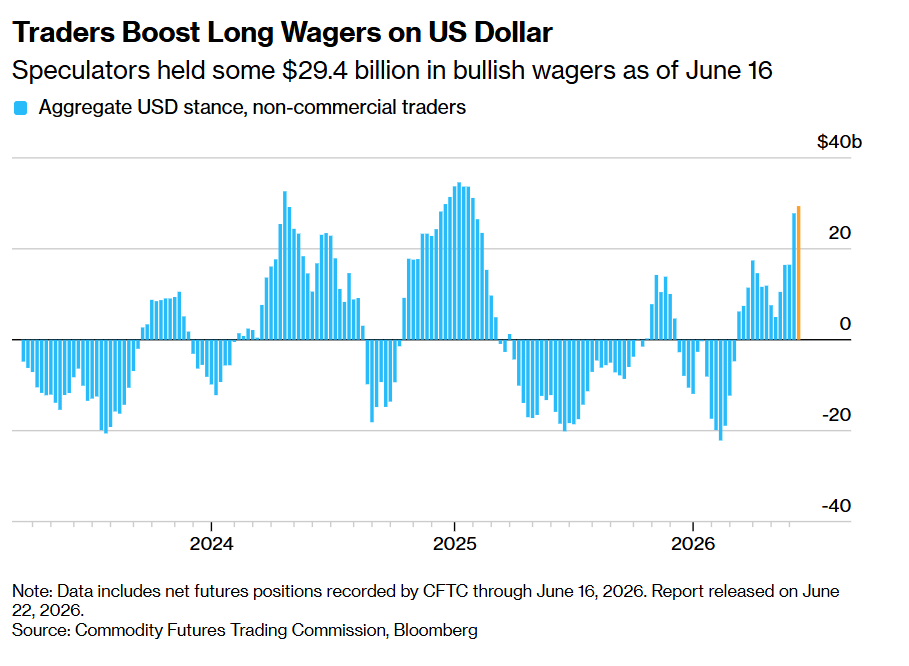
As shown in the chart above, traders increased their net long positions in the U.S. dollar—speculators held approximately USD 29.4 billion in bullish bets as of June 16. Note: Data includes net futures positions recorded by the Commodity Futures Trading Commission as of June 16, 2026, and reported on June 22, 2026.
AI-driven capital flows are reshaping the appeal of U.S. dollar assets, with American exceptionalism extending from equities to foreign exchange markets.
Goldman Sachs, Standard Chartered, and Deutsche Bank all emphasize that AI is boosting U.S. economic growth expectations, corporate profitability, and equity market returns, attracting global capital toward U.S. assets and positioning the dollar as the primary beneficiary of future AI-related profit streams.
Kamakshya Trivedi, Chief Foreign Exchange and Emerging Markets Strategist at Goldman Sachs, stated that part of the large-scale capital inflow into U.S. markets is driven by AI-compute-related hot trading themes.
As the risk premium associated with the Iran conflict dissipates, traders have overwhelmingly resumed positions in pre-war, highly popular trading themes dominated by short-term U.S. Treasuries and the AI computing infrastructure supply chain.$NVIDIA (NVDA.US)$, AMD, ARM, and$Micron Technology (MU.US)$The AI computing power supply chain it leads can be considered the strongest investment theme in the pre-conflict trading narrative. Within the equity market, stocks directly tied to AI computing infrastructure—namely NVIDIA, Micron Technology,$Broadcom (AVGO.US)$and AMD—the leaders of AI computing power who head up the so-called 'AI computing supergroup'—are typically the most sensitive, first to move, and exhibit the largest upside during broad market and tech stock rebounds. The core logic behind their leading rally is exceptionally 'hardcore': they are directly linked to technology giants’ record-breaking, trillion-dollar AI capital expenditures, rather than merely speculative narratives.
Trivedi from Goldman Sachs remarked, 'The reality is that the AI compute trade is lifting U.S. domestic growth expectations and equity market returns, making it an attractive destination for capital.'
In Goldman Sachs’ view, the AI bull market is far from over; it is transitioning from the initial phase of 'AI chip buying frenzy' into a second stage characterized by 'large-scale construction of AI factories.' Consequently, excess alpha returns in the next phase will no longer be confined solely to leading names in AI GPUs or AI ASICs but will systematically spread across the full-stack AI infrastructure ecosystem—including high-performance CPUs for data centers, DRAM/NAND/HBM memory, AI PCBs, liquid cooling systems, optical interconnects for data centers, ABF substrates/glass core substrates, MLCCs, electronic fabrics, and broad-based wafer foundry services. Jensen Huang, CEO of NVIDIA, further noted last Wednesday that AI infrastructure could revitalize U.S. manufacturing, potentially ushering in a new era of industrial and manufacturing growth in America.
$STANCHART (02888.HK)$The foundation for Standard Chartered’s bullish stance on the U.S. dollar also includes productivity gains closely associated with AI computing infrastructure. Steven Englander, Global Head of G-10 FX Research at the bank, stated that capital inflows and higher earnings benchmarks are supporting the dollar. George Saravelos, Head of Currency Strategy at Deutsche Bank, believes the dollar is 'the primary beneficiary of future AI-driven profit streams.'
However, Trivedi believes the dollar will follow a divergent path: it will strengthen against low-yielding currencies—particularly those sensitive to oil prices—but underperform relative to high-carry, terms-of-trade-sensitive commodity currencies such as the Mexican peso, Brazilian real, and Australian dollar.
He stated, "When I look back to the end of last year, my outlook on the U.S. dollar was significantly more pessimistic. That view was based on the idea that investors would find better returns outside the United States."
That view has undergone a profound shift as currencies of oil-importing countries—particularly Asian currencies—and those with lower exposure to AI computing power trade themes have emerged as clear underperformers. Goldman Sachs expects the Thai baht and the Philippine peso to be among the sovereign currencies that weaken significantly against the U.S. dollar over the next three months. Trivedi noted, "Discussions around reducing exposure to U.S. dollar-denominated assets are far less prominent than they were a year ago. Investors certainly don’t feel compelled to increase their hedging ratios for U.S. dollar holdings."
Editor/Rocky