
While the market has priced in a 75% probability of a rate hike in September, Academy Securities analyst Tchir has offered a contrarian view: Chair Waller’s hawkish stance may be nothing more than a carefully crafted smokescreen—by suppressing long-end rates, redefining inflation metrics, and vying for influence over the narrative on the neutral rate, the Fed chair could be quietly paving the way for consecutive rate cuts in September and October, timed to take effect just before the midterm elections.
Federal Reserve Chair Kevin Warsh’s hawkish stance may be nothing more than a carefully orchestrated smokescreen.
In a recent report, Peter Tchir, an analyst at Academy Securities, argued that although markets have already priced in a 75% probability of a rate hike in September and anticipate a cumulative increase equivalent to 1.25 hikes by year-end, they are overlooking a genuine path toward a September rate cut—one that Warsh himself may be quietly laying out.
 Tchir noted that Warsh has sent sufficiently clear signals: using hawkish rhetoric to suppress tail risks in long-end yields (the 10-year U.S. Treasury yield has already declined this week from 4.46% to 4.37%), while simultaneously creating room for a subsequent pivot in the data narrative. In his view, the ultimate outcome of these maneuvers could be a rate cut in September followed by another in October—timed precisely before the midterm elections.
This assessment remains a personal opinion, and Tchir himself acknowledges its inherent uncertainty. However, his reasoning is tightly constructed, encompassing a redefinition of inflation data, the contest over the narrative surrounding the neutral rate, and the core premise that the White House’s policy objectives have never changed.
Is Hawkishness Just Theater? Political Logic Points Toward Rate Cuts
Tchir’s argument begins with a political-economy interpretation of Warsh’s motives.
He contends that the Trump administration’s policy goals have never undergone a fundamental shift. The president himself has repeatedly stated his deep understanding of real estate and emphasized the importance of low interest rates for the housing market. Against this backdrop, it is hard to imagine Trump being satisfied with sustained hawkishness from a Fed chair he personally appointed—unless this posture itself is part of a prearranged strategy.
Tchir sketches a hypothetical scenario: Warsh convinces Trump that sending dovish signals at this moment would be disastrous. By adopting a hawkish stance, Warsh can suppress long-end yields, preserve the appearance of Federal Reserve independence, and steer Wall Street analysts and the media fully toward expectations of rate hikes. Later, as incoming data gradually 'cooperates,' he can pivot to rate cuts under the guise of being 'data-dependent'—and even blame inflation on his predecessors for 'using incorrect data and acting too late.'
He added that Warsh’s father-in-law is a major donor to Trump—a connection that may not be entirely irrelevant.
Targeting Inflation Data: PCE Is Not This Fed’s Benchmark
The most substantive element of Tchir's argument is his systematic critique of the current inflation measurement framework.
He explicitly stated that the PCE is not the preferred inflation metric of the current Federal Reserve under Chair Waller. In his view, the PCE was more a preference of the Bernanke era, and Waller would not lie awake at night worrying about PCE data.
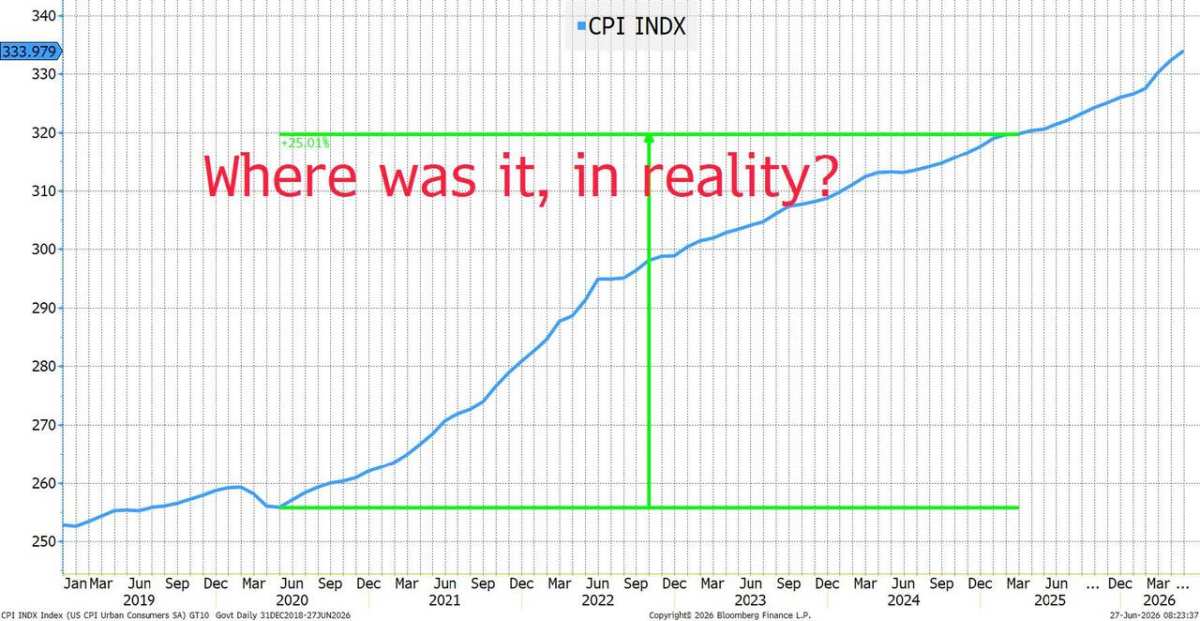
His criticism is particularly sharp regarding the measurement of housing inflation. The Owner’s Equivalent Rent (OER) component in the CPI did not peak until mid-2023, reaching approximately 8%, whereas Zillow’s rental data had already hit a high of nearly 16% as early as the beginning of 2022. He pointed out that the Cleveland Fed has developed the 'New Tenant Repeat Rent Index' (NTRR), whose trend closely aligns with Zillow’s data, yet this more realistic indicator has received almost no attention.
He concludes that the Federal Reserve could readily switch to using the Cleveland Fed’s own indicator—without incorporating external data—and thereby establish a data-driven justification for rate cuts.
Truflation and 'Low Twos Are Good Enough'
Beyond the PCE, Tchir also cited Truflation’s real-time inflation data. According to him, Truflation constructs a daily inflation index based on vast real-time datasets, and its core inflation rate currently stands at approximately 1.45%, having remained below 1.8% consistently since February of this year.
He also noted that Waller recently hinted that the 'leading digit' (i.e., the integer part) of inflation figures matters more than precise decimal values. Based on this, Tchir infers that markets may be gradually being 'conditioned' to accept a cognitive framework in which 'low twos' are effectively equivalent to the 2% target. In his chart, he labels the inflation target line as 2.9%, rather than the traditional 2%.
He believes that once the narrative around the data shifts, the technical barriers to cutting rates will be significantly reduced.
Tchir also referenced former Fed insider Miran’s work on the neutral interest rate. He argues that although the neutral rate is currently absent from market discussions, this topic will resurface at an appropriate time.
His reasoning is that the neutral rate itself is inherently difficult to measure precisely and carries a wide estimation range. If the new Fed leadership can demonstrate that their predecessors overestimated the neutral rate, that alone could provide theoretical justification for a 50- to 100-basis-point rate cut, while attributing responsibility to the 'old Fed’s errors.'
Apple Price Hikes and AI-Driven Inflation: Rate Hikes Are Missing the Mark
In response to market concerns about AI-driven inflation, Tchir offered a contrarian interpretation.
He pointed out that$Apple (AAPL.US)$the recent share price decline following the announced price hike demonstrates precisely that the market is questioning consumers’ tolerance for higher prices. If even a premium consumer company like Apple struggles to pass on price increases without adverse market reaction, the pricing power of ordinary consumer firms will be even weaker—contradicting the narrative of persistently rising inflation.
He also cited feedback from a semiconductor company: memory prices have not surged significantly due to AI demand; in fact, some products are now cheaper than they were five years ago. He argued that while spending on AI and data centers is indeed inflationary, it operates on a dimension entirely distinct from the affordability challenges faced by ordinary consumers.
More critically, he contended that rate hikes have virtually no dampening effect on AI/data center expenditures—technology companies trading at 100x valuations are simply insensitive to a 50-basis-point shift in interest rates. Those truly harmed by higher rates are ordinary borrowers who have no connection whatsoever to AI-driven inflation.
Based on this assessment, he expects markets to begin repricing rate-cut expectations, with the clearest opportunity lying at the short end of the yield curve—going long on short-dated Treasuries to bet on declining front-end yields. For the long end, he maintains a neutral-to-slightly-bullish stance, noting that Treasury Secretary Bessent would like to see the 10-year yield return to the '3%' range, and that Waller has already mitigated tail risks on the long end through his hawkish commentary.
On the equity side, he recommends a significant overweight in the energy sector, particularly global nuclear power assets; within the defense and security (ProSec) theme, he favors an overweight in biotech/pharmaceuticals and an underweight in semiconductors. He remains cautious about valuations in AI and data centers and warns that potential share issuance by large tech firms could weigh on their stock prices.
Editor/melody