
The U.S. Bureau of Economic Analysis announced it will implement methodological adjustments to three components of the PCE price index on September 30. Goldman Sachs estimates that the combined effect of these three changes will revise down May's core PCE annual inflation by 0.2 percentage points to 3.2%. UBS Group warned that the two components selected for revision happen to be among the top four contributors to core PCE inflation, and the lack of transparency in the new methodology makes independent verification difficult, raising concerns about potential data manipulation.
The Federal Reserve's preferred inflation gauge is undergoing a 'quiet rewrite.'
The U.S. Bureau of Economic Analysis (BEA) announced methodological adjustments to three components of the Personal Consumption Expenditures (PCE) price index. According to Zhui Feng Trading Desk, research reports from Goldman Sachs and UBS Group suggest these changes will systematically lower core PCE inflation readings. UBS went further, stating that the selection of these adjustments 'appears designed to reduce inflation,' and warned that the new methodology lacks transparency, making independent verification difficult and raising concerns about potential data manipulation.
Three changes, one consistent outcome
 The BEA’s revisions involve three components and will take effect on September 30, 2026, with historical data revised retroactively as per standard practice.
First: Computer software and accessories
Current methodology: Uses software and accessories prices exclusively from the Consumer Price Index (CPI).
New methodology: Adopts a 'composite price index' combining the Producer Price Index (PPI) for data processing services, the PPI for video game software, and the CPI for software and accessories.
Goldman Sachs analysts, including Manuel Abecasis, estimate that because the PPIs for data processing and video games are currently rising more slowly than the CPI software component, this change will reduce year-over-year core PCE inflation by 0.05 to 0.1 percentage points in May and by 0.1 to 0.2 percentage points in December.
Analysts also noted that even after the adjustment, the contribution of software and accessories to core PCE inflation may remain overstated by approximately 0.1 percentage point (in May), peaking at around 0.3 percentage points.
Second: Portfolio management services
This is the most impactful and controversial of the three changes.
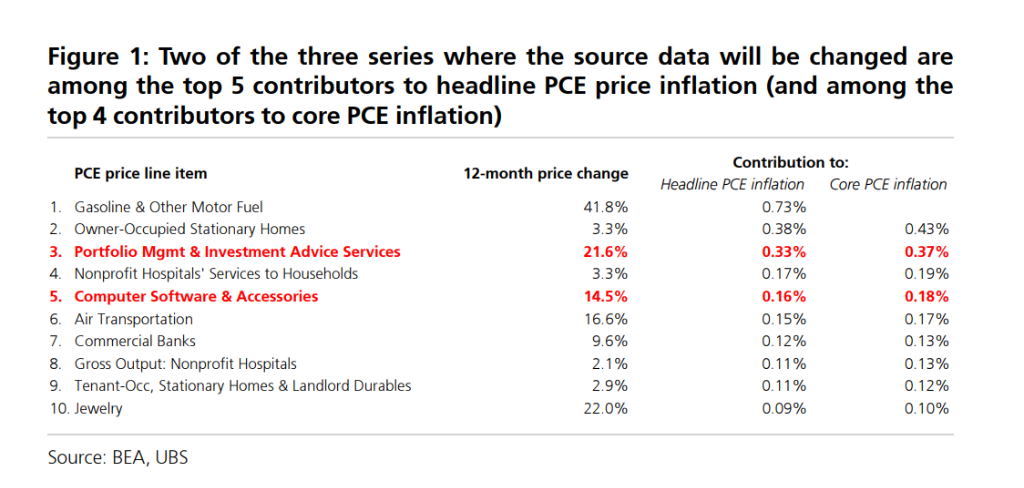
Current methodology: The Producer Price Index (PPI) for portfolio management services is directly used to deflate nominal expenditures to derive real prices. Because rising asset prices increase management fees—typically charged as a percentage of assets under management—the PPI has also risen sharply, resulting in a year-over-year increase of 21.6% over the past 12 months, making it the second-largest contributor to core PCE inflation.
New methodology: Total hours worked in this industry from employment surveys will be used to measure 'real service volume.' Prices will then be back-calculated by dividing nominal expenditures by real service volume.
Logically, growth in hours worked is far slower than growth in asset values, so the calculated 'price increase' would decline substantially. Analysts estimate that this change will reduce year-over-year core PCE inflation by 0.10 to 0.15 percentage points in May and by 0.10 to 0.20 percentage points in December.
Economists at UBS Group, including Alan Detmeister, estimate that over the past 12 months, prices for portfolio management services rose 21.6% year-over-year, making it the second-largest contributor to core PCE inflation (adding 0.37 percentage points). Under the new methodology, the year-over-year price increase for this component would have been only 9.0%, reducing its inflation contribution by approximately 0.21 percentage points (lowering core PCE by about 0.21 percentage points).
The firm argues that substituting direct price indices with labor data extrapolation 'could reduce the accuracy of the price index and expose future data to greater revision risk due to monthly and annual revisions in employment data.'
Third item: Legal services
Current methodology: Uses CPI-based prices for legal services.
New methodology: Switches to a composite price index constructed from a specific legal services PPI.
Goldman Sachs estimates that this change will cause a modest increase in year-over-year core PCE inflation of approximately 0.04 percentage points in May, with a slightly smaller effect in December.
The background is that the U.S. Bureau of Labor Statistics (BLS) has largely refrained from publishing its CPI legal services data since 2023 due to sample quality issues. The Bureau of Economic Analysis (BEA) quietly deviated from the CPI data source in January and March of this year without public disclosure—only acknowledging the shift after external researchers flagged anomalies in the data.
Currently, year-over-year PCE inflation for legal services stands at +2.5%, while the corresponding implied CPI series is approximately +7.6%.
UBS Group noted that the specific PPI subcomponents and their respective weights used in the new methodology have not been disclosed. The price changes across these subcomponents vary widely—from +1.6% for 'other legal services' to +8.9% for 'real estate legal services.' If the aggregate PPI index for legal services (+8.1%) were used instead, it would increase PCE inflation by approximately 0.05 percentage points.
Combined impact of the three adjustments: Core PCE could be revised downward by 0.2 percentage points.
Taking all three adjustments into account, Goldman Sachs estimates that the May year-over-year core PCE inflation rate will be revised down by 0.2 percentage points to 3.2%.
Based on this, the firm lowered its forecast for core PCE inflation in December 2026 from 3.2% to 3.0%, while maintaining its December 2027 forecast unchanged at 2.2%.
The CPI is unaffected by this methodological change. The firm maintains its forecasts of 2.6% year-over-year core CPI inflation for December 2026 and 2.2% for December 2027.
UBS Group’s estimates are close to those of Goldman Sachs: over the past 12 months, overall PCE inflation would have been approximately 0.21 percentage points lower under the new methodology, and core PCE inflation about 0.23 percentage points lower.
UBS Group: The choice of revised series 'appears designed to lower inflation.'
Goldman Sachs’ report remains relatively neutral, focusing on quantifying the impact. UBS Group, however, uses sharper language.
The bank noted that two of the three series revised by the U.S. Bureau of Economic Analysis (BEA) this time happen to be among the top four components contributing most to core PCE inflation over the past year: portfolio management services (the second-largest contributor) and computer software and accessories (the fourth-largest contributor).
The bank wrote: "Only those series that have exerted a relatively large positive impact on inflation under the current methodology were included in the revision plan. Series that are similarly problematic but have had neutral or negative effects on inflation—such as spectator sports, various household operation price series, photo printing, and computer prices—were all excluded."
Thus, the conclusion is: "The skew of the revised series toward the upper end of the inflation contribution distribution suggests they were selected specifically to reduce inflation."
This logic is analogous to a student requesting only the questions they answered incorrectly to be re-graded after an exam, rather than having the entire paper reviewed—the result, naturally, would be a score that can only go up, not down.
Insufficient transparency makes external verification difficult
Both institutions expressed concerns about the transparency of the new methodology.
Goldman Sachs pointed out that the BEA has not yet disclosed the specific weights of the three inputs in the new software composite index, creating uncertainty around its estimates.
UBS Group was more critical: "The new methodology clearly lacks transparency, which in itself is a problem. It will make it harder for external parties to forecast and verify official inflation data."
UBS Group further warned: "The lack of transparency regarding key components of the Federal Reserve’s preferred inflation gauge is particularly concerning. If statistical agencies are influenced by partisan politics, this opacity could make inflation data more susceptible to manipulation."
This implies that after September 30, the predictability of core PCE data will decline, market interpretation of inflation figures will become more challenging, and uncertainty surrounding the Federal Reserve’s monetary policy path will increase accordingly.
Editor/joryn