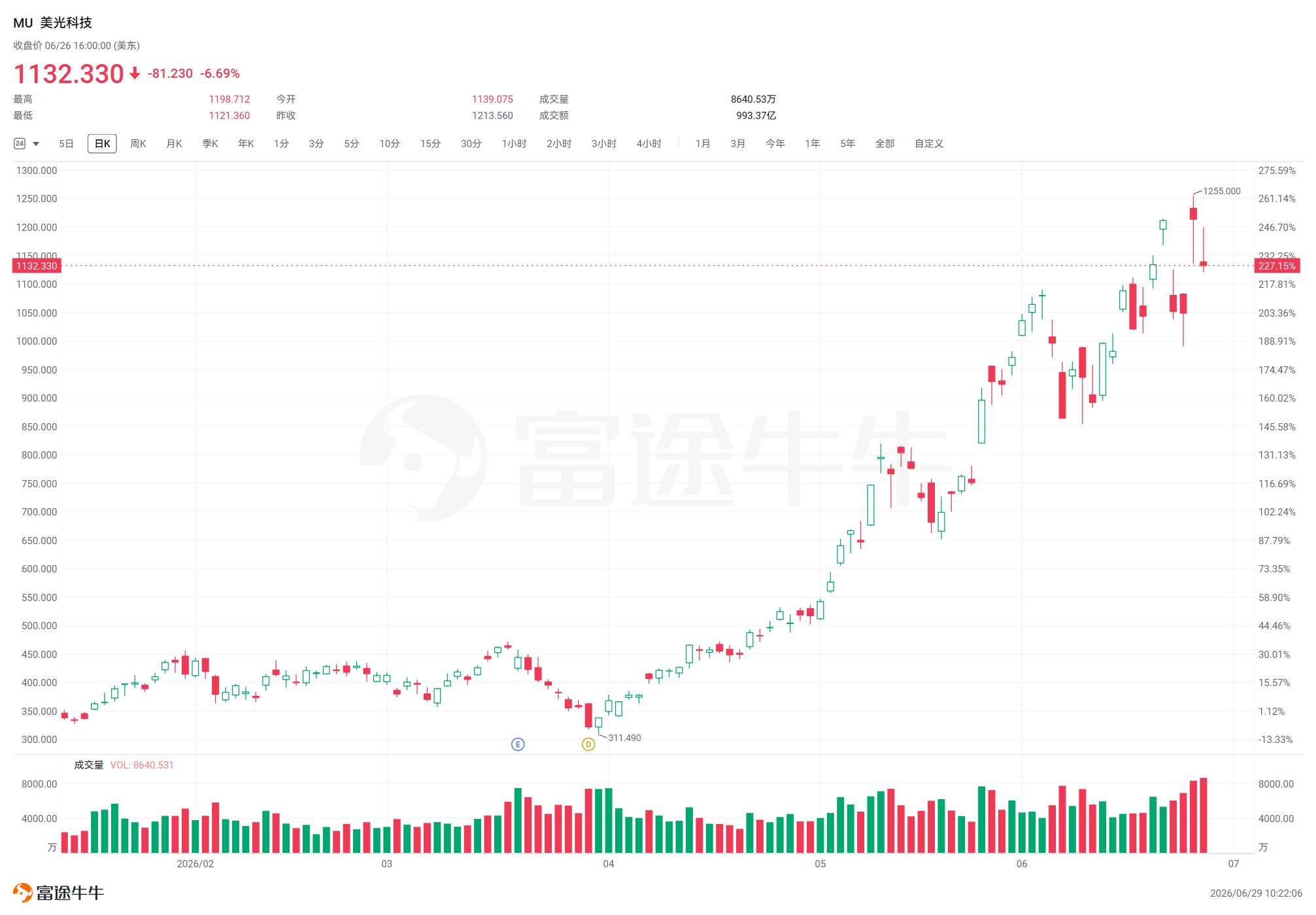
Micron's earnings vastly exceeded expectations, and a $100 billion long-term order has locked in its position in the AI memory supercycle. However, the sharp drop following a surge reveals underlying market concerns: at peak pricing, the positive catalyst is already fully priced in. While this $100 billion order has effectively cemented a profit floor, it has also placed a valuation cap on the AI bull market.
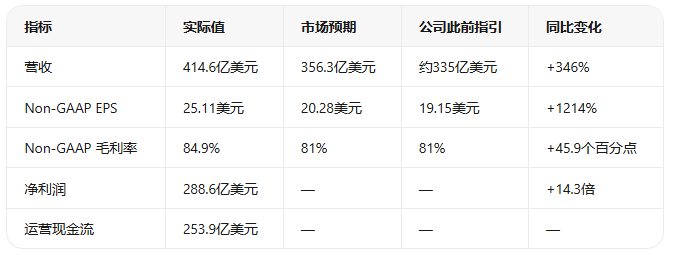
After the market close on June 24, $Micron Technology (MU.US)$ delivered the most explosive quarterly earnings report in the history of human memory chip manufacturing: revenue of $41.46 billion, up 346% year-over-year; gross margin of 84.9%; and EPS of $25.11, nearly 24% above market expectations. Sixteen strategic customer agreements have locked in approximately $100 billion in guaranteed revenue, with customer prepayments amounting to $22 billion.
Following the earnings release, the stock surged as much as 15.78% in after-hours trading. However, it fell 6.69% the next day. This report confirmed one thing while exposing another: the supercycle for AI memory has been firmly cemented by contracts, yet the valuation ceiling of the AI bull market is being increasingly constrained.
The numbers themselves: this wasn’t just beating expectations—it was obliterating them.
 Micron’s Q3 FY2026 earnings report left analyst models far behind across virtually all key metrics.
Even more striking to the market was the guidance for the next quarter: revenue of $50 billion (±$1 billion), gross margin of approximately 86%, and EPS of around $31. The prior consensus expectation had been in the range of $43–44 billion—meaning Micron raised its next-quarter revenue outlook by a staggering $6–7 billion in one go.
This is not an earnings report that merely aligns with the bull-market narrative. It is one that transforms the bull-market narrative from ‘potential’ into ‘already realized.’
All business segments also hit record highs. Data-center-related revenue exceeded $25 billion in a single quarter, implying an annualized run rate surpassing $100 billion. Core data center business (including HBM) generated $11.52 billion in revenue with an 87% gross margin; cloud memory business brought in $13.77 billion with an 83% gross margin. Data center SSD revenue surpassed $5 billion, doubling sequentially.
Even mobile, client, and automotive segments saw broad-based growth. Automotive and embedded business revenue quadrupled year-over-year to $4.63 billion, with a 79% gross margin. DRAM prices have risen more than 200% since early 2025, and the average selling price of smartphones reached a record high of $523 in 2026—the wafer capacity pull from AI data centers has already been directly passed on to every consumer.
The real headline: 16 contracts, $100 billion, and $22 billion in deposits
But the most important figures in this earnings report aren’t $41.46 billion or 84.9%.
These are 16 Strategic Customer Agreements (SCAs).
According to disclosures made during its earnings call, Micron has signed 16 multi-year agreements with four large customers and three mid-sized customers. Fourteen of these agreements include minimum revenue commitments totaling approximately $100 billion over the period from 2026 to 2030. These agreements are take-or-pay contracts—customers are obligated to purchase the agreed-upon volumes regardless of future market prices.
More critically, the structure of the terms includes:
Price floor: A minimum price is set to ensure Micron’s gross margin exceeds the highest level achieved in any previous cycle in the company’s history;
Price ceiling: Approximately equal to the market price in Q2 2026;
Coverage: Represents roughly 20% of DRAM shipments and one-third of NAND shipments during the term of the agreements;
Advance deposits: Customers have already paid or committed to deposits amounting to $22 billion;
HBM capacity: The entirety of Micron’s HBM capacity for the full calendar year of 2026 has already been secured under these agreements.
What does this mean?
Over the past 30 years, the DRAM industry has followed a recurring boom-bust cycle: demand surges → capacity expansion → oversupply → price collapse → industry-wide losses → capacity rationalization → demand recovery. No memory company has ever escaped this cycle. Now, however, Micron is attempting to eliminate this cyclical pattern from the industry’s DNA through long-term contracts.
CFO Mark Murphy said on the earnings call: "We have demand visibility. This is committed volume that gives us confidence to invest."
CEO Sanjay Mehrotra added a sharper assessment: "There is currently no clear point at which memory supply will catch up with persistently growing demand."
The new fab will not contribute meaningful capacity until fiscal year 2028. In other words, the supply shortage will not materially ease until at least the end of 2027.
Following the earnings release, TD Cowen analyst Krish Sankar raised his price target from $660 to $1,500, with straightforward reasoning: "Memory’s role in AI is structural, not cyclical."
Then why did the stock price plummet?
If fundamentals are so strong, why did Micron’s stock close down 6.69% on June 27, despite surging 15.78% in after-hours trading on June 26?
This is not just one company’s story. It is a stress test for the entire AI trade in the summer of 2026.
1. Valuation is already on the cliff’s edge: up 863% in a year, leaving zero room for error
Before the earnings release, Micron’s stock had risen 863% over the past 12 months. Even after the sharp volatility between June 24 and June 26, its year-to-date gain remained around 325%. Once a stock has risen at such a steep trajectory, any positive news is already priced in, while even minor disturbances get amplified.
The 15.78% after-hours jump had already fully priced in the beat. On the following day’s open, profit-taking, quant model deleveraging, and options gamma reversal all contributed to technical selling pressure. In an extremely crowded long position, being ‘too good to be true’ itself becomes a risk.
2. AI Capex Fears Are Spreading: From NVIDIA to Alphabet, and Now to Memory
June 26 was not an isolated event. On the same day:
$Intel (INTC.US)$ fell 3%, $Arm Holdings (ARM.US)$ dropped nearly 4%, $Marvell Technology (MRVL.US)$ declined 5%;
European semiconductor stocks broadly declined: $ASML Holding (ASML.US)$ down 2%, $INFINEON TECHNOLOG (IFNNY.US)$ fell 4%, ASM International down 4%, $STMicroelectronics (STM.US)$ slid 4%;
$SoftBank (9434.JP)$ plunged more than 5% in Asian markets.
CNBC highlighted a deeper market anxiety in its report: investors are growing increasingly wary of the surging costs of artificial intelligence infrastructure.
One catalyst was The New York Times’ report that OpenAI might delay its IPO until next year. If even the brightest star in the AI sector is reconsidering its listing timeline, the market immediately questions whether the current hundreds of billions of dollars in AI capital expenditures are being reassessed.
The day before, Alphabet plummeted 10% amid investor concerns over its AI spending. The same logic quickly spread to Micron: even with $100 billion in secured orders, Micron is not entirely immune if hyperscalers slow their AI spending growth.
The 'cyclical ghost' in the memory industry has never truly left.
Bulls call it 'structural'; bears call it 'cyclical.'
TechInsights forecasts a potentially broader downturn in the memory industry as early as 2027. Morningstar flagged all major memory chip stocks as overvalued in mid-May. The bears’ thesis remains unchanged: today’s massive capital expenditures will translate into tomorrow’s new supply capacity. Micron itself continues to ramp up spending—raising its fiscal year 2026 capital expenditure guidance to approximately $27 billion, with quarterly capex in fiscal 2027 expected to remain above Q4 FY2026 levels.
When a company pushes its capital expenditures to historic highs, the market simultaneously sees two narratives: one reflecting demand certainty, and the other signaling a future flood of supply.
SCA agreements can lock in pricing and gross margins, but they cannot prevent this risk: if new capacity comes online en masse in 2028 while AI demand growth falls short of expectations, the more than 60% of revenue not covered by contracts, along with excess DRAM/NAND supply and potential inventory adjustments, could pull the cycle back down.
What exactly is the market pricing in?
If we interpret Micron’s post-earnings stock price volatility as a signal, its message is clear:
Fundamentals have been confirmed, but valuation has already run ahead of fundamentals.
Judging by the earnings figures, this represents nearly the most optimistic scenario possible: gross margins exceeding the 81% guidance, confirmed contract coverage extending into 2027 and beyond, elevated capital expenditures that management insists align with visible demand, and exceptionally upbeat commentary.
Yet it did not trigger a sustained, retaliatory rally of 10–15%. Instead, the market completed an entire cycle of 'euphoria followed by reversal' within 24 hours.
This reveals a more nuanced issue: the AI hardware narrative has shifted from 'whether it will happen' to 'it has already been fully priced in.' Investors are no longer willing to pay a premium for Micron merely proving strong AI memory demand—that is now consensus. What they want to know now is: how long will this strength last? How quickly will competitors catch up? And could cloud providers suddenly slow their AI spending in some quarter?
That is precisely why the stock price fell.
Not because it was bad—but because it was so good that all positive news has already been priced in as 'known conditions,' and the market has begun scrutinizing it under a microscope for any hidden risks not yet disclosed.
What should we watch next?
Micron is not the only protagonist in this story. Over the next two weeks, two key events will determine whether this earnings report is an isolated case or sets a new benchmark.
First is Samsung Electronics. As the world’s largest memory chip manufacturer and one of the three HBM leaders, Samsung’s earnings will validate whether Micron’s demand narrative reflects a broader industry trend. If Samsung also provides strong guidance, Micron’s story will evolve from a 'company-specific tailwind' into an 'industry supercycle.' Conversely, if Samsung’s results are weak, the market will immediately question whether Micron merely benefited from structural advantages within NVIDIA’s supply chain.
Second is SK hynix. Currently holding approximately 61% of the global HBM market share, it is the undisputed leader. Its guidance and capital expenditure plans will determine how long the tight supply-demand balance in the HBM market can persist. Micron’s 21% share and Samsung’s 17% share are both priced within the capacity framework set by SK hynix.
Additionally, the Federal Reserve’s FOMC meeting in July and persistent high inflation data will continue to weigh on highly valued technology stocks. Bank of America previously projected up to three rate hikes by 2026. If interest rate expectations keep rising, higher discount rates will directly compress the present value of future earnings—a development that would be unwelcome for Micron, whose valuation is already at historic highs.
Conclusion: The $100 billion in orders locks in not the future, but the ceiling
Micron’s latest earnings report represents a pivotal piece in the AI hardware narrative.
With $41.46 billion in revenue, an 84.9% gross margin, $100 billion in long-term contracts, and $22 billion in advance payments, Micron has demonstrated to the market that AI has transformed memory from a 'commodity' into a 'strategic asset'—a position the memory industry has never achieved in the past three decades.
Yet it also serves as a reminder to the market: once a company has already embedded its most optimistic outlook into binding contracts, its stock’s upside no longer comes from 'proving it was right,' but from 'proving it can do even better.'
The 6.69% decline on June 26 was not a rejection of Micron, but rather a correction of its valuation stance. After an 863% surge over the past year, any positive news could be interpreted as 'selling the news,' and any macroeconomic uncertainty could trigger profit-taking.
The multi-billion-dollar long-term supply agreement has secured a profit floor for Micron. Yet, it has also implicitly placed a tighter cap on the market’s upside valuation of the company.
The supercycle for AI memory has indeed arrived. However, the next major move in Micron’s share price may hinge on market confirmation of two factors: that SK Hynix and Samsung will not rapidly catch up, and that AI-related capital expenditures will not peak in 2027.
Until then, this earnings report is more of a milestone than a starting line.
 Looking to select stocks or analyze your holdings? Want to understand the opportunities and risks in your portfolio? For any investment-related questions,just ask Futubull AI!

Editor/KOKO