In the first half of 2026, global financial markets were marked by volatility and uncertainty, presenting both opportunities and risks—the emergence of major events such as the U.S.-Iran conflict, Kevin Warsh assuming the role of Federal Reserve Chair, and SpaceX completing the largest IPO in history has been relentless. Fellow investors are not only participants in the market but also witnesses to this era.
Looking back, we draw on past experience—may all our efforts in the first half of the year lay the groundwork for pleasant surprises in the second half.
With the first half of 2026 drawing to a close, AI-driven trading remains the market’s most prominent theme. As AI rapidly shifts from 'training' to 'inference,' coupled with the surge in intelligent agents such as OpenClaw, the entire AI industry chain is undergoing a systemic transformation—from foundational computing power to upper-layer applications. In this profound industrial shift, semiconductors have undoubtedly emerged as one of the biggest beneficiaries.
 As of June 29, $PHLX Semiconductor Index (.SOX.US)$ has risen more than 93% year-to-date, with constituent stock $Micron Technology (MU.US)$ surging as high as 301%, $Intel (INTC.US)$ up over 256%, $Marvell Technology (MRVL.US)$ gaining more than 227%, $Arm Holdings (ARM.US)$ and rising over 214%.
South Korea’s equity market has also shone brightly, leaping to become the world’s sixth-largest by market capitalization, with $Korea Composite Index (.KOSPI.KR)$ nearly doubling year-to-date. The two heavyweight leaders, $Samsung Electronics (005930.KR)$ 、 $SK Hynix (000660.KR)$ have surged over 169% and 304%, respectively, with both surpassing the $1 trillion market capitalization milestone.
Meanwhile, leveraged and sector-specific ETFs linked to semiconductors and South Korean equities have also emerged as the market’s brightest stars.
Semiconductor- and South Korea-related ETFs dominate performance rankings, with the strongest surging 4.6-fold in just six months
According to Futubull data, applying the screening criteria of “assets under management exceeding USD 100 million and excluding single-stock ETFs,” semiconductor- and South Korea-themed ETFs have dominated the top ten best-performing ETFs in the U.S. market year-to-date.
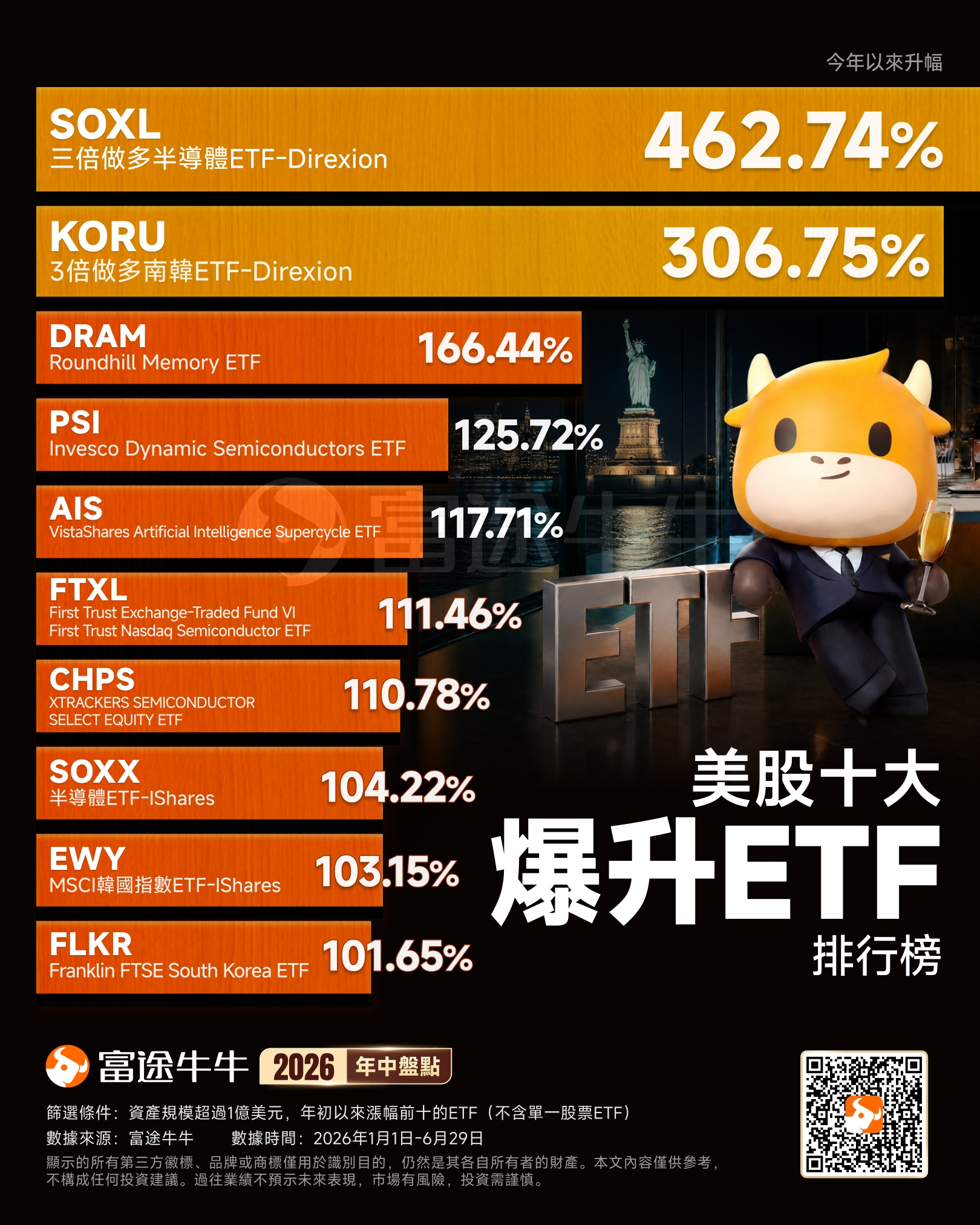
On this list, semiconductor-related ETFs alone occupy seven spots and lead by a wide margin, forming the most robust thematic trend of the first half of the year. Among them, $Direxion Daily Semiconductor Bull 3x Shares ETF (SOXL.US)$ topped the ranking with a staggering gain of 462%. As a triple-leveraged product, it magnified the already sharp rally in the semiconductor sector, achieving a near fivefold return in just six months.
The memory-focused ETF, which debuted on April 2 of this year— $Roundhill Memory ETF (DRAM.US)$ —has also posted cumulative gains exceeding 166%. As the world’s first pure-play memory ETF, it precisely targeted memory giants such as SK Hynix, Samsung, and Micron Technology, becoming the most vivid embodiment of the current memory “super cycle”—driven by AI demand, both volume and pricing of memory chips are soaring, and the supply-constrained environment may persist well beyond 2027.
Close behind are $Invesco Dynamic Semiconductors Etf (PSI.US)$ 、 $VistaShares Artificial Intelligence Supercycle ETF (AIS.US)$ 、 $First Trust Exchange-Traded Fund VI First Trust Nasdaq Semiconductor ETF (FTXL.US)$ 、 $XTRACKERS SEMICONDUCTOR SELECT EQUITY ETF (CHPS.US)$ and $iShares Semiconductor ETF (SOXX.US)$ Five products surged by 125%, 117%, 111%, 110%, and 104%, respectively. Behind the collective rally of semiconductor ETFs lies the exponential surge in demand for computing power driven by the AI industrial revolution: from training large language models with hundreds of billions of parameters to the large-scale deployment of AI agents, chips remain the most certain and central 'shovel sellers' in this wave.
Another notable highlight is the collective breakout of Korea-related ETFs, reflecting global capital’s strong confidence in South Korea’s technology and manufacturing supply chains. $Direxion Daily MSCI South Korea Bull 3X ETF (KORU.US)$ With a cumulative gain of 306%, it ranked second overall—likewise leveraging 3x leverage to fully capture the robust momentum in the South Korean market. $iShares MSCI South Korea ETF (EWY.US)$ 、 $Franklin Templeton Etf Tr Ftse South Korea Etf (FLKR.US)$ Both also achieved gains exceeding 100%.
Notably, the strength of South Korean equities is also deeply rooted in semiconductors—Samsung Electronics and SK Hynix are the global duopoly in memory chips. This means that two seemingly distinct investment themes ultimately converge at a fundamental level, both benefiting from the AI-driven tailwinds in memory and computing power.
Outlook for the Second Half: The Rally May Be 'To Be Continued'
Following significant gains earlier in the year, both semiconductor and South Korean equities have recently experienced pullbacks, prompting questions: Is this merely a bull market pause—'a dip to pick up more investors'—or a signal that the rally has peaked?
Looking ahead, Taiwan Semiconductor projected in its latest closed-door meeting that the global semiconductor market will surpass $1 trillion this year and reach $1.5 trillion by 2030, driven primarily by demand from high-performance computing and artificial intelligence, which together will account for 55% of the total market. This indicates that the semiconductor industry is entering an era propelled by AI computing demand, and as long as AI continues to thrive, the semiconductor sector will continue to benefit.
Regarding South Korean equities, JPMorgan raised its 12-month $Korea Composite Index (.KOSPI.KR)$ target to 12,500 points in its latest report, forecasting a bull-case KOSPI target of 15,000 points and a bear-case scenario of 8,000 points.
JPMorgan noted that drivers of upside potential in the South Korean market include earnings growth among AI-related hardware companies, additional profit momentum in the industrial sector, improved profitability of financial stocks, and valuation re-rating spurred by corporate governance reforms. The bank also believes that, as AI investment expands and drives sustained increases in memory demand, earnings improvements among South Korean semiconductor firms are likely to persist over the long term.
In summary, whether in semiconductors or South Korean equities, this bull market may still be 'unfinished business.' However, investors should remain cautious: as cumulative gains mount, market volatility has also increased in tandem, and the risk of elevated volatility cannot be overlooked. For investors, the second half of the year may require greater attention to timing and tactical trading to strike a balance between trend opportunities and risk management.
Want to select stocks or get a stock diagnosis? Curious about the opportunities and risks in your portfolio? For all your investment questions,Just ask Futubull AI!

Editor/KOKO