
The yen fell below 162 against the U.S. dollar, hitting a nearly 40-year low. In April, Japan spent a record $74 billion in a single month on currency intervention, but the effect lasted only a few weeks. With wide interest rate differentials, oil price shocks from the Middle East, trade pressure from Trump, and public debt exceeding twice the size of GDP, Japan’s quickest weapon has proven unsustainable under these multiple constraints. Meanwhile, the structural reforms truly capable of reversing this trend remain too distant to address immediate challenges.
Japan deployed a record amount of foreign exchange reserves to intervene in the currency market but failed to prevent the yen from falling to its lowest level in nearly 40 years. Caught between geopolitical conflicts driving up oil prices, shifting U.S. interest rate expectations, domestic political pressures, and trade-related pressure from Trump, Japanese monetary authorities are facing an almost intractable policy dilemma.
On June 30, the yen breached the 162-per-dollar mark, hitting its weakest level since 1986. Earlier, in April alone, Japan’s Ministry of Finance spent nearly USD 74 billion buying yen—the largest single-month intervention on record—triggering a brief, sharp rebound in the exchange rate. However, this effect lasted only a few weeks; by early June, the yen had already returned to around 160 per dollar before breaking further downward. Finance Minister Satsuki Katayama promptly reiterated that authorities were 'ready to take appropriate action whenever necessary.'
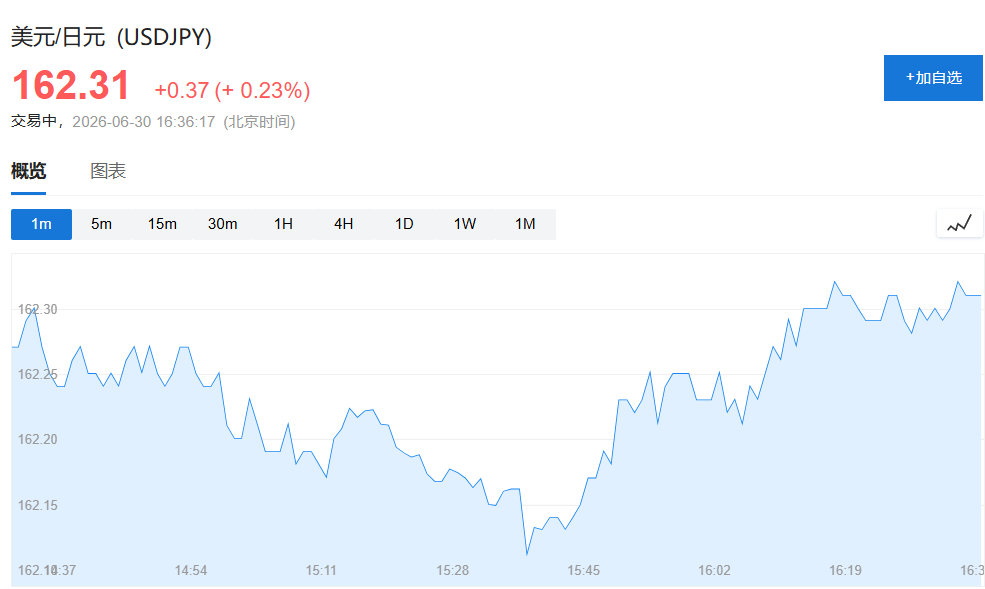
 With foreign exchange reserves still as high as USD 1.09 trillion as of the end of May, the market’s question is no longer whether Japan has the capacity to continue intervening, but rather how meaningful such interventions still are. Tsuyoshi Ueno, chief economist at NLI Research Institute, stated bluntly: 'The market clearly understands that the government has almost no tools left that can immediately reverse the trend. I believe this is one of the reasons the yen continues to weaken.'
Interest Rate Differentials: The Structural Root of Yen Weakness
The core driver behind the yen’s persistent depreciation lies in the persistently wide interest rate gap between Japan and the United States as well as other major economies. This ultra-low interest rate environment has fueled large-scale carry trades—in which investors borrow yen at low cost to invest in higher-yielding overseas assets—resulting in sustained capital outflows that exert systemic downward pressure on the yen.
Although the Bank of Japan (BOJ) raised its policy rate in June to the highest level in 31 years, the rate remains extremely low by international standards. Notably, since the BOJ exited its negative interest rate policy in March 2024, the policy rate differential between the U.S. and Japan has narrowed to less than half of what it was previously. Yet, rather than stabilizing, the yen has continued to depreciate, indicating that monetary tightening alone is insufficient to fundamentally reverse the trend.
Meanwhile, Japan’s heavy fiscal burden further erodes market confidence. With government debt exceeding 200% of GDP—the highest among major economies—persistent fiscal deficits have raised external concerns about the sustainability of Japan’s public finances, thereby diminishing the attractiveness of Japanese assets and the yen.
Geopolitical Shocks: Middle East Conflict Fuels Import-Driven Inflation
The military conflict between the U.S./Israel and Iran has added further complexity to the yen’s decline. Japan relies almost entirely on imported energy, with over 95% of its oil imports coming from the Middle East, making it highly vulnerable to supply disruptions in the region. Rising oil prices mean Japan must spend more dollars on its energy import bills, directly increasing demand for foreign exchange and further weakening the yen.
The global inflationary surge triggered by this conflict also impacts the yen through another channel. Market expectations for U.S. interest rates have shifted from anticipated cuts to potential hikes, significantly boosting the appeal of dollar-denominated assets and intensifying selling pressure on the yen. For an economy heavily reliant on imported energy and raw materials, yen depreciation and import-driven inflation feed into a vicious cycle, leaving policymakers caught between conflicting pressures.
Intervention Dilemma: Effective in the Short Term, Ineffective in the Long Run
Historically, Japan’s foreign exchange intervention has produced immediate and significant effects—typically, the yen appreciates by about 2 yen against the dollar within seconds and by 4 to 5 yen within hours. However, if the underlying economic fundamentals driving yen weakness remain unchanged, the impact of such interventions tends to be short-lived.
The intervention at the end of April clearly illustrated this limitation. The yen surged immediately after authorities stepped in, but the rally quickly faded. By early June, the exchange rate had fallen back to around 160 yen per dollar, and by month-end it slid further to 162.40—the lowest level in four decades.
Operationally, the Ministry of Finance makes the intervention decision, while the Bank of Japan (BOJ) executes it through a handful of commercial banks. Funding typically comes from cash holdings or U.S. Treasury securities within Japan’s foreign exchange reserves. According to Bloomberg, there are indications that authorities utilized foreign securities holdings—including U.S. Treasuries—during the latest round of intervention in April. To maintain market uncertainty, officials usually refrain from immediately confirming interventions; instead, they disclose the total amount spent each month only at month-end, aiming to sow market anxiety and deter speculators.
However, repeated interventions carry political and diplomatic risks. Frequent unilateral actions may invite accusations of 'currency manipulation' and create complications for corporate pricing, payments, and hedging strategies, while inflicting substantial losses on traders betting on further yen depreciation.
Caught Between Domestic and External Pressures: Takai Sanae Has Extremely Limited Policy Space
The persistent depreciation of the yen has become a serious domestic political issue. In Japan’s economy, which is heavily reliant on imported energy and raw materials, a weak yen has driven up household living costs and squeezed profit margins for domestically oriented businesses. The resulting cost-of-living crisis contributed to the resignations of the two prime ministers who preceded Takai Sanae. After assuming office, Takai unveiled a strategic plan in June aimed at stimulating private investment in key sectors—including artificial intelligence, semiconductors, defense, and shipbuilding—to boost Japan’s economic growth rate.
External pressures are equally significant. Trump has long accused Japan of deliberately weakening the yen to gain a trade advantage and threatened last March to impose additional tariffs. Japan remains on the U.S. Treasury’s currency 'Monitoring List.' Although the U.S. and Japan issued a joint statement in September last year clarifying that interventions should be limited to addressing excessive volatility or disorderly market conditions—not to secure competitive advantage—this framework has effectively confined Japan’s policy options to a very narrow range.
U.S. Treasury Secretary Bessent recently made his preferred solution clear—suggesting that the BOJ should be allowed to raise interest rates independently, enabling the yen to return to a more appropriate level. This statement not only exerts pressure on Japan’s monetary policy but also objectively further narrows Tokyo’s diplomatic room to unilaterally support the yen through intervention.
The Way Forward: Structural Adjustment Remains the Only Viable Solution
Beyond direct intervention, Japan could theoretically underpin the yen fundamentally by encouraging corporate capital repatriation, expanding domestic investment, and deepening fiscal consolidation. Stronger domestic investment would boost demand for yen-denominated assets, while reducing government debt and restoring fiscal credibility would enhance the long-term appeal of Japanese assets.
However, all these measures require time to take effect. In the current environment—marked by multiple overlapping pressures—the reality facing Japanese monetary authorities is that their quickest tool, direct intervention, has proven difficult to sustain, while structural policies capable of fundamentally altering the situation remain too distant to address immediate challenges. As Tsuyoshi Ueno noted, the market is well aware of this dynamic, which lies at the heart of the yen’s persistent depreciation.
Editor/Deng