
The yen exchange rate (USD/JPY) has fallen to its weakest level in four decades, prompting strategists and professional traders to search for the next red line that the Japanese government might set for the currency.
Zhitong Finance APP learned that the yen exchange rate (USD/JPY) has fallen to its weakest level in four decades, prompting strategists and professional traders to search for the next intervention threshold that Japanese authorities might defend. After USD/JPY breached the critical 162 mark on Tuesday, an increasing number of seasoned foreign exchange strategists pointed to 163 and higher levels as key thresholds to watch next. They believe the Japanese Ministry of Finance may tolerate a weaker yen than during its interventions in 2024. Strategists noted that crowded bearish yen positions and the significant impact of this week’s U.S. nonfarm payroll data could rapidly push the yen toward these new thresholds.
This also highlights a major shift in market sentiment among traders and FX strategists, as concerns grow that the Japanese government, which had recently signaled stronger rhetoric, failed to prevent the yen from approaching its weakest level since 1986. More broadly, the Bank of Japan’s historic exit from ultra-low interest rates is seen as overly gradual and insufficient to reverse the yen’s deepening depreciation trend.
 The latest exchange rate movements show that the yen has broken below the 162 per U.S. dollar mark, reaching approximately 162.41 per dollar—the weakest level since 1986, or a 40-year low. This indicates that the impact of the Ministry of Finance’s interventions between late April and early May has entirely dissipated, failing to halt further yen depreciation. The core driver remains the wide interest rate differential between the U.S. and Japan, persistent market bets on continued Fed hawkishness, sustained dollar strength, and the Bank of Japan’s still-cautious pace of monetary tightening.
After the yen fell to 162.41 per U.S. dollar, the Japanese government maintained only verbal intervention rhetoric rather than issuing a stronger ‘final warning’ signal. Market participants are increasingly focused on whether Japanese authorities will intervene again to support the weakening yen. Market pricing is shifting from ‘whether Japan will intervene’ to ‘at what level—163, 165, or even higher—Japan will actually step in.’ Although Finance Minister Satoshi Kajiyama and Chief Cabinet Secretary Yoshimasa Hayashi reiterated their readiness to take appropriate action if necessary, their wording did not escalate, leading traders to conclude that the Ministry of Finance currently has a higher tolerance than during its previous intervention band near 162.
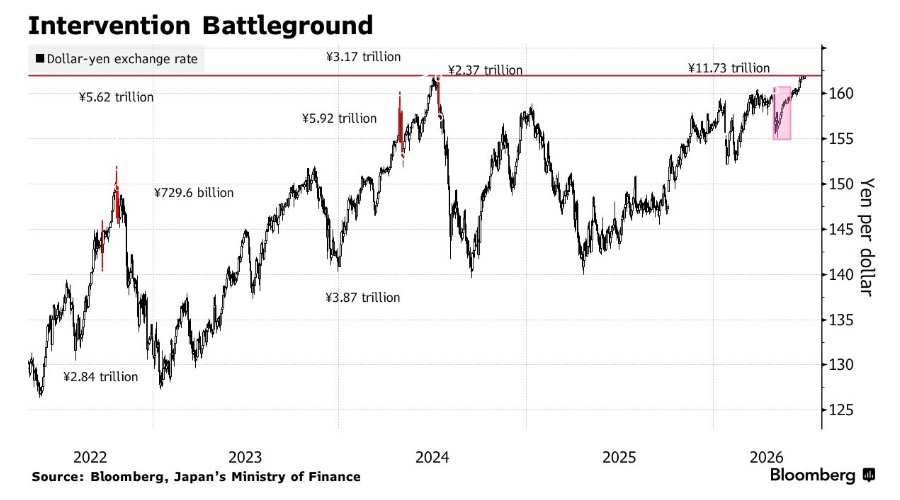
Underlying yen weakness stems primarily from fundamentals, not just speculation: the Bank of Japan has raised its policy rate to 1%, the highest since 1995. However, as long as the Federal Reserve remains hawkish, the dollar stays strong, and the U.S.-Japan interest rate gap remains wide, yen short-sellers will continue testing the Ministry of Finance’s reaction function. Positioning dynamics are also reinforcing momentum: as of June 23, leveraged funds’ net short positions in yen rose to 115,033 contracts, nearing the highest level since November 2017; simultaneously, market net long positioning in the U.S. dollar has reached its highest point in over a year. Thursday’s U.S. nonfarm payroll data will serve as a key catalyst—if it reinforces expectations of Fed hawkishness, the probability of USD/JPY accelerating toward the 163–165 range will rise significantly.
Japan is not lacking ammunition, but the marginal effectiveness of intervention is diminishing. According to Ministry of Finance data, Japan spent approximately ¥11.7 trillion (about $73.5 billion) to buy yen between April 28 and May 27—a record-scale intervention—yet its impact was short-lived, with the yen quickly resuming its depreciation path. This demonstrates that unilateral foreign exchange intervention can only interrupt the pace of decline, not reverse the underlying trend. What truly determines whether the yen can stabilize is whether the U.S.-Japan interest rate differential narrows, whether dollar longs ease, whether the Bank of Japan tightens policy more decisively, and whether energy import pressures and fiscal risks moderate.
The 163–165 range now appears to be the new zone of policy risk, but without actual market intervention, markets will continue probing the limits of Japanese authorities’ tolerance. Should real intervention by the Ministry of Finance occur, it would likely trigger a sharp, temporary yen rally rather than fundamentally reversing its long-term weakness.
Yen breaks below 162, triggering intervention countdown: After hitting a 40-year low, is the Japanese Ministry of Finance’s ‘red line’ gradually moving higher?
Rinto Maruyama, Senior FX and Rates Strategist at SMBC Nikko Securities, stated: ‘The next level to watch is 163.’ He added that concerns about potential Ministry of Finance intervention have helped keep the yen stronger than it otherwise would have been following the Federal Reserve’s most recent monetary policy meeting.
Maruyama noted that if the yen had weakened in line with other major currencies, USD/JPY would already be trading around 163 or 164.
Ikue Saito, a foreign exchange strategist at JPMorgan, stated that if the Ministry of Finance authorities employ the 'stealthy approach' used in their 2024 interventions, the current intervention trigger level is likely higher. She wrote that the limited effectiveness of the previous intervention may also make the ministry more cautious about entering the market too quickly. She added that Tuesday’s price action suggested stop-loss orders and option barriers around the 162–162.50 area had been triggered.
Despite continued verbal warnings from Japanese Ministry of Finance officials, markets are reassessing the situation. Finance Minister Satoshi Kajiyama and Chief Cabinet Secretary Yoshimasa Hayashi both reiterated on Tuesday that Japan stands ready to take appropriate foreign exchange action whenever necessary.
However, such verbal intervention barely stemmed the yen’s decline, which fell as low as 162.41 during Tokyo trading hours.
Kajiyama’s remarks on Tuesday were not as forceful as those made in late April, prior to Japan’s record-breaking round of intervention. At that time, she even remarked that people should not take their eyes off their smartphones, even while traveling or on vacation during Japan’s Golden Week holidays.
Prior to the April 30 intervention, Atsushi Mimura, Japan’s top foreign exchange official, also issued a 'final warning' ahead of the authorities’ entry into the market to support the yen, underscoring how imminent government intervention had become.
After the yen initially breached the 160-per-dollar mark, Japan spent a record 11.73 trillion yen (approximately USD 72.4 billion) between April 28 and May 27 to defend its currency. According to Ministry of Finance data on foreign exchange reserves, this intervention likely drew upon Japan’s holdings of foreign securities, including U.S. Treasuries. However, as with interventions in 2022 and 2024, it provided only temporary relief, after which the yen resumed its broader depreciation trend.
Risk remains elevated heading into Thursday’s release of U.S. nonfarm payroll data, which could rapidly push the yen toward new levels against the dollar.
“Historical data has not been kind to one-sided foreign exchange interventions. It is especially unforgiving when fundamentals are moving in the opposite direction—and that is precisely the predicament Japan currently faces,” said Vass Karamanis, a foreign exchange strategist at Bloomberg Strategists.
Masahiko Loo, Senior Fixed Income Strategist at State Street Investment Management, said: “Breaking through the 162-yen level further reinforces that the yen’s depreciation remains momentum-driven. The market is now eyeing the 163–165 range as the next key technical and psychological target zone, where both positioning risk and policy risk will become significantly sharper.”
Loo added: “Ahead of the nonfarm payrolls release, the threshold for immediate intervention appears slightly higher, as authorities may prefer to assess whether the dollar’s strength is being driven by fundamentals.”
The strong dollar storm is returning with renewed force.
Speculative positions remain heavily skewed toward being short the yen and increasingly tilted toward being long the dollar. According to data from the U.S. Commodity Futures Trading Commission (CFTC), as of the week ending June 23, leveraged funds increased their net short positions in yen to 115,033 contracts, approaching the highest level since November 2017.
The Bank of Japan raised its policy interest rate to 1% earlier in June—the highest level since 1995—but traders expect the Federal Reserve to adopt a relatively more hawkish stance, thereby maintaining the substantial interest rate differential that has persistently weighed on the yen.
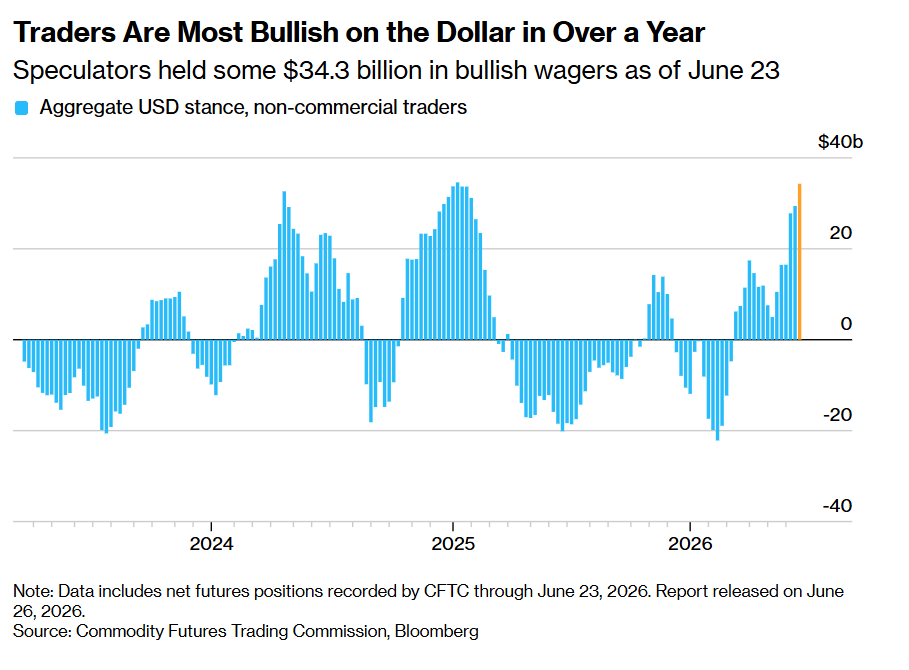
As illustrated in the chart above, traders’ bullish sentiment toward the dollar has reached its highest level in over a year—speculators held approximately $34.3 billion in net long dollar positions as of June 23. Note: Data includes net futures positions reported by the U.S. Commodity Futures Trading Commission as of June 23, 2026. The report was published on June 26, 2026.
Investors are also increasingly concerned that the Japanese government wants the Bank of Japan to proceed cautiously with further policy tightening, following media reports indicating that the government will call for 'appropriate' monetary management in its Basic Policy Guidelines.
Maruyama of SMBC Nikko stated that this effectively constrains the Bank of Japan’s room to raise rates more aggressively while introducing additional fiscal risks. He remarked, 'This combination has driven a sharp rise in long-term government bond yields and ultimately triggered a fresh wave of yen selling.'
Chidu Narayanan, Chief Asia-Pacific Strategist at Wells Fargo & Co., noted that markets may continue testing the Japanese authorities’ willingness to act at specific exchange rate levels. He stated, 'As the dollar-yen exchange rate climbs higher, the market may test the Ministry of Finance’s readiness to intervene.' Although verbal warnings can sometimes help stabilize the exchange rate, 'actual intervention will be necessary to credibly sustain the fear of intervention.'
Notably, the market narrative has undergone a significant shift in recent weeks. With a Fed led by Warsh adopting a more hawkish stance than anticipated, coupled with an AI-driven super bull market fueled by surging demand for computing power and renewed confidence in the resilience of the U.S. economy, optimistic speculation has resurfaced that 'American exceptionalism' will continue supporting all dollar-denominated U.S. assets. Statistical data indicates that the U.S. economy will maintain its robustness relative to the rest of the world. Meanwhile, artificial intelligence continues to drive massive corporate spending on AI-related initiatives and global capital inflows into equities, as investors bet that AI-driven gains in labor productivity will further enhance the value of dollar-denominated assets.
This marks a dramatic reversal from just over a year ago, when themes such as 'hedging against American exceptionalism,' global de-dollarization, and dollar depreciation trades dominated market sentiment and weighed heavily on the greenback. Since Warsh formally assumed leadership of the Fed and delivered a strongly hawkish signal at his first FOMC meeting, these themes have cooled considerably.
Even before Warsh took office, the dollar had already shown signs of strengthening, primarily because investors sought safe-haven assets following U.S. and Israeli strikes on Iran in February, during which the dollar was virtually the only appreciating asset globally. The surge in oil prices at the time also significantly bolstered the dollar, given the United States’ status as the world’s largest oil producer—although oil prices have since returned to pre-conflict levels.
Top foreign exchange strategists from major banks including JPMorgan, Bank of America, and Goldman Sachs have renewed their strong bullish conviction on the U.S. dollar following new Fed Chair Kevin Warsh’s pledge to restore price stability, which has fueled rising market bets on further rate hikes.
Meera Chandan, Co-Head of Global Foreign Exchange Strategy at JPMorgan, stated in an interview that the Federal Reserve has 'activated' a bullish outlook for the dollar. 'It appears other central banks won’t catch up, and the gap between U.S. interest rates and Treasury yields relative to those elsewhere won’t narrow significantly.'
The early signals under Warsh’s leadership at the Federal Reserve are unmistakable: the Fed’s monetary policy and forward guidance framework are being recalibrated firmly toward 'inflation control,' rather than toward international market stability, exchange rate coordination, or the comfort of risk assets. For Asian financial markets, this serves as a sobering reminder—the U.S. central bank’s foremost constraint remains domestic inflation and financial conditions in the United States.
Editor/Deng