① Kevin Warsh, the new Federal Reserve chair, is no stranger to Wall Street, yet investors remain uncertain whether he is truly as committed as he claimed last month to curbing U.S. inflation; ② in other words, is Warsh really that hawkish?
Kevin Warsh, the new Chair of the Federal Reserve, is no stranger to Wall Street, yet investors remain uncertain whether he is truly as committed to curbing U.S. inflation as he claimed last month. In other words, is Warsh really that hawkish?
At 9 p.m. Beijing time tonight, Warsh will appear at the European Central Bank’s forum in Sintra, Portugal, joining other senior central bank officials in a panel discussion on pressing economic issues. Investors hope this event—effectively Warsh’s international debut—will offer clearer insight into his stance.
 Two weeks ago, the former Fed governor and Wall Street veteran presided over his first Federal Open Market Committee (FOMC) meeting since taking office. Many analysts believe his concern about inflation exceeded Wall Street’s prior expectations, while his willingness to cut rates was lower than anticipated.
During the post-meeting press conference, Warsh mentioned “price stability” eight times and lamented that inflation has remained above the Fed’s 2% target for more than five consecutive years.
“The Committee will achieve price stability,” Warsh solemnly pledged during his first press conference, following the Fed’s June statement that removed its previously signaled bias toward rate cuts.
Some analysts therefore believe that Warsh’s first interest rate adjustment—whenever it occurs—is more likely to be a hike than a cut.
This stands in sharp contrast to the prevailing sentiment before his appointment. Prior to assuming the Fed chairmanship in May, Warsh’s commitment to fighting inflation had been questioned by Wall Street. After all, before being nominated by Trump as Fed chair earlier this year, he had publicly supported Trump’s calls for rate cuts.
Trump had repeatedly criticized Warsh’s predecessor, Powell, accusing him of failing to deliver aggressive rate cuts. The U.S. president insisted that lowering rates is essential to boosting the economy and claimed that interest rates had been weaponized against him for political purposes.
Will Warsh remain that hawkish tonight?
Regarding the panel discussion featuring Waller tonight, industry insiders noted that if markets are expecting forward guidance on interest rates, they should not hold high hopes. Waller has clearly stated that he wishes to scale back forward guidance and believes it is unhelpful for the Federal Reserve in practice.
However, Waller may offer insights into his views on U.S. inflation and the multiple economic assessments announced last month. At last month’s press conference, Waller announced the formation of a special task force covering five areas, which will focus on: ① the Federal Reserve’s communication practices; ② the Federal Reserve’s balance sheet policy; ③ the use of and reliance on existing data sources; ④ productivity and employment in an era of transformation; and ⑤ the Federal Reserve’s inflation framework.
Therefore, analysts noted that although Waller is unlikely to provide forward guidance, he might instead offer “framework guidance.”
“We will closely monitor how he articulates the inflation outlook and its drivers—including the sharp drop in oil prices, moderating inflation expectations, other commodity prices, a stronger U.S. dollar, and spillover effects from AI-related cost reductions—while also assessing the extent to which more optimistic expectations hinge on enhanced credibility that still needs to be validated,” said Krishna Guha, Head of Central Bank Policy, Strategy, and Economics at Evercore ISI.
Of course, there is one point investors may still receive clear affirmation from Waller on: the Federal Reserve’s commitment to achieving price stability.
The Federal Reserve’s preferred inflation gauge—the core PCE price index, which excludes volatile food and energy prices—rose to 3.4% in May, marking its highest level since October 2023.
Ed Yardeni, President and Chief Investment Strategist at Yardeni Research, suggested that Waller may be attempting to lower government bond yields—and thereby reduce borrowing costs, as Treasury yields influence mortgage and auto loan rates—by taking a hawkish stance on inflation.
“We believe there may be an implicit new agreement between the Treasury and the Federal Reserve aimed at lowering the 10-year Treasury yield,” Yardeni wrote in a report. He argued that Treasury Secretary Bessent and Waller are working closely together and have convinced Trump that the best way to reduce borrowing costs is through strong anti-inflation rhetoric—even raising rates if necessary—which should lower bond yields and stimulate the economy.
Bessent recently acknowledged the power of the bond market and stated that Trump recognizes this as well. Speaking at the Economic Club of New York on June 23, Bessent remarked, “The bond market has toppled more governments than artillery,” and added that Waller would optimize the path for both inflation and economic growth. “I am confident the president has full faith that the Fed Chair will make the right decisions,” Bessent said.
Although Waller himself did not offer any new insights last month on monetary policy, the economic outlook, or interest rates beyond the scope of the Fed’s official statement, nine of his Federal Reserve colleagues expect at least one rate hike this year—six of whom anticipate at least two hikes—while eight other Fed officials believe rates should remain unchanged for the year.
Bets on rate hikes in the futures market remain restless.
Notably, even as many investors await Waller’s speech and the nonfarm payrolls data this week, some traders in the interest rate futures market continue to increase their bets that the Federal Reserve could start raising rates as early as July. Whether this aggressive expectation materializes will depend in the near term on a series of upcoming core economic data releases.
In fact, the interest rate swap market currently still reflects a low probability of a rate hike at next month’s meeting—the latest pricing implies an increase of only about 9 basis points, equivalent to roughly a 36% chance of a 25-basis-point hike.futures exchange,some members are still attempting to 'seek fortune through risk'…
Since the June 17 policy meeting, open interest in August federal funds rate futures—representing the volume of new trading positions held by investors—has risen rapidly. The rapid accumulation of new positions has been skewed toward the short side, indicating that traders are selling the contract; such positions would benefit if the probability of a rate hike continues to rise.
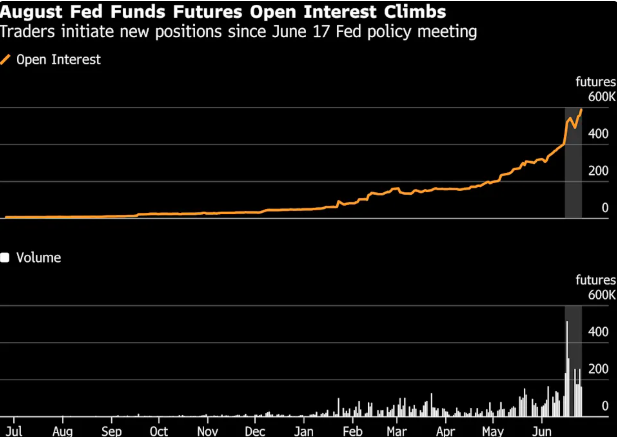
Open interest in August federal funds rate futures, which reflect expectations for the policy statement on July 29, has increased from approximately 454,000 contracts on the day before the June policy announcement to nearly 590,000 contracts as of Monday’s close—an increase of about 30%. Since Waller opened the door to two-way risks in the Fed’s rate path, daily trading volumes in these contracts have consistently remained above average during this period.
These bets have intensified even as options traders had previously sought to hedge against the number of rate hikes already priced into the market.
These bets could face a test as early as today or tomorrow, with Waller’s appearance and the U.S. Department of Labor scheduled to release Junenon-farm payroll datadata on Thursday. Any sign of weakening job growth could reduce the likelihood of a rate hike in July, thereby exposing newly established short positions to risk.
Notably, further out along the yield curve, the market is now showing greater interest in building long positions, betting that longer-dated U.S. Treasuries will outperform. “Long-end U.S. Treasury yields appear to have peaked in mid-May. Even amid heightened equity market volatility and sideways trading, long-duration bonds have continued to deliver positive returns,” said Jason Vaillancourt, Chief Portfolio Strategist at Columbia Threadneedle Investments.
Priya Misra, Portfolio Manager at J.P. Morgan Asset Management, stated that the flattening yield curve reflects a shift in market risk focus from the labor market to inflation. “If inflation data remains strong and labor market data also holds up, the curve could continue flattening as the market prices in additional rate hikes—it could well become a painful trade direction. However, given my view that the peak in inflation has already passed, I’m not particularly keen on flattening trades right now.”
Guha of Evercore remarked, “If Waller believes that rate hikes are necessary to establish credibility—and that this means at least two hikes—then there’s a case for hiking in both July and September to get it done before the midterm elections. However, our sense is that he isn’t convinced rate hikes are needed to build credibility, so he may let the July opportunity pass quietly.”
 Looking to select stocks or analyze your holdings? Want to understand the opportunities and risks in your portfolio? For any investment-related questions,just ask Futubull AI!

Editor/KOKO